








Product request
You are looking for a solution:

Select an option, and we will develop the best offer
for you


Containerization in IPTV: How Docker and Kubernetes Simplify Platform Deployment

IPTV platforms are no longer the monolithic systems they once were. Instead, a modern service consists of dozens of interconnected components, such as middleware, billing, DRM, EPG, advertising modules, CDN integrations, analytics, and applications for multiple device types.
As the audience and feature set grow, not only does the architecture become more complex, but also the platform's daily operations. At this stage, operators increasingly turn to containerization and orchestration—primarily Docker and Kubernetes. The implementation of IPTV platform containerization is not a fashionable trend, but a practical response to real infrastructure challenges.
In effect, we are seeing containerization becoming the foundation of a cloud native IPTV platform built on an IPTV microservices architecture.
Why Traditional Deployment Stops Working
The classic approach to deploying IPTV systems relies on physical or virtual servers, manual environment configuration, and tight coupling between services. At the beginning, this seems manageable, but over time typical issues emerge: updates require downtime, scaling takes days, test and production environments diverge, and every change risks breaking a neighboring module.
In IPTV, this is especially critical. Live broadcasting does not tolerate errors, and peak loads during sports events or mass broadcasts quickly expose architectural weaknesses. A containerized IPTV infrastructure breaks this cycle by isolating services and standardizing environments, making the platform more predictable and resilient.
Docker in IPTV: Isolation and Repeatability
Docker based IPTV deployment solves one of the operator’s core problems—environment inconsistency. A container includes the application and all its dependencies, namely library versions, configurations, and runtime. This means that middleware, APIs, or EPG processing services behave identically in testing, staging, and production.
For an IPTV operator, this delivers several tangible benefits:
- updates can be tested in an exact replica of the live environment
- new nodes are deployed in minutes instead of hours
- failure of one service does not affect others
- solution handover between teams and integrators becomes easier
This model enables automated IPTV platform deployment, so that a container with an NPVR recording module or ad insertion service can be updated independently, without touching the platform core. This reduces operational risk and accelerates development.
Kubernetes: Managing Complexity and Growth
If Docker handles packaging, Kubernetes manages services at scale. IPTV workloads are rarely uniform: daytime activity is low, evenings bring sharp growth, and major broadcasts create extreme peaks.
Kubernetes automates what was previously manual:
- scaling services based on CPU, memory, or request volume
- automatic restart of failed containers
- load distribution across nodes
- rolling updates without service interruption
The result is a kubernetes managed IPTV platform that adapts to audience behavior in real time. This directly improves QoE by reducing freezes, accelerating interface response, and keeping live channels stable.
In practice, operators achieve a scalable IPTV platform deployment built on high availability IPTV infrastructure, supported by horizontal scaling and fault tolerant systems.
A Practical Architecture for IPTV Operators
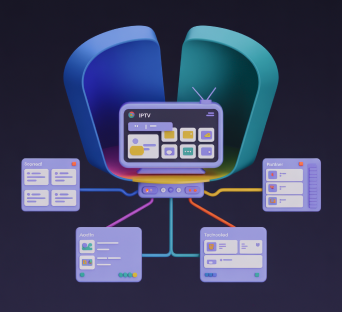
A typical containerized IPTV architecture will involve middleware, billing, authorization services, EPG, recommendations, and analytics, all running as separate containers. Kubernetes orchestrates their interaction, scaling, and fault tolerance. CDN and media servers may remain outside the cluster, but they integrate through APIs.
This model works especially well with modular platforms. Containerization allows operators to migrate gradually—starting with auxiliary services and moving toward the core—without rewriting the entire system. The result is a cloud native media platform built around service orchestration, infrastructure automation, and modern media DevOps workflows.
What to Consider Before Implementation
Containerization is not a “magic button,” but an engineering practice. Operators must assess process maturity, revise CI/CD pipelines, train technical teams, and deploy monitoring and logging at both container and cluster levels. Without this foundation, Kubernetes may complicate operations rather than simplify them.
However, these investments pay off. Teams begin thinking in terms of services rather than servers, feature release cycles shorten, and infrastructure becomes predictable and controllable. IPTV backend services turn into components of distributed media systems with built-in platform resilience.
Conclusion: Why IPTV Operators Need Docker and Kubernetes
For IPTV businesses, containerization is a tool for sustainable growth. Docker provides repeatability and isolation, while Kubernetes delivers scalability and automation. Together, they enable operators to launch new services faster, withstand peak loads, and reduce operational risks.
In a market where users expect stable video, instant response, and continuous improvement, success belongs to operators who invest not only in content but also in modern infrastructure.
Docker and Kubernetes become the foundation on which an IPTV platform can evolve for years—without painful migrations or downtime—supporting IPTV platform containerization, cloud native IPTV platform design, and long-term competitiveness.
Recommended
Role-Based Access Control in IPTV Projects: Why Operators Need It
An IPTV project rarely remains a static system. While the service is still small, it may seem enough to configure the platform once, grant the team access, and then simply maintain its operation.

How to Improve Viewer Retention with Smart Push Notifications
In today’s IPTV market, competition for viewer attention has become just as intense as the battle for content.

How to Properly Build a Staging Environment for Testing IPTV Updates
Any update in an IPTV ecosystem affects more than just one component. Changes in set-top box firmware, the client application, middleware, or content delivery logic can impact authentication, channel launch, EPG, VoD, DRM, and even network stability on the subscriber device side.