

Product request
You are looking for a solution:

Select an option, and we will develop the best offer
for you


How Google TV Simplifies the Launch of Interactive Content in Hotels
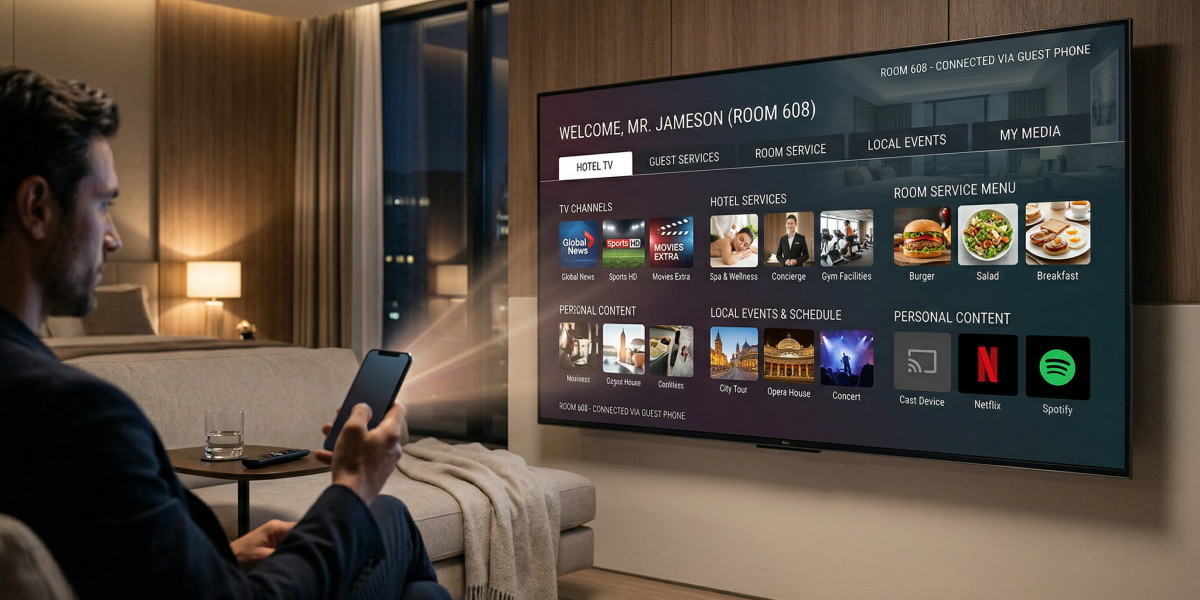
The television in a hotel room has long ceased to be just a screen for watching different channels. For a hotel, it's now become a full-fledged digital touchpoint with the guest: it can be used to display a welcome message, information about services, the restaurant menu, event schedule, accept room service orders, stream movies and channels, and show the guest’s personal video content.
Launching such a solution however is often held back by the technological foundation. This is due to hotels needing an attractive interface as well as a clear and manageable platform that allows them to quickly introduce new services, update content, and still maintain control over the entire system.
All this has led to Google TV increasingly being seen as a convenient foundation for hotel television and guest room entertainment.
The platform relies on the mature Android TV ecosystem, standard development tools, familiar app logic, and built-in mechanisms for displaying content on the home screen. This significantly simplifies the launch of interactive sections, content discovery, app usage, TV channel presentation, and the connection between the television and the guest’s smartphone.
TV applications are built on the same Android foundation, and Google TV comes with developer guidelines focused on usability, navigation, and user engagement.This is crucial for the hospitality market when looking at interactive hotel TV solutions, because guest expectations have risen significantly.
According to J.D. Power, in 2025, 40% of guests already considered a Smart TV or the ability to watch their own streaming content not a “nice bonus,” but a necessary amenity; 72% said their room had a Smart TV, and 60% actually used it during their stay.
Another study in 2025 by Hotels.com showed that more than half of hotels feel pressure from the need for constant technology upgrades, while 52% already have to explain to guests at check-in how to use the in-room technology. In other words, the market needs not just a “smart screen,” but a clear and guest-friendly digital service.
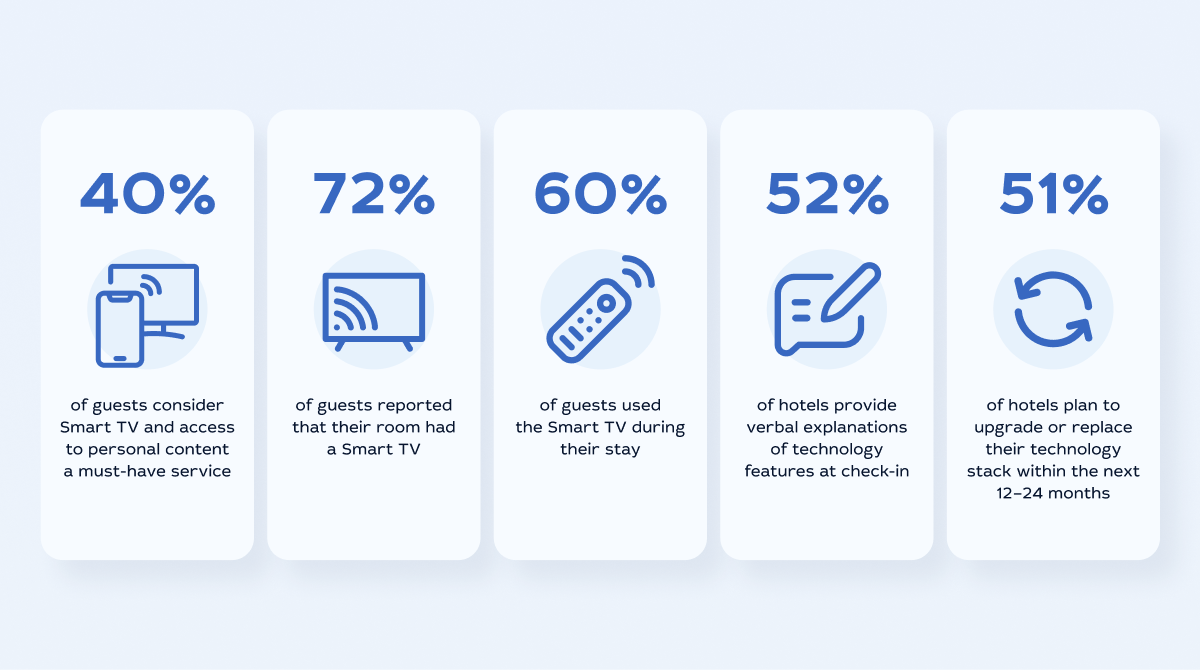
The Market Has Changed: Guests Expect a Modern In-Room TV Service
Why Google TV Has Become a Convenient Foundation for Hotel Television
The main advantage of Google TV integration in hotels is that the platform simplifies the launch of interactive content, not through a complex closed shell, but through the familiar model of a TV application.
A hotel or integrator doesn't need to reinvent the entire logic of navigation, control, and content display for the big screen. The platform already defines how the remote works, how screens are structured, how search functions, how recommendations are shown, and how content cards are displayed. Google explicitly states that TV applications should be designed with distance-based navigation, a minimal number of actions, and fast access to the desired content in mind.
This is especially important for hotels. Guests don't want to learn a complicated menu, and they are even less willing to spend time “figuring out the system.” The faster they see useful sections — channels, movies, hotel services, food ordering, event information, and their own video services — the greater the chance that the interactive solution will actually be used rather than remain a visually appealing but rarely used feature.
How Google TV Simplifies the Launch of Interactive Content
Google TV hotel entertainment systems create a unified environment in which an establishment can flexibly manage exactly what the guest sees on the screen. The interface is designed from the start for quick access to content and intuitive navigation, so launching interactive hotel services doesn't require complex customization or overloaded solutions.
The platform makes it possible to structure sections logically, set priorities, and combine different types of content — from broadcast television to digital services. As a result, the guest gets a clear and familiar hotel TV user interface, while the hotel gains an effective tool for communication and service delivery.
Makes It Easier to Create Hotel Screens and Sections
Google TV and Android TV use the standard Android development stack, so hotel IPTV with Google TV will have an interface that can be built as a full-fledged application: with a home page, service cards, a service catalog, a promotions screen, a restaurant menu, weather, a clock, an events section, and other useful modules.
For TV interfaces, Google is developing the modern Compose for TV toolkit, making it easier to create convenient screens for the big screen and remote control.
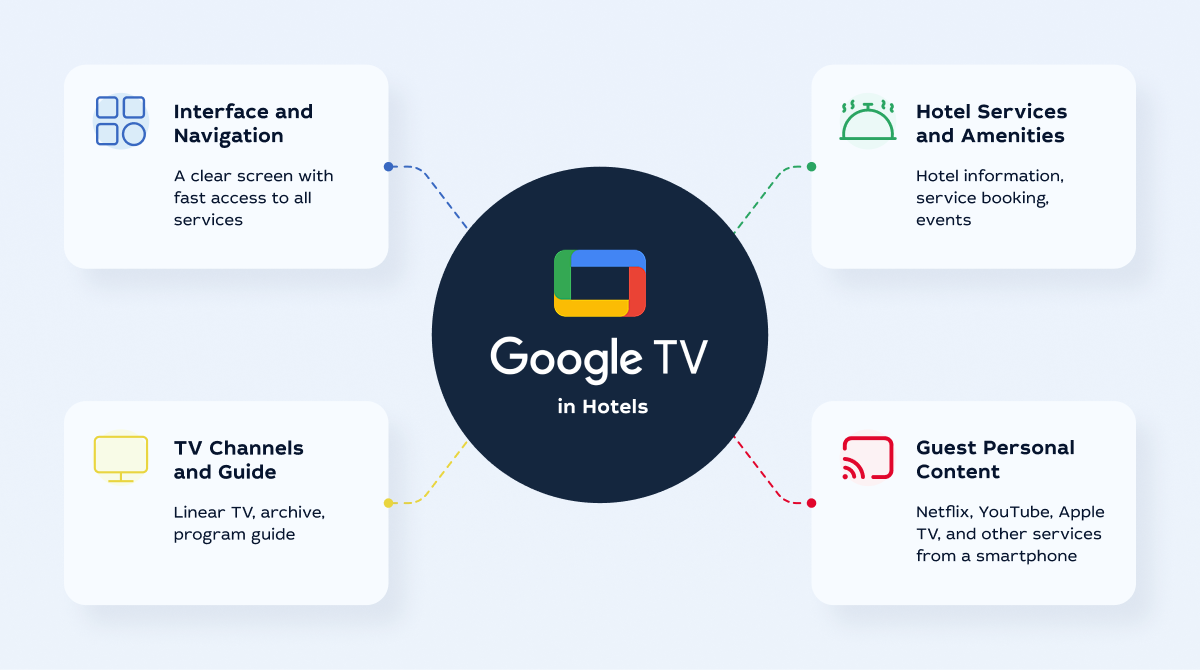
Google TV in Hotels: A Unified Platform for Content and Service
In practice, this shortens the path from idea to launch. For example, if a hotel wants to quickly add a new section — conference information, a seasonal spa offer, or a selection of excursions — it's much easier to do it on a clear platform with familiar app logic than on a closed TV solution, where every modification turns into a separate project.
Brings Important Content Closer to the Home Screen
One of Google TV’s biggest advantages is its recommendation system and content rows on the home screen. Google specifically explains how apps can help users find content faster through recommendations, search, and visible cards on the TV home screen. This is especially useful for hotels, because important sections don't need to be hidden deep inside the menu.
For example, the first screen can include:
- a welcome message for the guest
- quick access to channels
- hotel services
- room service ordering
- event schedules
- movies and videos
- restaurant, spa, or late check-out offers
Such an approach to hotel TV personalization is valuable not only for convenience, but also for the economics of the project. Interactive content only starts creating value when guests actually see it, ensuring greater visibility for services, higher usage of internal offerings, and a clearer connection between the TV and the guest’s everyday experience.
Simplifies the Combination of TV Channels and Digital Services
For many hotels, it's important not to abandon traditional television, but to enhance it with modern digital features. This is where Google TV is especially convenient compared to other hospitality streaming solutions, because Android for TVs includes the TV Input Framework — a mechanism that makes it possible to present a video stream source as television channels and programs.
Google describes this approach as a way to display linear video content in the format of channels and shows, with support for an electronic program guide, parental controls, and other features familiar to the TV environment.
For hotels, this means that linear television, the electronic program guide, and interactive sections can all be combined into one clear and coherent user experience. This is much more convenient than keeping regular channels separate from the hotel menu and separate again from movie services or guest requests.
And this is where Infomir’s hotel solution looks especially relevant. The preinstalled solution on the MAG555 media player gives hotels not only the modern Google TV environment, but also a practical hospitality layer that is already easy to understand: linear TV, server-based content loading, convenient channel navigation, an electronic program guide, informational modules, hotel details, and service actions directly on the screen.
Simplifies Displaying the Guest’s Personal Content on the Big Screen
Another important use case when launching hotel IPTV on Android TV is letting guests watch their own content. For modern travelers, this is no longer an extra feature, but a familiar behavior pattern, where they want to continue watching their own streaming services, videos, and other content just as they do at home.
Google Cast allows users to choose content on their phone and send it to the TV, while the phone remains the control device. In addition, the Cast Connect library allows an Android TV app to work together with this content-casting model.
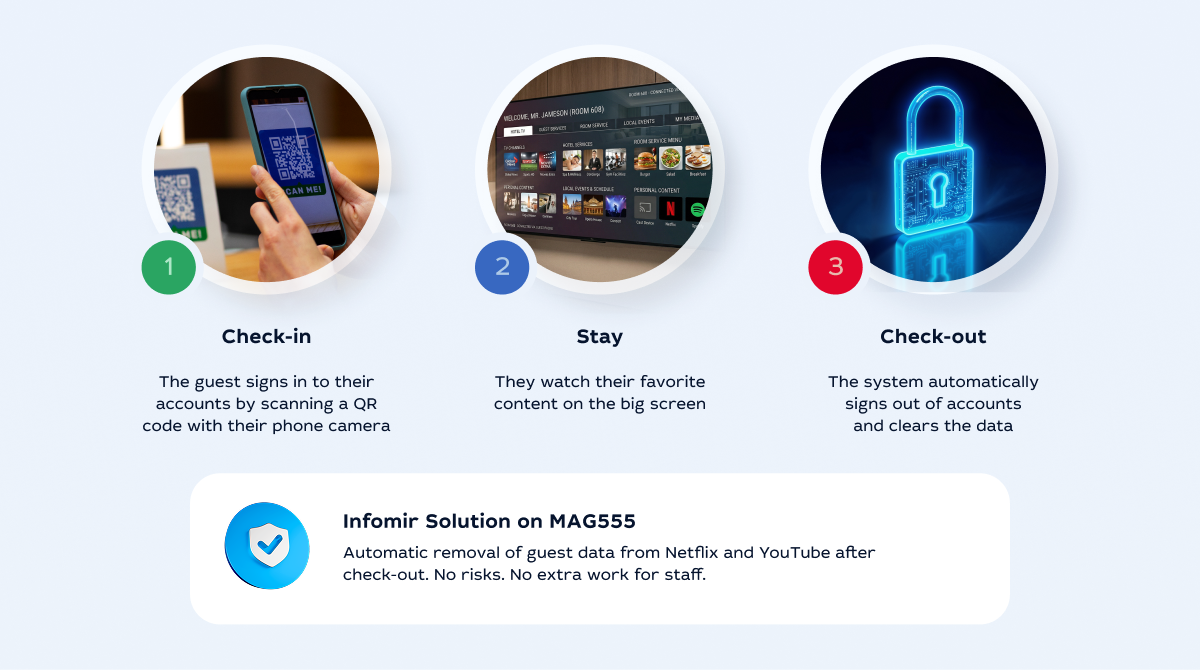
Guest Personal Content — Safe and Hassle-Free for Staff
For hotels, this solves several tasks at once. First, guests don't have to enter long credentials using the remote control. Second, the television becomes a natural extension of their personal digital experience. Third, the actual value of the in-room TV increases, as it stops being “just another screen” and instead becomes a convenient viewing tool.
However, these improvements to digital services mean that security and proper session termination are more important. If a guest signs in to personal video service accounts, the hotel must be sure that no unauthorized accounts or personal data remain in the system after check-out.
In Infomir’s hospitality solution, this is handled natively: the system automatically signs out of Netflix and YouTube accounts after the guest checks out.
For the hotel market, this isn't just a useful feature, but one of the most practical elements of trust in digital in-room television.
Why This Matters Specifically for Hotels, Not Just for the Consumer Market
A hotel TV is not simply a home device placed in a different setting. In a guest room, the television must serve several roles at once: it must be a source of entertainment, a communication channel with the hotel, a point for presenting services, and a secure screen for the guest’s personal content. That's why hotels have higher requirements for manageability, interface clarity, and the cleanliness of the user session.
This is also confirmed by recent market data. In the 2025 Hotels.com report, 56% of hotels said they feel pressure to constantly update in-room technology, while 70% said that guests still prefer live human interaction during check-in and when asking for help. In other words, modern hotel technology must be not only “smart,” but also easy to understand.
This is particularly relevant for Google TV, because the platform is strongest where a digital service needs to feel familiar and simple. More often than not, successful hotel projects are built around clear user scenarios, rather than a set of "flashy features. Guests want to:
- quickly turn on channels
- get hotel information
- order a service
- watch personal content
- safely end the session after check-out
How Google TV Helps Hotels Generate Revenue, Not Just Provide Information
Interactive content on a TV is both a service and sales tool. If the guest sees clear hotel offers on the screen, they start working as an additional monetization channel. This is not about intrusive advertising, but useful and relevant offers: breakfast, late check-out, spa, restaurant, events, transfers, laundry services, photo galleries, excursions, and special packages.
Google TV hospitality solutions simplify this approach through the platform's screen structure, cards, and quick navigation paths. As a result, the television can function not only as an informational showcase, but also as a conversion point inside the room. And if service buttons are added — report a problem, request housekeeping, call laundry service, set an alarm — the television also becomes a working interaction channel between the guest and the staff.
Because of this, in Infomir’s hotel solution, what matters is not one separate feature, but the combination of several elements: PMS integration, personalization and branding, linear TV, multilingual support, core information modules, hotel information, a service catalog, guest requests, and secure display of personal content.
This kind of hotel IPTV platform and setup is much closer to the real needs of a business than simply installing a TV device with a modern interface.
PMS Integration as the Foundation of Automation
For hotel television, the decisive moment for PMS integration IPTV comes when the digital screen begins to operate in sync with the hotel. This is where the connection with the PMS plays a key role. When the TV system is synchronized with the hotel management system, scenarios become possible that are especially important for operational stability:
- automatic guest welcome
- screen personalization
- room status changes
- guest session start and end
- automatic data clearing after check-out
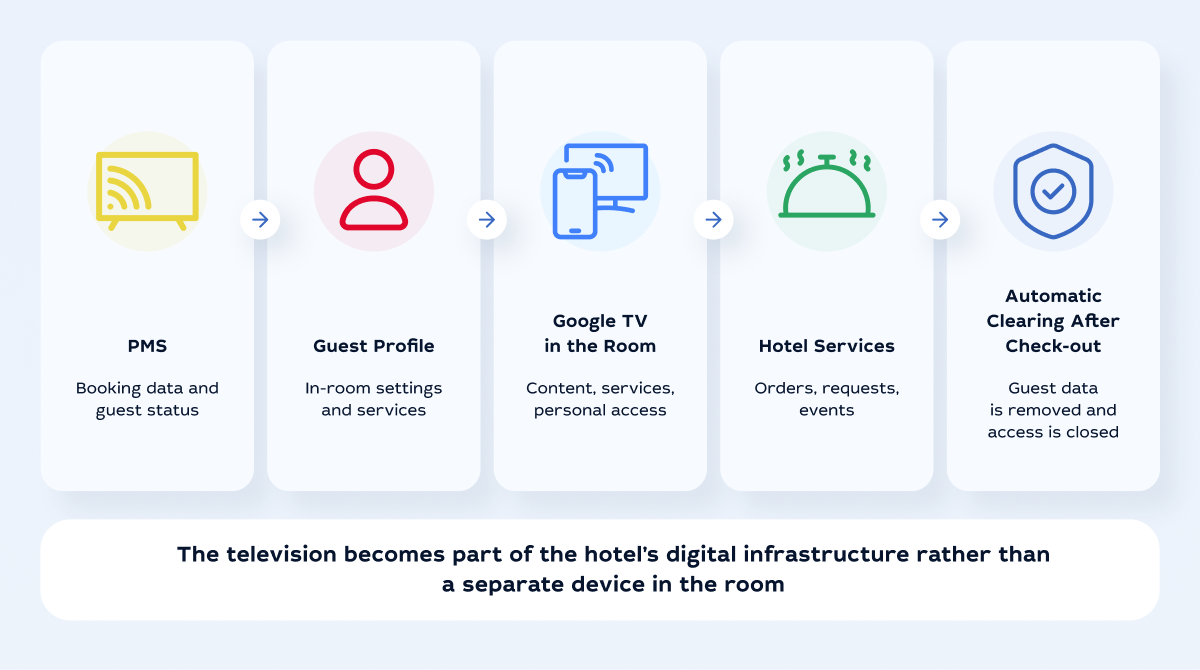
Integration with the Hotel Management System (PMS) for Full Automation
In the hotel technology market, this shift is only gaining momentum. According to the 2026 Hotel Tech Outlook report, 38% of survey participants identified integration as one of the main challenges, while 51% plan to replace or upgrade their technology stack within the next 12–24 months. This is an important signal that the market is moving not just toward new features, but more coordinated, interconnected systems.
Against this backdrop, a solution in which PMS connectivity is already built in as the foundation of automation looks like both a practical necessity and an added advantage.
For hotels, the result is fewer manual actions, fewer errors, and greater confidence that the in-room digital service matches the real lifecycle of check-in and check-out.
A Practical Takeaway for Hotels and Integrators
Google TV simplifies the launch of interactive content in hotels primarily because it provides a clear television-based foundation for applications, recommendations, channels, electronic program guides, and the display of a guest’s personal content from their phone.
These advantages make it possible to bring hotel services, information sections, linear television, and modern viewing scenarios to the screen more quickly, without the overloaded and outdated logic of traditional hotel TV systems.
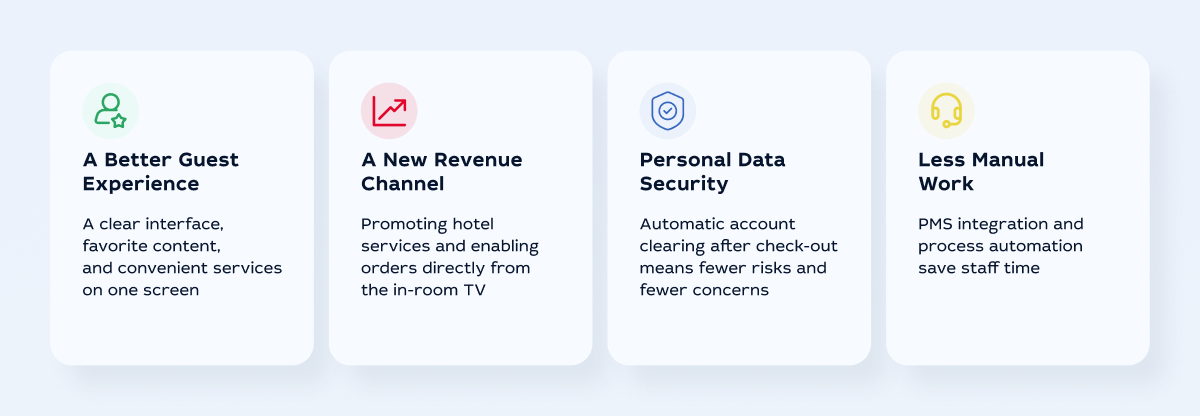
What the Hotel Gets
For a hotel, the real value appears when the Google TV platform becomes a ready-to-use operational tool, and explains why the most promising solutions are not abstract “Google TV in general” concepts, but those that take into account the needs of the hospitality market: PMS integration, branding, channels, program guides, hotel information, service buttons, multilingual support, personal content access, and secure clearing of user data after check-out.
In this form, using Google TV for hotels is more than just the adoption of a convenient television platform, it's the foundation of a modern hotel digital environment.
Recommended
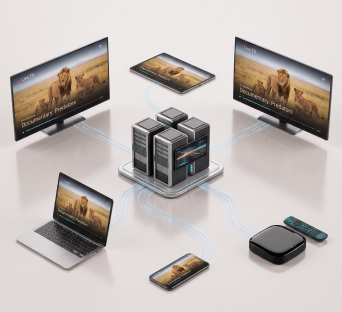
How to Expand an IPTV Platform to Web, Android, iOS, and Smart TV
For an IPTV operator, launching a service on just one type of device is rarely enough anymore. With users now watching linear channels on a TV, viewing content on a smartphone, opening catch-up content in a browser, or using an IPTV set-top box as the main screen at home, expanding a service across multiple client platforms is not simply a matter of releasing additional apps.
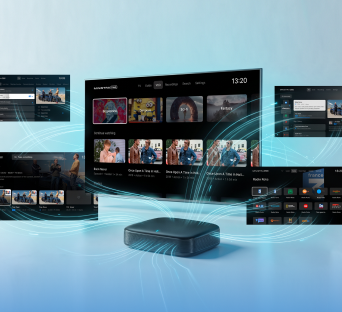
All Content in One Service: Live TV, VoD, Radio, Archive, TimeShift, and EPG in Ministra PRO
A television service has long been more than just a list of channels. Viewers now want to watch live broadcasts, return to a missed program, pause a show, schedule recordings of individual episodes or an entire series using nPVR, or choose a movie from a catalog. At the same time, all these capabilities should feel like parts of a single media environment rather than separate systems.
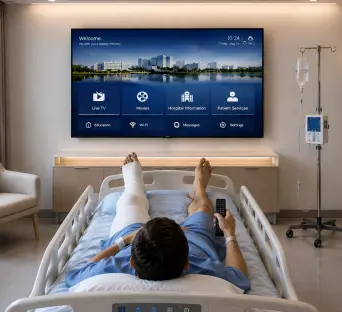
IPTV and the Modernization of Hospital Digital Infrastructure
Because hospitals operate around the clock, it's essential that their digital infrastructure supports stable departmental operations, data security, internal communications, and patient comfort. As a result, a hospital’s digital infrastructure requires a stricter approach than the infrastructure of a hotel, office, or residential complex.