


Product request
You are looking for a solution:

Select an option, and we will develop the best offer
for you


Distribution of IPTV Equipment in Africa: What Matters Before Market Entry

Entering the African market is often seen as a logical expansion of international business. Growing demand for digital services, the development of telecom infrastructure, and relatively low competition in certain segments create the impression that distributing IPTV equipment can become a fast and straightforward growth direction.
However, the reality of course is more complex. Africa is not a single market, but a group of separate countries, each operating under its own rules. Nigeria import requirements can differ markedly from those in South Africa or Kenya for example, both from a regulatory perspective and in terms of import procedures, taxation, and operational practice.
In many countries, importing equipment requires going through type approval procedures confirming that the device complies with local standards. Import procedures and duties also vary from country to country, while the time it takes to get through customs in Africa rarely matches the expectations of companies entering the region for the first time.
Against this background, it becomes clear that the success of a project depends not only on the product, but al so on how carefully the distribution model is selected. Logistics, local presence, and service support are not secondary factors, but key elements of the entire business model.
Regulatory and Certification Requirements Across African Markets
The first layer of complexity companies face is regulatory requirements. In most African countries, IPTV equipment cannot simply be imported and sold on the basis of European or international certification.
The key element here is type approval. This is a procedure under which a device is assessed in order to establish whether it meets the regional compliance requirements of a specific country. It may include evaluation of radio-frequency characteristics, electrical safety, and electromagnetic compatibility (EMC).
These processes are overseen by national telecom regulators. Their role is not limited to market control, but also includes ensuring that equipment does not cause interference and complies with local operating standards.
It is important to understand that requirements differ between countries. What has been approved in one jurisdiction will not necessarily be accepted by a different telecom regulatory authority in another country. This is reflected in the comparative table below:
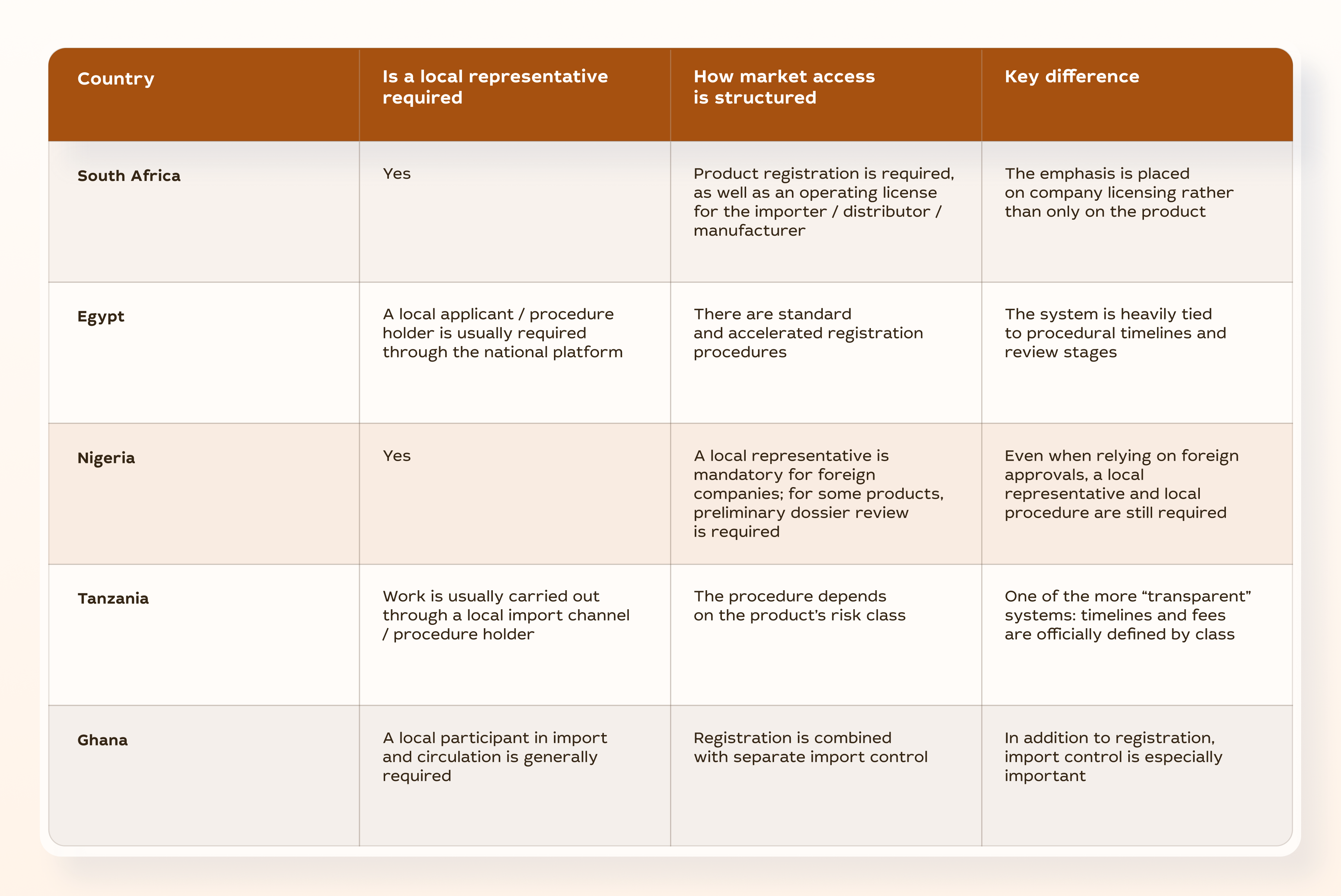
The regulatory environment in Africa is not chaotic, but it is heterogeneous. This variability requires separate attention even before shipments begin.
Import, Customs and Tax Considerations
After certification, the next critical stage is import. This is where the main risks related to timing, cost of VAT registration in Africa, and process control most often arise.
In South Africa, import value-added tax (VAT) is 15%, and it is calculated not only on the customs value, but also taking into account a 10% uplift for goods from outside the Customs Union and non-refundable duties.
In Kenya, importing goods generally requires working through a customs representative who files documents in the electronic customs system. In addition, an import declaration fee of 2% of the customs value is charged, while standard VAT is 16%.
In Tanzania, the importer submits documents through a customs agent, and the documents are recommended to be filed at least 7 days before the vessel arrives. Standard import VAT is 18%, and the system provides for pre-arrival declaration in order to reduce clearance time after the cargo arrives.
Therefore, the import model must be calculated in advance: differences between countries appear not only in tax rates, but also in the logic of customs clearance, the set of required documents, and the role of local intermediaries.
Telecom and Market Environment
The IPTV market in Africa is shaped by national telecom regulators and the specifics of local services.
It is important to distinguish between two things: the sale of equipment and the provision of an IPTV service. In some countries, the requirements for these areas differ. Equipment may be allowed for sale, while the service may require a separate license or compliance with additional rules.
In some cases, localization requirements arise. This may concern both interfaces and software, including firmware localization and user experience.
Local partners play a significant role, helping companies navigate the regulatory environment, simplifying communication with authorities, and providing a more stable presence in the market.
Distribution Models in African Markets
The choice of distribution model directly affects the risks and economics of the project.
Direct export gives full control over supplies and the brand, but requires the company to solve all issues independently, from certification to service. This is the most complex option from the standpoint of operational workload.
Working through a local IPTV distributor in Africa reduces part of the risk, as many processes are handled by the partner. However, this creates dependence on the partner’s competence and operating structure.
Regional hubs make it possible to centralize logistics and simplify the movement of goods between countries. For example, this approach to IPTV distribution in South Africa and neighboring countries is effective when working with several markets at the same time, but it requires more complex organization.
Cross-border distribution may seem like a convenient model, but in practice this option is associated with additional regulatory and logistics constraints.
So each model has its own advantages and risks, and there is no universal solution.
Logistics and Infrastructure Considerations
Logistics in Africa is not just delivery, but an important part of the entire business model.
According to official data, the timelines for customs clearance in Africa varies considerably: in Mauritius the benchmark is around 1 hour, in Kenya from 42 to 110 hours, and in South Africa the statutory period may reach 28 days depending on the type of cargo.
This shows that border delays should be built into the model in advance rather than treated as an exception.
There can be supply chain challenges in Africa as well. In some regions, infrastructure constraints that affect transportation and distribution of goods remain in place. This requires careful planning.
Warehousing also becomes an important element. The presence of a local warehouse makes it possible to accelerate deliveries and improve service reliability.
Returns and warranty cases are another complex aspect. Without a well-designed reverse logistics process, RMA processes can become lengthy and costly.
Warranty, Support and After-Sales Service
In the B2B segment, customer expectations go beyond the product itself, with the key factor being the quality of support. Customers expect a clear and predictable support system, including warranty obligations and return procedures. RMA in international logistics requires clear organization, otherwise, timelines can become critical.
Firmware updates are another important aspect of after-sales support in Africa. Updates must be available and timely, especially given the differences between markets. SLA plays a significant role in building trust. Clearly defined response and issue-resolution timelines become part of the value proposition.
A separate issue is the balance between local and remote support. In some cases, local presence is necessary to maintain the required service level. Service is often the factor that determines the long-term success of the project.
Market Entry Checklist
Before entering the market, it is important to systematically assess the key aspects:
- identify the target country
- check product market access requirements
- clarify the structure of import duties and VAT
- choose the sales and supply model
- define the procedure for warranty service and equipment returns
- plan logistics and product storage
- work through the terms of distributor agreements
- assess the requirements for local telecom authority approval
Common Problems in African Markets
In practice, most problems are related not to the product, but to the market approach. Companies that wish to distribute IPTV in Africa often face misunderstanding of local requirements and underestimate the complexity of logistics. Grey market sourcing may provide short-term gains, but it creates long-term risks.
Service remains one of the most vulnerable areas. Without a structured support model, even a successful start can quickly lead to a decline in trust. Additional complications are created by currency risks and differences in regulatory practice between countries.
When Entry Into the African Market May Be Inadvisable
There are situations in which it is better to postpone market entry. If there is no understanding of local legislation or no partner in the country, the risk increases significantly. Likewise, the absence of a service support model makes the project unstable.
Unrealistic margin expectations and the absence of a long-term strategy are also signals that plans should be reconsidered. In such cases, preparation becomes more important than speed of launch.
Distribution of IPTV equipment in Africa is not a matter of “finding an importer and shipping the goods,” but a full market entry model in which regulation, import, logistics, service, and channel selection must be designed simultaneously. Africa is not a single market: differences between countries begin at the product approval stage, continue in customs and tax matters, and directly affect timelines, margins, and the sustainability of the entire operating model.
FAQ
1. Do IPTV devices require type approval in African countries?
In most countries, yes, type approval in Africa is a mandatory requirement for the legal import and sale of equipment.
2. Can products be supplied to several African countries from one hub?
Movement of IPTV hardware in Africa is possible, but it requires taking into account regulatory differences and logistics constraints.
3. Are import duties high for IPTV equipment?
That depends on the country. In some cases, import duties in Africa significantly affect the final cost.
4. Is local representation required?
Not always formally, but in practice a local partner significantly simplifies operations.
5. What are the main risks when distributing IPTV in Africa?
The main risks are related to regulation, logistics, service, and the wrong choice of distribution model.
Recommended

Interactive TV Trends on Google TV: What to Know in 2027
When choosing a television platform for 2027, businesses need to assess more than picture quality and the app selection. Equally important considerations are how viewers will find content, what capabilities the operator will have, and how predictably the equipment will perform after updates.

How to Expand an IPTV Platform to Web, Android, iOS, and Smart TV
For an IPTV operator, launching a service on just one type of device is rarely enough anymore. With users now watching linear channels on a TV, viewing content on a smartphone, opening catch-up content in a browser, or using an IPTV set-top box as the main screen at home, expanding a service across multiple client platforms is not simply a matter of releasing additional apps.

All Content in One Service: Live TV, VoD, Radio, Archive, TimeShift, and EPG in Ministra PRO
A television service has long been more than just a list of channels. Viewers now want to watch live broadcasts, return to a missed program, pause a show, schedule recordings of individual episodes or an entire series using nPVR, or choose a movie from a catalog. At the same time, all these capabilities should feel like parts of a single media environment rather than separate systems.