


Product request
You are looking for a solution:

Select an option, and we will develop the best offer
for you


Control and Security of Guest Data in Hotel IPTV
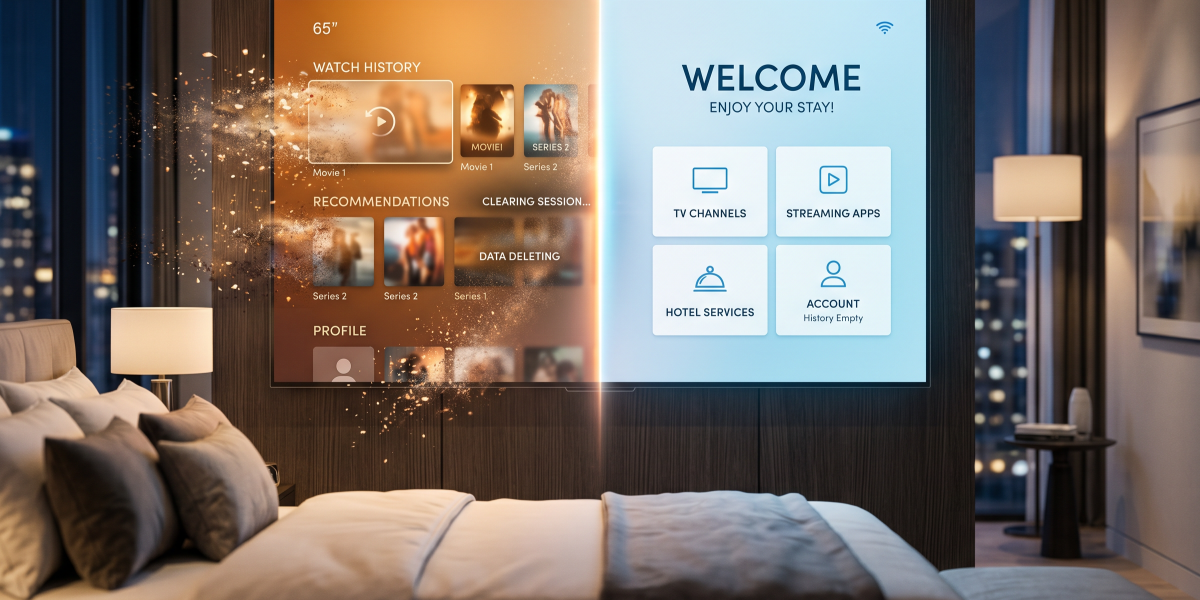
A hotel room has always been thought of as a space where a guest can relax and feel safe. However, as Smart TVs, streaming services, and interactive features become standard in rooms, this perception is changing.
Today, hotels are expected to ensure not only comfort for residents, but also guest data privacy and security.
Television in a hotel room is not limited anymore to just broadcast channels. Guests log into personal accounts, watch content through their own subscriptions, and interact with interfaces that store their preferences. And that raises an important question: what happens to all that data after checkout?
Industry research shows that the hospitality sector regularly faces incidents related to data breaches, while user concern about privacy continues to grow. This means that data security can no longer be treated as a secondary aspect of digital services.
How Guest Behavior Has Changed – and Why It Matters
To understand the scale of the problem, we can look at how content consumption has changed in recent years. IPTV and OTT services have not only intensified competition with linear television – they have completely transformed viewing behavior.
In 2025, streaming surpassed traditional TV for the first time in terms of viewing time share. This is confirmed by Nielsen and Accio data:
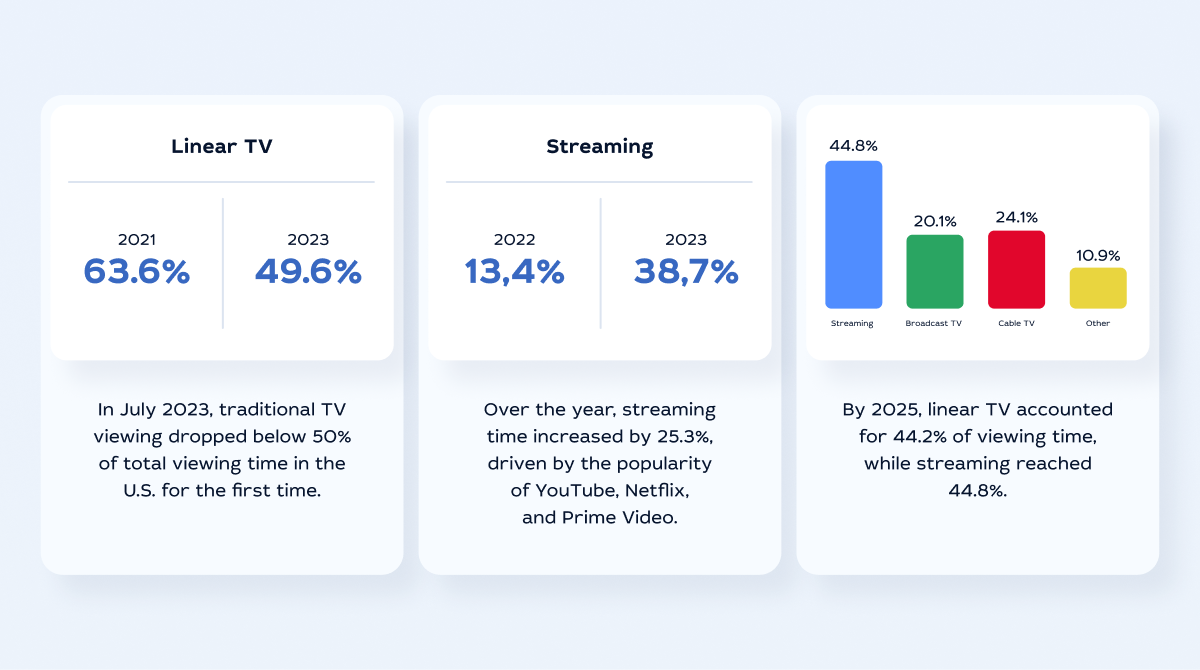
IPTV continues to grow and is expected to become one of the dominant content delivery technologies in the coming years. This directly affects the hospitality sector where guests no longer see television as background entertainment, using it the same way they do at home – with login-based access, personalized recommendations, and viewing history.
Guest Data: What Happens Between Stays
The most vulnerable moment in hotel IPTV is not login, it's what happens after the user leaves.
In a home environment, a device belongs to one person or household. But in a hotel, the same TV is used by dozens of guests in a short period of time. Each of them may log into personal services, watch content, and interact with the interface. However, sessions are not always properly terminated.
In practice, this leads to situations where a new guest can see a previous guest’s account, viewing history, and even personalized recommendations. At this point, it becomes clear that hotel guest data control is not a minor inconvenience but a full data exposure issue – and the problem surrounding hotel TV privacy settings extends beyond technology into the realm of trust.
Security as a Factor of Trust
Trust has always been an intangible asset in hospitality. While previously it was built around service and comfort, today it also includes digital security.
Research shows that users increasingly make decisions based on how secure they feel when using services. According to Cisco’s 2024 survey, 75% of customers are willing to stop buying from companies they do not trust with their data.
Loss of control over data affects not only how technology is perceived, but also how a brand is viewed overall. For guest data protection at hotels, just a single incident can have a greater impact on reputation than dozens of positive reviews.
Where Convenience Meets Control
At first glance, security within hospitality TV solutions may seem to conflict with convenience. The more restrictions there are, the harder it becomes to use a system. The issue however is not that security complicates the interface, but that it's often implemented incorrectly. Users should not have to think about data protection – the system should handle it automatically.
This leads to a key principle of modern hotel IPTV privacy solutions, which is that security must be invisible.
If a guest has to manually log out or take additional steps, the likelihood of error remains high. But if the system automatically ends sessions, clears data, and completes a TV session reset on the device, the risk is effectively eliminated.
Why the Problem Does Not Solve Itself
One might expect that modern Smart TVs already account for user turnover scenarios. Unfortunately, they don't. Most devices are designed for home use, where user change does not occur.
Hotel environments introduce specific requirements:
- guaranteed data deletion
- session control
- prevention of data accumulation
If these mechanisms are not implemented at the system level, operators and hotels lose control over what happens inside the device. Modern devices operate across multiple communication channels and integrate with external services, making them part of a complex digital environment. Any inconsistency increases the likelihood of data leaks and a failure to ensure GDPR hotel compliance.
While the market already offers devices that address this scenario – such as hospitality TVs with automatic data reset – these are specialized solutions, and their integration comes with its own complexities.
The Technical Advantage of IPTV
From a security perspective, the difference between the traditional model and modern hotel IPTV systems is fundamental.
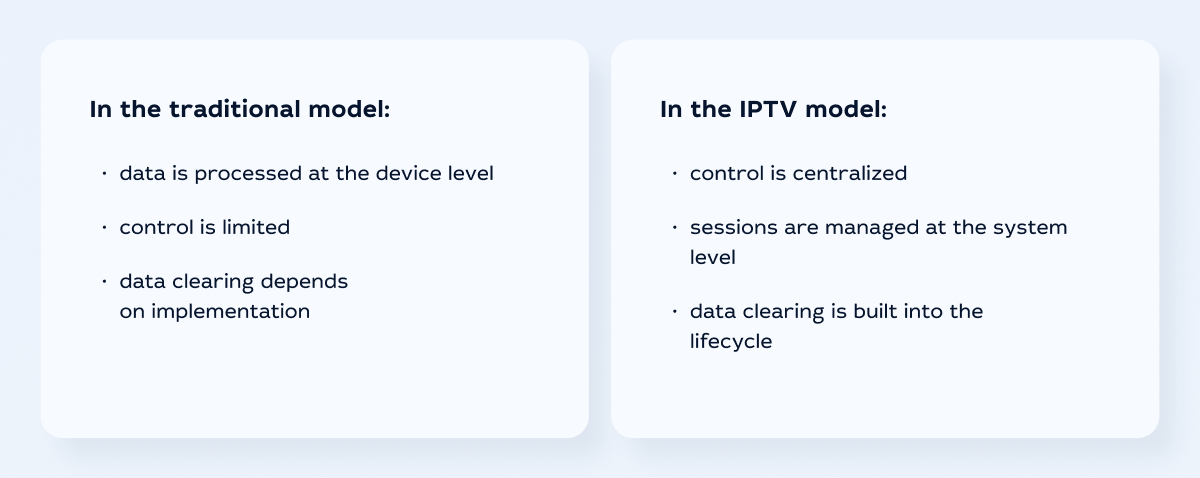
This is particularly important in hotels, where a single device is used by multiple guests. The ability to guarantee session termination and data deletion on a secure smart TV becomes not just a convenience but a requirement.
Why IPTV Becomes a Management Tool
Traditional television did not involve interaction. IPTV, on the other hand, is built around it. This means that the platform inherently processes and manages data.
IPTV can therefore address security at the system level:
- managing user sessions and streaming account logout
- controlling access
- ensuring data deletion
- synchronizing with the guest lifecycle
This fundamentally distinguishes IPTV from consumer-grade solutions.
The Cost of Security: Why IPTV Often Becomes the More Cost-Effective Choice
When selecting technology for guest rooms, hotels often instinctively choose branded hospitality TVs. At first glance, they appear to be a safe option: a familiar manufacturer, straightforward setup, and minimal deployment effort. However, a closer look reveals that the long-term economics of such solutions differ significantly from initial expectations.
Entry cost: Hospitality TVs may start at approximately €275–€540 per unit, depending on size and configuration. But this only covers the display, not the management systems, integrations, or service functionality.
If we look at full-scale solutions such as Samsung Hospitality systems, costs increase. Industry data suggests implementation may start from around €800 per room, excluding installation and additional services. Many advanced features – particularly those related to management, analytics, or integration – often require additional licenses or recurring fees. Now the TV has gone from being a one-time purchase to a long-term expense.
Why “Cheaper at the Start” Is Not More Cost-Effective
Hospitality TVs solve a single task, that of content display with basic interactivity. Expanding beyond this introduces additional costs:
- PMS integration
- interface customization
- service feature deployment
- updates and ongoing support
Such systems are typically built as closed ecosystems, meaning that any change – from adding a new service to modifying interface logic – requires vendor involvement or additional investment.
At scale, the impact becomes more pronounced. In hotels with 100–200 rooms, each new feature increases costs linearly, causing budgets to grow faster than the value delivered.
IPTV as a Different Cost Model
IPTV platforms, such as those offered by Infomir, are built on a different principle. The television is no longer the core of the system – the platform is.
This fundamentally changes the cost structure:
- infrastructure is deployed once
- new features are implemented at the platform level
- scaling does not require proportional cost increases
The key difference lies not in the price of the device, but in the ownership model of the system.
Conclusion: Where the Real Value Lies
While smart hotel TVs and IPTV solutions may initially appear comparable in cost, over time the difference becomes clear.
Televisions provide a quick start but limit flexibility and increase dependency on the vendor. IPTV platforms require more thoughtful implementation but deliver:
- control over data
- architectural flexibility
- scalability
- predictable long-term costs
So, the real question about guest privacy on smart hotel TVs isn't “what is cheaper,” but “what allows the hotel to maintain control and grow without continuously increasing costs?”
In this context, solutions like Infomir represent a more secure and sustainable model, especially for hotels that view IPTV as part of their digital infrastructure, rather than a standalone feature.
Hotel IPTV data security today sits at the intersection of user experience and data control. As guests increasingly rely on digital services, the importance of secure data handling and proper session management continues to grow.
The market is gradually recognizing that having secure hotel TV systems is not a limitation – it is a component of service quality. In the coming years, the ability to prevent data leaks on hotel TVs and manage user data effectively will be one of the defining criteria for selecting IPTV solutions in the hospitality sector.
Recommended
Interactive TV Trends on Google TV: What to Know in 2027
When choosing a television platform for 2027, businesses need to assess more than picture quality and the app selection. Equally important considerations are how viewers will find content, what capabilities the operator will have, and how predictably the equipment will perform after updates.
How to Reduce Video Delivery Costs Without Compromising Quality: CDN, Edge Cache, and Multi-CDN
As an IPTV/OTT service’s audience grows, so do both revenue and video delivery costs. For an operator, this means additional terabytes of outbound traffic. For a hotel, it means greater pressure on its internet connection. And in the case of maritime transport, it means the video service has to compete with other applications for limited bandwidth.
How to Expand an IPTV Platform to Web, Android, iOS, and Smart TV
For an IPTV operator, launching a service on just one type of device is rarely enough anymore. With users now watching linear channels on a TV, viewing content on a smartphone, opening catch-up content in a browser, or using an IPTV set-top box as the main screen at home, expanding a service across multiple client platforms is not simply a matter of releasing additional apps.