


Product request
You are looking for a solution:

Select an option, and we will develop the best offer
for you


Bulk Purchase of IPTV Hardware
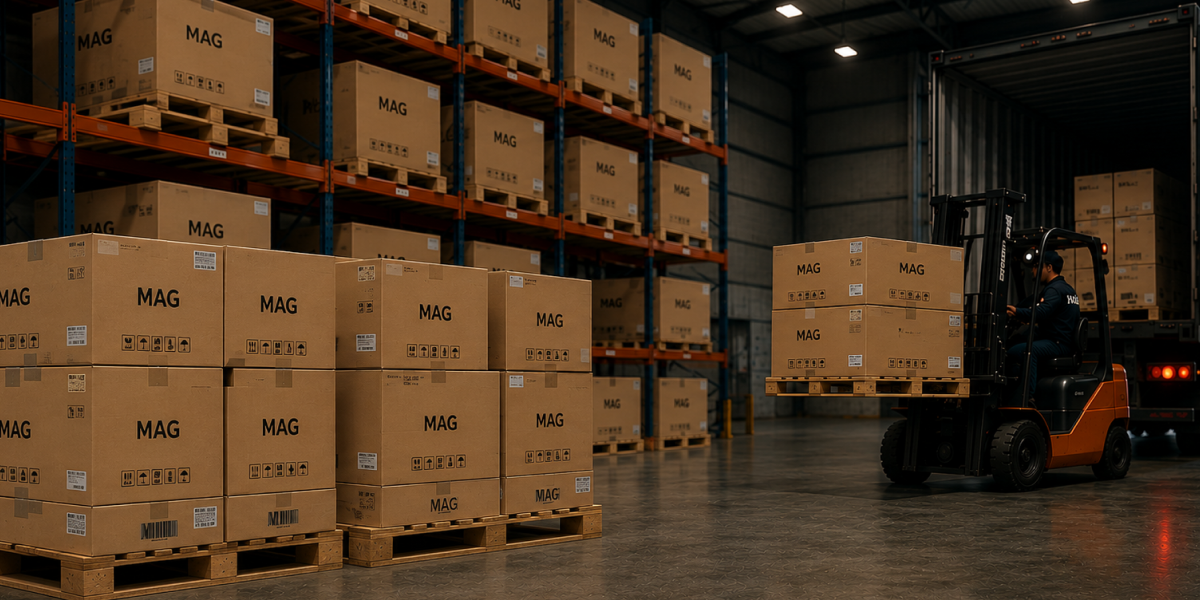
A bulk purchase of IPTV hardware is not just a way to reduce the unit price through higher volume. For many operators, integrators, distributors, and those involved with hospitality projects, this method of procurement becomes an essential part of a successful operating model.
However, for those looking to buy IPTV set-top boxes in bulk, planning is key. This includes assessing in advance the minimum order quantity, wholesale pricing structure, delivery timelines, logistics, warranty terms, RMA procedures, and supplier stability.
In this article, we explain how bulk purchasing of IPTV set-top boxes works, and look at which factors influence the total cost, why logistics and service can be just as important as price, and when a wholesale model is truly suitable for a project.
This approach helps project procurement teams do more than simply request a commercial offer – it prepares them for a well-informed B2B discussion with a supplier.
Why Bulk IPTV Hardware Purchasing Requires Dedicated Planning
A bulk IPTV hardware purchase differs from a retail purchase not only in the number of devices. For companies planning to purchase 50 or more set-top boxes, the unit price may well be top of the list, but it's just one of a number factors that need to be considered, such as minimum order quantity, supply model, production lead times, logistics, warranty terms, and service support.
In a wholesale model, volume directly affects the pricing structure. The larger the batch, the higher the likelihood of wholesale pricing tiers, project-based terms, or a long-term agreement. At the same time, the final cost depends on the purchase price, as well as on delivery, customs clearance, warehousing, currency risks, and service terms.
According to market reviews for 2025–2026, the IPTV and TV set-top box markets remain active, with IMARC estimating the global IPTV market at USD 105.6 billion in 2025, with projected growth to USD 304.9 billion by 2034.
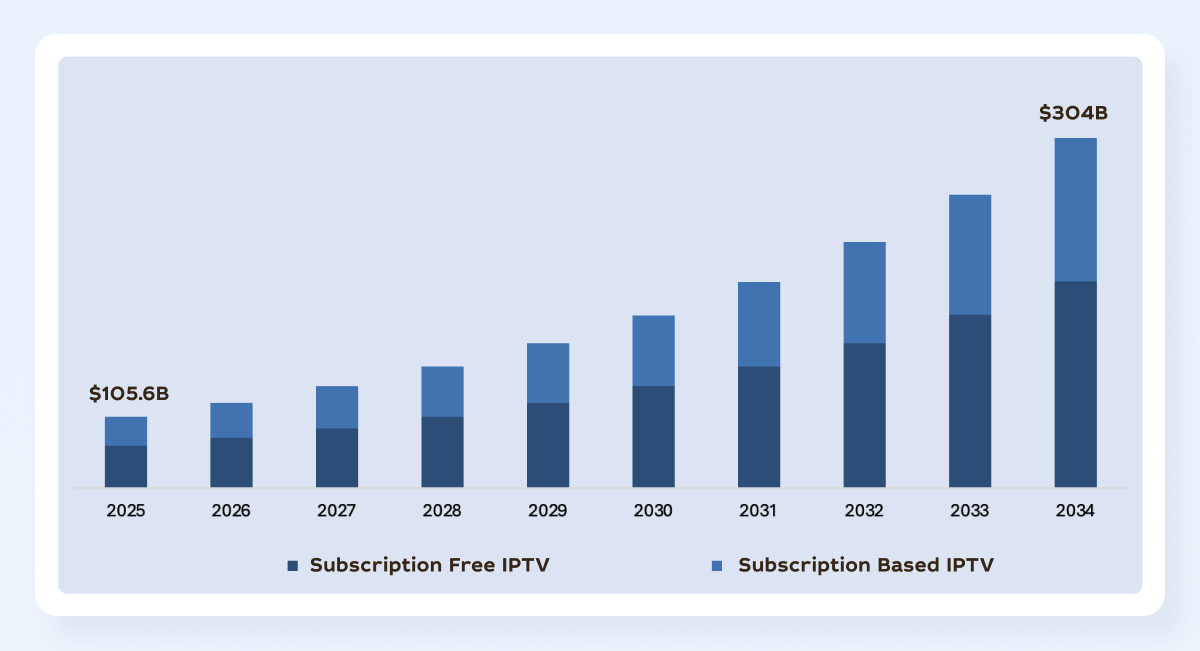
Size, By Subscription Type, 2025–2034 (USD Billion)
This data confirms that, for operators, distributors, and integrators, stable hardware supply remains a strategic issue rather than a one-time purchasing decision.
What Qualifies as a Bulk IPTV Hardware Order?
In the context of IPTV hardware, a bulk purchase usually starts with batches of 50 or more devices. For a small operator, hotel, or integrator, this becomes more than a simple retail purchase, but a procurement process that requires advance planning: selecting the set-top box model, assessing warehousing capabilities, agreeing on timelines, and checking the warranty framework.
Batches of 100 or more devices are often treated as a full-scale IPTV wholesale order of set-top boxes. At this level, the supplier may discuss wholesale pricing tiers, project-based terms, shipment schedules, and possible customization – for example, branding, preinstalled software, or configuration for a specific IPTV platform.
A separate category includes project rollouts and recurring supply contracts. These may involve phased subscriber-base connections, fleet renewal, the launch of a hotel network, or cooperation with a regional distributor. In such cases, wholesale is not just about quantity, it's a cooperation model between the supplier and the buyer.
Wholesale Pricing Structure and Volume Discounts
The wholesale price of IPTV hardware is usually based on a tiered model. This means that the cost may depend on batch size, order frequency, payment terms, logistics, the level of customization, and the project’s long-term potential. In this context, it's more accurate to discuss the structure of the total cost of ownership rather than the “lowest price.”
The minimum order quantity, or MOQ, helps the supplier plan production, warehouse inventory, and logistics. For the buyer, MOQ serves as a benchmark, indicating the volume at which the purchase becomes economically and operationally viable.
Large projects may also involve long-term pricing agreements and the inclusion of an IPTV volume discount. These volume discount tiers help reduce uncertainty for procurement teams, especially when the purchase is divided into several stages. However, such terms usually depend on demand forecasts, delivery schedules, contract currency, and the stability of the production plan.
Logistics and Delivery of Large Batches
Logistics, particularly freight coordination, is one of the key factors in the final cost of a bulk purchase of IPTV set-top boxes. Air freight may be used for smaller batches, but larger shipments are more often handled through pallet shipments, ocean freight, or combined routes.
The choice between air and ocean freight depends on the urgency of the project, the budget, the delivery region, and launch timeline requirements. Air freight is usually faster, but more expensive. Ocean freight may be more cost-effective for large batches, but it requires earlier planning and allowance for possible delays.
A clear example of how unexpected factors can affect supply conditions is U.S. tariff policy in 2025. According to Freightos, ocean freight conditions became less predictable due to uncertainty around the timing of new tariffs. Importers either booked containers in advance to bring goods in before possible tariff increases, or temporarily paused orders while waiting for new decisions. As a result, typical seasonality was disrupted, with U.S. import volumes rising in the first half of the year and declining in the second half.
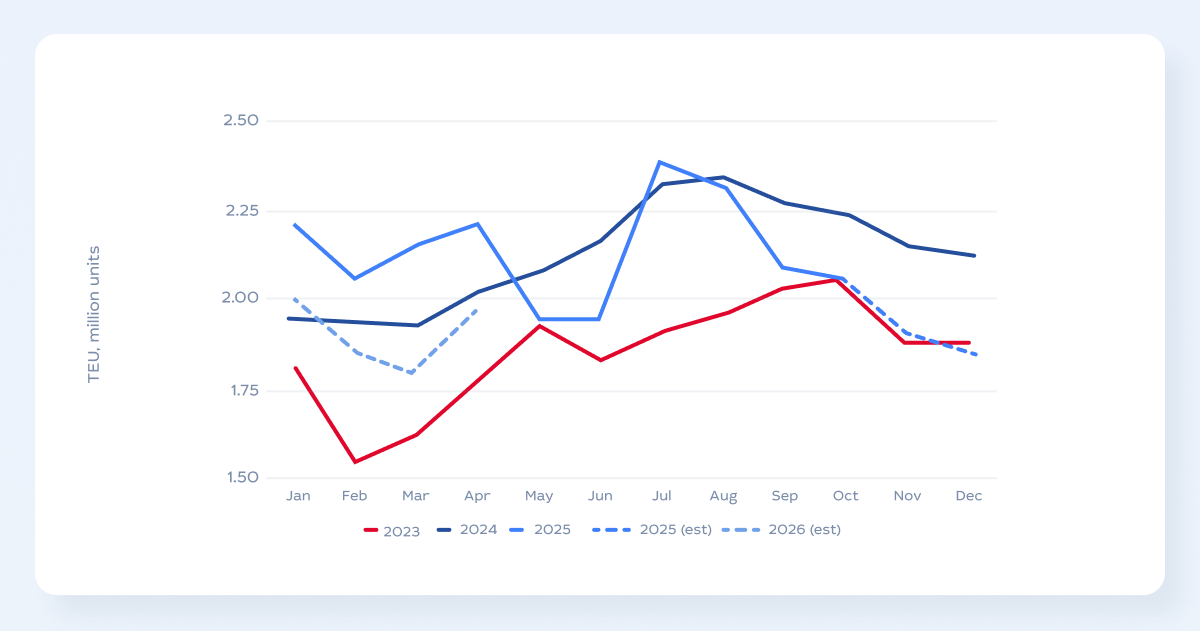
NRF: US ocean import volumes
For IPTV hardware procurement, this means that delivery timelines and costs may change not only because of logistics, but also due to political decisions. When companies shift shipments to earlier dates at scale, ports, warehouses, and carriers come under increased pressure. When demand drops sharply, freight rates and route availability change.
Therefore, for bulk orders, it's important to agree on the delivery schedule in advance, account for possible delays, freight, insurance, customs duties, warehouse handling, route stability, transport availability, customs risks, inland delivery, potential storage costs, and the broader situation in global trade – and build a time buffer into the project plan.
Payment Terms and Financial Planning
A bulk purchase of hardware requires dedicated financial planning. Depending on the scale of the order and the relationship with the supplier, advance payment conditions, partial prepayment, milestone-based payment, or deferred payment may be discussed. These terms are not universal and should be fixed in the contract.
Procurement teams also need to account for currency risks in advance. If the contract, production, logistics, and internal revenue are tied to different currencies, the final project economics may change before delivery even takes place.
Cash flow also needs to be planned. A large batch of IPTV set-top boxes may be more cost-effective in terms of unit price, but it requires additional working capital, warehousing infrastructure, and control over the implementation timeline.
Project-Specific Supply Terms
When purchasing IPTV hardware in bulk, supply terms can be adapted to the specific project. These terms will relate to the number of devices, but also in configuration, timelines, logistics, and technical requirements. This is especially important for integrators and operators deploying solutions in non-standard environments – for example, in closed networks, remote sites, or infrastructure without constant internet access.
A good example is the case of a European system integrator deploying TV systems on yachts. The project architecture involved satellite signal reception, Linux set-top boxes, and a fully isolated environment without an internet connection. As a result, the hardware and software platform had to be prepared in advance so that the system could be quickly deployed on board without complex on-site configuration.
The solution used Infomir Linux set-top boxes and Ministra PRO middleware, enabling a centrally managed TV system for a closed environment.
The case also shows that bulk purchasing often involves operational flexibility on the supplier’s side. In this instance, the hardware had to be delivered to different ports within short time windows while the vessel was docked. To make this possible, shipments were redistributed between warehouses, and order configuration was adapted to the vessel’s location and implementation schedule.
This approach demonstrates that, in large B2B projects, supplier value is defined not only by devices and price, but also by the ability to account for technical constraints, launch timelines, and complex international IPTV bulk logistics.
Warranty and RMA for Bulk Orders
Warranty terms for bulk IPTV hardware purchases differ from the standard retail model. For large batches, it's important to determine in advance how defective devices are handled, which return terms apply, and when replacement is used instead of repair.
In B2B projects, the service model may include local diagnostics, centralized returns, a pool of spare devices, or contractual SLAs for large orders. This is especially important for operators and hospitality projects, where hardware downtime affects the quality of service for the end user.
Service is part of the total purchase cost. A cheaper batch without a clear RMA procedure may create additional costs later, relating to return logistics, device replacement, support request handling, and customer support.
Production Capacity and Supply Chain Stability
For purchases of 50+, 100+, and especially recurring batches, it's vital to assess not only current device availability, but also the supplier’s ability to maintain stable supply in the future. For production capacity planning, the procurement team should understand whether the supplier has a production plan, warehouse reserve, component forecast, and transparent communication on timelines.
Of course, global factors can also affect hardware availability, with logistics disruptions, tariff changes, demand fluctuations, component shortages, geopolitical restrictions, and currency instability all having the potential to impact business operations. Supply chain reports for 2025–2026 identify resilience, supply chain visibility, and supplier diversification as some of the key business priorities (ASCM).
For long-term IPTV projects, this means that hardware procurement should be linked to connection forecasts, the project launch schedule, inventory forecasting, and a clear repeat-order model.
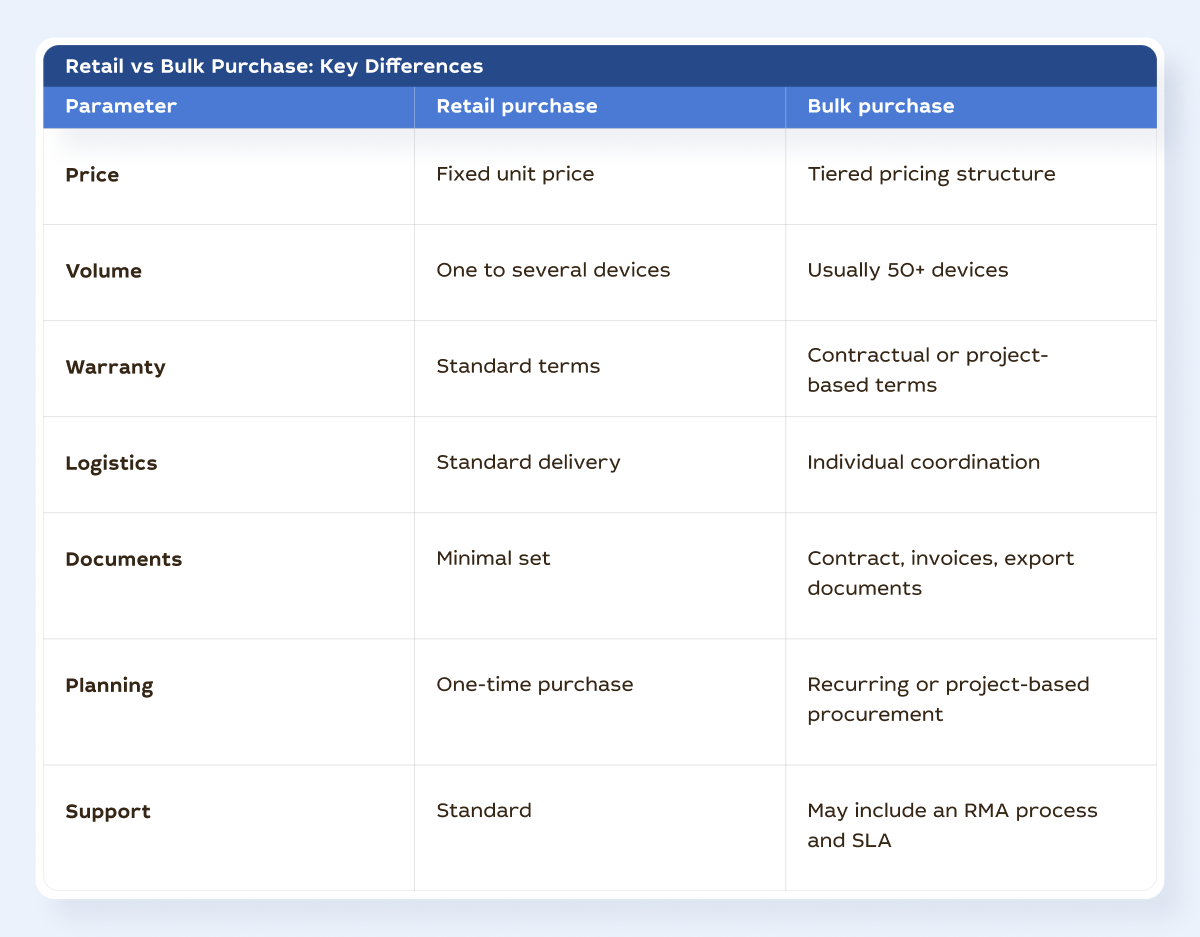
This comparison helps explain why wholesale price should not be assessed by the device price alone. In a wholesale model, the overall supply terms, predictability, and the buyer’s operational readiness are all important.
When Bulk Purchasing May Not Be Suitable
Bulk purchasing of IPTV hardware is not always the optimal solution. If the volume is too small, demand is unstable, or the project has not yet passed technical validation, a large batch may create unnecessary pressure on the budget and warehouse.
A wholesale model may also be inefficient if the company lacks warehousing infrastructure, device accounting procedures, a plan for distributing equipment to subscribers, or a team to handle warranty cases.
In such situations, it's sensible to start with a pilot batch, check hardware compatibility with the platform, assess support quality, and only then move on to a larger order.
Bulk IPTV Hardware Purchase Checklist
Before placing an order, it's worth checking:
- Minimum order quantity and MOQ terms.
- Wholesale IPTV bulk pricing tiers.
- Availability of project-based pricing or a long-term agreement.
- Logistics model: air, ocean, pallet shipping, warehouse.
- Production and delivery timelines.
- Payment terms and contract currency.
- Warranty structure and RMA process.
- Handling of defective devices.
- Customization options.
- Production capacity and supply stability.
FAQ
1. What is the minimum order quantity for IPTV hardware?
The minimum order quantity depends on the device model, supplier terms, and the project. In a B2B context, bulk purchasing and large order pricing often starts from 50 devices, but MOQ may be higher for specific models or customization.
2. Are volume discounts negotiable?
Yes, volume discounts are usually discussed within the model with the IPTV wholesale supplier. Terms for contract-based pricing may be influenced by batch size, order frequency, payment method, logistics, customization, and the long-term potential of cooperation.
3. How long does delivery take for a large order?
The timeline depends on device availability in stock, the production plan, delivery route, customs clearance, and the chosen mode of transport. Air freight is usually faster, while ocean freight can be more cost-effective for large batches but requires additional lead time.
4. Can a bulk order be customized?
Yes, customization is possible in some projects: branding, preinstalled applications, firmware configuration, or packaging customization. Such terms usually need prior agreement and testing, and may affect MOQ and timelines.
Recommended
Interactive TV Trends on Google TV: What to Know in 2027
When choosing a television platform for 2027, businesses need to assess more than picture quality and the app selection. Equally important considerations are how viewers will find content, what capabilities the operator will have, and how predictably the equipment will perform after updates.
How to Reduce Video Delivery Costs Without Compromising Quality: CDN, Edge Cache, and Multi-CDN
As an IPTV/OTT service’s audience grows, so do both revenue and video delivery costs. For an operator, this means additional terabytes of outbound traffic. For a hotel, it means greater pressure on its internet connection. And in the case of maritime transport, it means the video service has to compete with other applications for limited bandwidth.

How to Expand an IPTV Platform to Web, Android, iOS, and Smart TV
For an IPTV operator, launching a service on just one type of device is rarely enough anymore. With users now watching linear channels on a TV, viewing content on a smartphone, opening catch-up content in a browser, or using an IPTV set-top box as the main screen at home, expanding a service across multiple client platforms is not simply a matter of releasing additional apps.