

Product request
You are looking for a solution:

Select an option, and we will develop the best offer
for you


Subscription and Household Management in Ministra PRO: How Operators Can Manage Accounts, Devices, Plans, Events, and Data
These requirements have turned subscriber management into a full-scale operational task, where it's necessary to see who has access to content, which devices subscribers use to watch the service, which plans are active, and what is happening with the user experience.
The IPTV/OTT market in 2025–2026: new challenges for operators
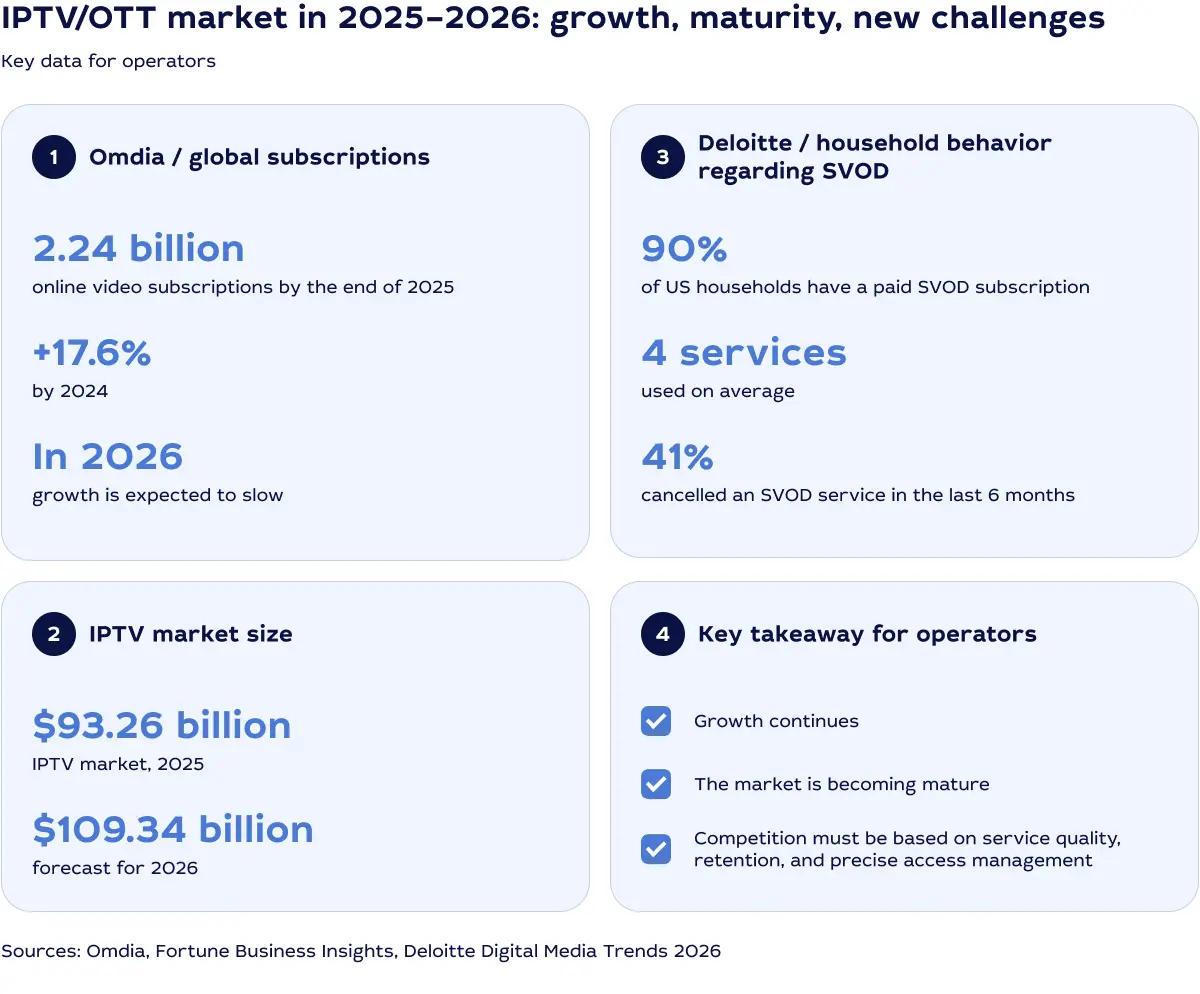
According to the market analyst Omdia, by the end of 2025 the number of global online video subscriptions reached 2.24 billion, up 17.6% compared with 2024. However, Omdia also expects growth to slow in 2026 as the market becomes more saturated. This is an important signal for operators: competing only by the number of connections is becoming more difficult, while retention, service quality, and precise access management are coming to the forefront.
The market research and consultancy company, Fortune Business Insights, estimates the global IPTV market at $93.26 billion in 2025 and forecasts growth to $109.34 billion in 2026.
In this environment, middleware must help the operator manage content, as well as the entire operating logic of the IPTV/OTT service: accounts, devices, tariff plans, access to features, and data on how users interact with the platform. Ministra PRO is an IPTV platform user control system, designed specifically for IPTV/OTT/VOD projects. Ministra Pro helps operators manage the service at the level of data, content, infrastructure, and tariff packages.
From subscriber account to household account
In the traditional model, an operator often thinks of a subscriber as one login or one contract. But real video service consumption is more complex. One user may watch IPTV on a TV set-top box, another family member may watch VOD on a Smart TV, and someone else may connect through a mobile app. For the operator, it's important to not only create an account, but to understand which devices are linked to it and what access is allowed for them.
Subscriber accounts are end users who subscribe to plans to access content. The platform supports household IPTV user accounts: one account with several linked devices. This approach to IPTV subscriber management is convenient for operators that sell the service not only for one device, but also for a household, hotel room, apartment, campus, or another scenario where one account may include several access points.
In practical terms, a household account helps the operator manage IPTV users and devices by combining several accounts of one user into a single household. This simplifies data management, account handling in billing, and helps avoid confusion and duplicate data.
What data the operator configures in an account
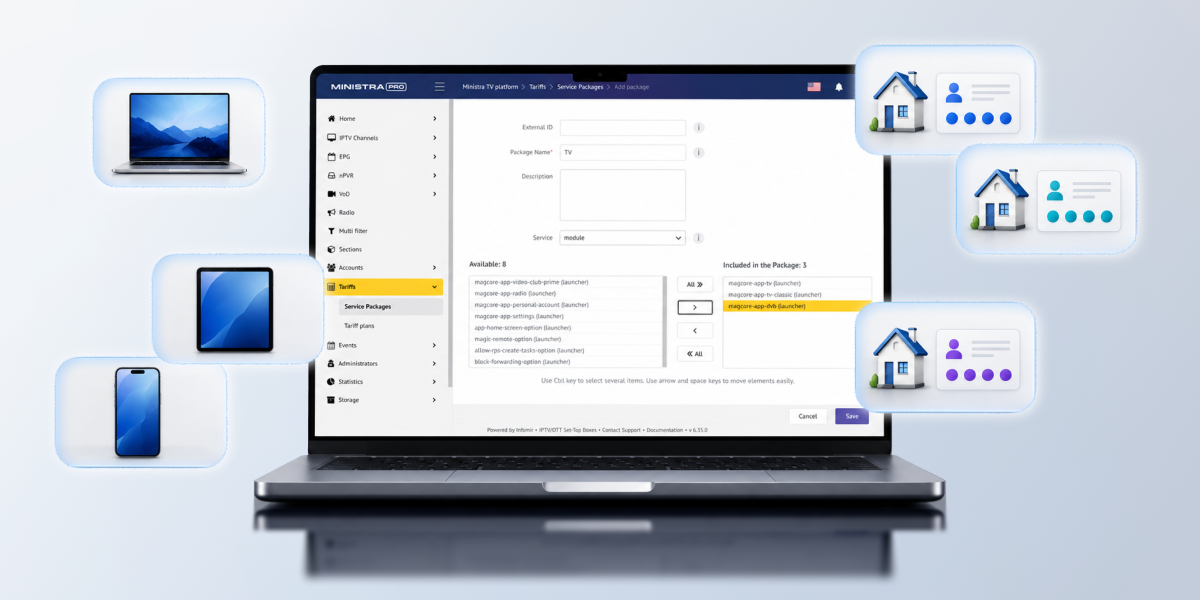
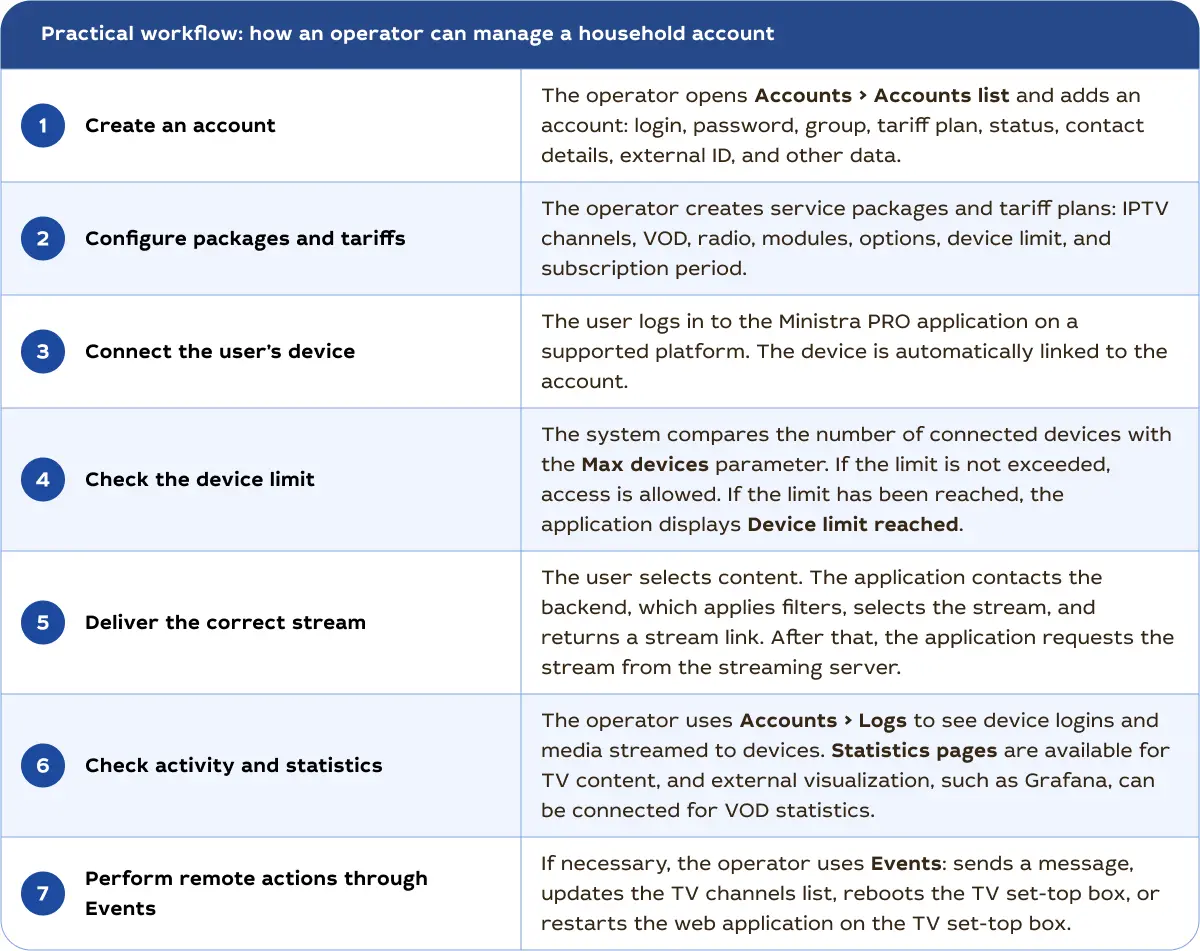
Ministra PRO also helps optimize IPTV billing and subscription management. An account is created in the Admin Panel or through the Billing API, and the operator then assigns a tariff plan, sets the account status, and may specify additional data needed for administration and support. This additional data could be login, password, group, contact information, external identifier, and internal comments.
This information helps connect the commercial and technical parts of the service. The tariff plan defines the set of services and restrictions available to the account: service package, access to archive, Timeshift and NPVR, the maximum number of devices, as well as the number of simultaneous playback sessions. Status shows whether the account is active. Parent PIN is used for access to age-restricted content. External ID helps identify the account and work with it through the billing API.
The IPTV billing system means that support, billing, and the technical team can work with a single account logic. If a user cannot see a channel, the operator doesn't have to start diagnostics with guesswork. Instead, they can check the account status, assigned plan, linked devices, and user activity.
Device management: linking, limits, and control
One of the key elements of subscriber and household management is device management for multi-screen users. Ministra PRO allows operators to see devices linked to subscriber accounts in Accounts > Devices list. The list can be filtered, for example, by IP address or other parameters, to find the required devices faster.
Devices are added automatically when the end user logs in on them. The maximum number of devices for an account is determined by the Max devices value in the tariff plan. To access the service on a new device, one of the already linked devices must be removed. If an error occurs during connection because the device limit has been reached, the app will ask the user to choose which device should be removed. This can be done either by the operator in the Admin Panel or by the user directly in the app.
This logic is important for building a flexible tariff model. If the operator sells a package for two or three devices, the middleware must technically support this rule. Otherwise, the tariff structure quickly loses its meaning, with user access becoming difficult to control, and support receiving more requests related to authorization and limits.
Supported platforms and multi-screen service
Ministra PRO supports a wide range of platforms: iOS, tvOS, Android, Android TV, AOSP, Firestick, Roku, Tizen, LG, MAG Linux STB, MAG PRO, as well as content viewing in a browser on a PC through Ministra PRO Web Player. This allows the operator to build the service around different user scenarios: a classic IPTV set-top box in the living room, a Smart TV app, mobile viewing, a web player, or a combination of several screens within one household account.
Multi-screen use changes the requirements for OTT service management. One user or household may use several devices, but the operator must separately control the number of registered devices and the number of simultaneous viewing sessions. For example, several devices can be registered within one household account, while content viewing is limited to one active device at a specific point in time. This approach to multi-screen IPTV user management helps the operator offer flexible multi-screen plans while maintaining control over access to the service.
Service packages and tariff plans: how access to content is defined
In Ministra PRO, access to content and individual service features is configured through service packages and tariff plans. A service package may include IPTV channels, VOD, radio, as well as modules and options. A service package can also be used as the main package, as well as an optional service package. In other words, an additional paid option or add-on that the subscriber can activate separately.
Through modules and options, the operator can manage not only access to content, but also individual elements of the interface and functionality of the end-user application. For example, in a hotel scenario, access to the app settings menu can be restricted so that the user does not accidentally change general parameters or log out of the account. In a consumer scenario, an optional service package can be used to connect additional TV channels, a VOD catalog, or other services for an extra fee.
Tariff plan, or subscription, defines what the account is subscribed to: which service packages are available and how many devices can be used. In practice, the operator can create a main service package with IPTV channels and radio, a separate package for VOD, and an optional service package with additional channels or features. These packages are then added to one or several tariff plans depending on the commercial model of the service.
How Ministra PRO selects the correct stream
When a user selects content in the end-user application, the application contacts the backend, which returns a link to the stream for playback through the streaming server. In a standard scenario, one IPTV channel may have one main link to the stream, and no additional selection rules may be required.
If the operator uses several broadcast links for one channel, filters can be configured in Ministra PRO. They are needed for scenarios where the same content must be delivered according to different rules, for example, for different platforms, protocols, or other playback conditions. In this case, filters help the IPTV backend system select the appropriate stream and pass the required stream link to the application. This mechanism gives the operator more flexibility, but it is used specifically when several stream variants are configured for one channel.
This is especially important in a multi-platform environment. Smart TVs, mobile apps, web players, and TV set-top boxes may have different technical requirements. Middleware helps connect content, device, and stream into a single working scheme.
Events: remote actions for applications and TV set-top boxes
In Ministra PRO, events are used for remote actions that an administrator can perform for end-user applications and TV set-top boxes. They can be used to send a message to the user or update the list of available TV channels. For Infomir Linux STBs, interaction options are broader, allowing the administrator to reboot the set-top box or restart the application loaded on the TV set-top box.
Message events allow text to be displayed in Ministra PRO end-user applications. TTL setting allows an event to be scheduled for the future and defines the period during which it remains relevant for the device. Events list shows events recorded in the database. By default, these are stored for 14 days, but the retention period can be changed.
For the operator, this is a useful tool in typical operational scenarios. For example, viewers can be sent a notification about maintenance work, a subscription renewal reminder, or a message about an important update. For TV set-top boxes, a remote action can be initiated when it is needed for device maintenance or channel list updates.
Activity monitoring, logs, and viewing statistics
Subscriber management is impossible without data. Ministra PRO features include enabling administrators to monitor activity to see how users interact with applications and content. In Accounts > Logs, administrators can see the following events:
Play – opening a playback session. When playback enters the playing state.
Pause – sent when playback is paused during Timeshift or Catch-Up.
Stop – means closing an open playback session. Sent on stop, completion, or error.
Error_playing – sent when the player enters an error state.
Empty_buffer – sent when rebuffering occurs.
Statistics pages provide access to TV content statistics. In TV statistics, viewing data for a selected period can be checked for channels that were streamed to a device for a certain time, covering channel name, number of views, last viewing date, and average viewing time. TV archive statistics shows statistics for archive channels, while Timeshift statistics shows data for channels streamed for more than one minute in Timeshift.
Playback statistics are also collected for VOD. This data can be viewed and visualized through an external monitoring system. This approach allows the operator to analyze VOD content consumption without overloading the platform’s main interface with unnecessary technical details.
For the operator, such data is useful in several ways. Support can see which content was launched, while the content team will know which channels or viewing types are in demand. The technical team can more quickly match user complaints with the platform, devices, or specific consumption scenarios.
Monitoring service quality and platform health
As a video service grows, the operator must control not only subscriptions, but also platform quality. This is especially noticeable during live events. AppLogic Networks notes in the Global Internet Phenomena Report 2025 that live sports broadcasts can create traffic peaks exceeding normal usage by 30–40%. For an IPTV/OTT operator, this means that a popular broadcast can sharply increase load and require infrastructure to be prepared in advance.
In Ministra PRO, monitoring is intended to control the quality of service users receive and the condition of platform components. The IPTV middleware platform helps detect viewing issues, such as buffering, before the user contacts support. The platform can also automatically disable non-working content links and distribute load between streaming servers. For broader infrastructure health control, the operator can use separate external monitoring systems, such as Prometheus, which collect data on server status, number of clients, and other metrics.
Such monitoring is not a built-in function of Ministra PRO itself, but it can complement the platform and help the technical team respond faster to failures or load growth.
The user evaluates the service by the result, not by its architecture: the channel must open, the video must play, switching must be fast, and the application must be stable. Monitoring helps the operator respond both to complaints as well as technical signals from the platform itself.
What this gives operators and providers
For an operator, Ministra PRO reduces the complexity of day-to-day IPTV account and device management. Accounts, devices, tariffs, and content access are all connected in a single system. Support can check user and device status faster. The commercial team can work flexibly with different packages, tariffs, services, and limits. The technical team receives data on viewing, activity, and the condition of platform components.
For internet providers and operators that want to add IPTV to existing infrastructure, it is important to be able to manage the service locally, support different client platforms, and control access through tariffs and devices. For hotels, campuses, hospitals, and residential complexes, household management is also useful: one account can combine several devices within a clear service scenario.
Subscriber and household management in IPTV/OTT is not just a customer list, but an operational model where accounts, devices, tariff plans, service packages, events, logs, and statistics work together.
Ministra PRO'S IPTV management system helps the operator manage this model at the middleware level by supporting household accounts with multiple devices, assigning tariffs, controlling device limits, delivering the correct stream, performing remote actions, and monitoring service quality.
In a mature market, this manageability and access to real-time user data becomes a competitive advantage — the operator better understands who watches content, and where and how they watch it. It also supports users faster, and develops the IPTV/OTT project without manual chaos.
Recommended
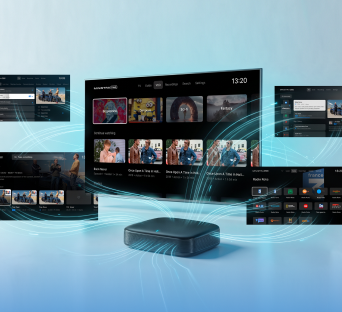
All Content in One Service: Live TV, VoD, Radio, Archive, TimeShift, and EPG in Ministra PRO
A television service has long been more than just a list of channels. Viewers now want to watch live broadcasts, return to a missed program, pause a show, schedule recordings of individual episodes or an entire series using nPVR, or choose a movie from a catalog. At the same time, all these capabilities should feel like parts of a single media environment rather than separate systems.
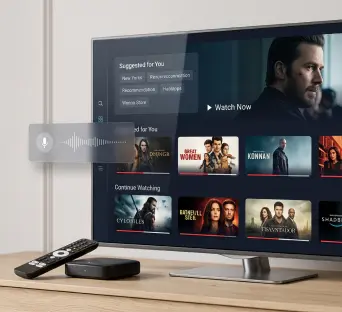
Interactive TV Trends on Google TV: What to Know in 2027
When choosing a television platform for 2027, businesses need to assess more than picture quality and the app selection. Equally important considerations are how viewers will find content, what capabilities the operator will have, and how predictably the equipment will perform after updates.
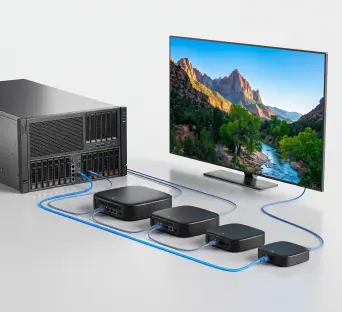
How to Reduce Video Delivery Costs Without Compromising Quality: CDN, Edge Cache, and Multi-CDN
As an IPTV/OTT service’s audience grows, so do both revenue and video delivery costs. For an operator, this means additional terabytes of outbound traffic. For a hotel, it means greater pressure on its internet connection. And in the case of maritime transport, it means the video service has to compete with other applications for limited bandwidth.