


Product request
You are looking for a solution:

Select an option, and we will develop the best offer
for you


Switching to a New IPTV Set-Top Box Brand: What Resellers Need to Consider
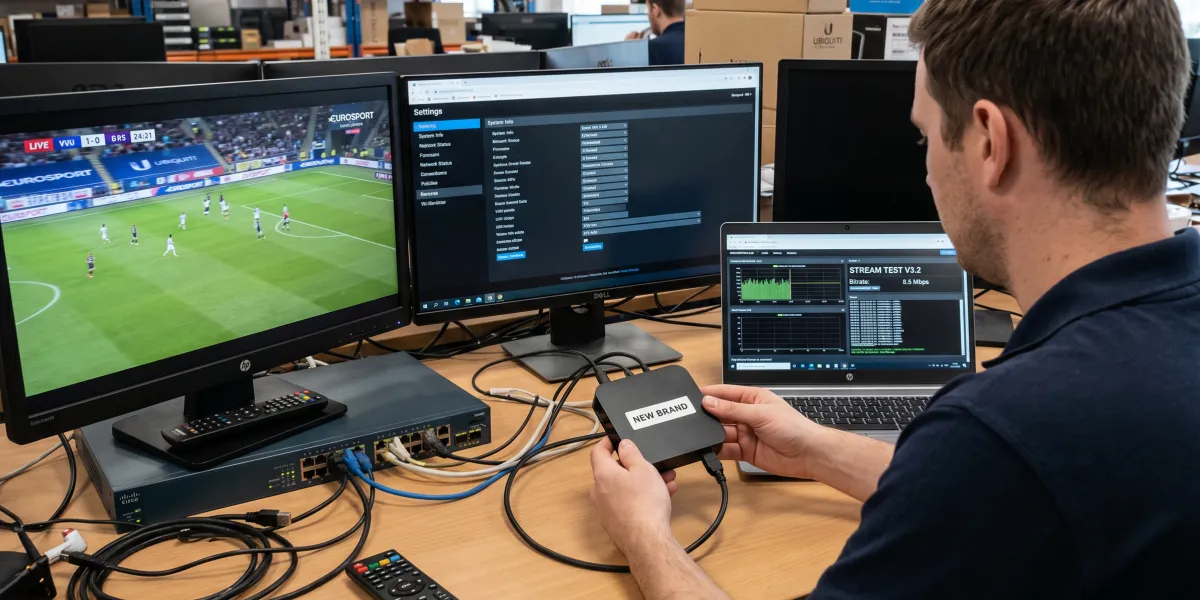
Switching an IPTV set-top box brand is not simply about purchasing a new batch of devices. For a reseller, it's a major strategic decision that affects the existing customer base, inventory, support, warranty obligations, firmware, middleware, and commercial terms.
If the transition is properly prepared, it can help expand the product portfolio, meet new customer requests, and reduce dependence on a single supplier. But if the decision is made only because of the device price, the reseller may face incompatibility, returns, an increase in support requests, and project delays.
Therefore, switching to a new IPTV set-top box brand requires technical compatibility checks, analysis of commercial terms, and a clear customer migration plan.
In this article, we provide a practical guide for IPTV set-top box resellers that helps assess risks before purchasing and prepare for discussions with a new supplier.
Why resellers consider switching IPTV set-top box brands
The IPTV and OTT market continues to grow, and device requirements are growing along with it. According to analysts’ estimates, the global IPTV market in 2025 was measured in tens of billions of dollars, and it continues to expand. At the same time, the Smart TV and TV set-top box market is developing, so resellers are increasingly reviewing their product range and supply terms.
One common reason is customer demand. Operators, internet providers, and local IPTV services may request devices with support for 4K, Android TV, OTT applications, modern codecs, a convenient interface, Ethernet, Wi-Fi 6, or customized firmware.
The second reason is pricing policy. If margins decrease, a reseller starts looking for an alternative brand or supplier. However, if you are looking to change IPTV hardware supplier, it shouldn't be based on the purchase price alone. A cheaper device may require higher costs for integration, support, replacement, and training.
The third reason is device availability. Supply disruptions, unstable delivery times, limited stock, or long lead times can interfere with customer orders. In this case, an IPTV supplier switch becomes a way to reduce operational risks.
The fourth reason is technical limitations. The current brand may not support the required middleware, DRM, OTA updates, new applications, or device management requirements. In that case, the reseller needs not simply add a new SKU, but prepare a full IPTV hardware migration.
Switching brands is not just “replacing the box”
At first glance, IPTV set-top boxes from different brands may look similar: casing, remote control, HDMI, Ethernet, Wi-Fi, Android, or Linux. But for a reseller, what matters more is how the device works inside a specific IPTV ecosystem.
Different brands may differ in firmware logic, SDK, API, provisioning, remote control behavior, DRM support, OTA update mechanics, and remote diagnostics capabilities. Therefore, IPTV set-top box brand comparison should be based not on the appearance of devices, but on compatibility with the reseller’s real projects.
For example, a set-top box may play video but work incorrectly with the TV archive. It may support the required video codec but fail DRM validation for premium content. Or it may connect to middleware but require changes to the activation process. Such details are discovered only during testing.
That's why the risks of switching an IPTV brand need to be assessed before purchasing a large batch. Pilot testing is cheaper than a mass rollout with returns and dissatisfied customers.
Technical compatibility: Infomir’s practice
Infomir has worked with IPTV and OTT operators in international markets for many years, and this experience shows that when switching to a new set-top box brand, it's important to assess more than just the device specifications. Middleware compatibility, provisioning logic, and the update model also play a significant role. Therefore, even before the transition, the reseller needs to conduct a technical audit: check how the new IPTV set-top box brand works with current platforms, customer scenarios, and operator requirements.
The first block is compatibility with IPTV middleware. Middleware is responsible for authorization, the interface, channel lists, EPG, VOD, catch-up TV, profiles, access restrictions, and service management. If the device doesn't integrate correctly with middleware, problems will appear even at the level of the basic user experience.
It's necessary to check how the set-top box processes the portal URL, MAC/SN logic, device ID, authorization, user profiles, EPG display, VOD launch, TV archive, logs, and API requests. It's also important to test remote control behavior: buttons, navigation, back, menu, volume, and quick access to functions.
The second block is IPTV set-top box firmware compatibility. Different brands may have different firmware branches, update policies, customization limitations, and rollback rules. To avoid firmware compatibility issues, the reseller must understand who controls it, how fixes are released, whether updates can be tested before mass installation, and how quickly the supplier responds to errors.
The third block is provisioning. The device provisioning process must be clear and scalable. It's necessary to check how the set-top box is activated, receives settings, is linked to a customer, is reset after replacement, and is diagnosed remotely. If provisioning requires too many manual actions, the support workload will increase.
The fourth block is DRM. DRM compatibility is especially important if customers work with premium content, protected channels, or OTT applications. The presence of Android or a modern chipset does not mean automatic support for all scenarios. DRM, security level, CAS, Widevine, PlayReady, and content partner requirements need to be checked separately.
The fifth block is OTA updates. The set-top box must receive updates safely and predictably. For the reseller, not only the availability of OTA matters, but also process control: test groups, the possibility of staged rollout, a clear changelog, and a rollback mechanism.
What to check when switching to a new IPTV set-top box brand
Quick table for resellers
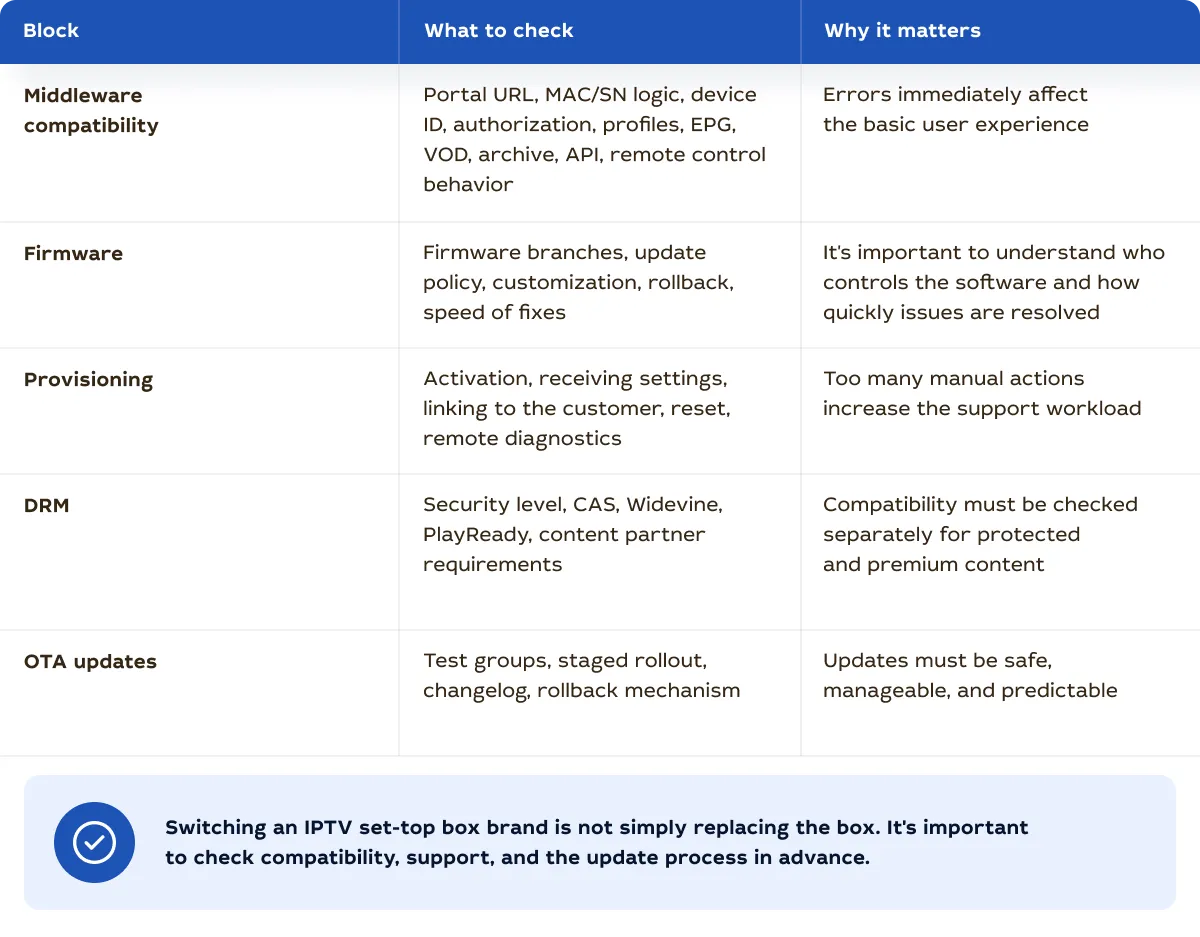
Switching an IPTV set-top box brand is not simply replacing the box. It's important to check compatibility, support, and the update process in advance.
Customer migration strategy
One of the most important questions is whether existing customers need to replace their devices. The answer is not always the same. In some projects, the new brand can be used only for new customers. In others, old and new devices work in parallel. Sometimes a gradual replacement of part of the device fleet is required.
This means that customer device migration must be a separate plan, not a side effect of purchasing. The reseller needs to determine which customers remain on the old brand, who is offered the new brand, who needs mandatory replacement, and which scenarios can be supported simultaneously.
Parallel use of two brands often reduces risks. Existing customers continue working on familiar devices, while new connections move to the new brand. This approach makes it possible to collect feedback, check support, and avoid a sharp increase in support requests.
But the dual-brand period requires discipline. The support team must have instructions for both brands, clear troubleshooting scenarios, a knowledge base, warranty information, and replacement rules. The sales team must also understand the differences so they do not promise customers features that have not yet been tested.
Communication with customers is especially important. If the interface, remote control, speed of operation, available applications, or activation process changes, the customer must learn about this in advance. A good reseller transition strategy reduces uncertainty and helps maintain trust.
Commercial and contractual terms of the new supplier
After the technical check, the commercial side needs to be assessed. A new brand may look attractive in terms of price, but the final model depends on the supplier’s terms.
The reseller should check MOQ, pricing model, distributor agreement, payment terms, lead time, warranty obligations, RMA, firmware customization terms, availability of documentation, and the possibility of technical escalation in advance.
Special attention should be paid to the reseller agreement terms. It's important to understand whether there are regional restrictions, volume requirements, exclusivity terms, branding rules, forecast requirements, and responsibilities of the parties in case of delivery delays.
The warranty model also affects the economics. Warranty model comparison should include the warranty period, RMA procedure, replacement timelines, diagnostic rules, packaging requirements, responsibility for shipping, and availability of spare devices.
If the supplier does not provide clear documentation, define SLA, or explain the after-sales procedure, some risks automatically move to the reseller. In the short term, this may not be noticeable, but as sales grow, the support workload will increase.
Inventory, logistics, and transition planning
Switching brands always affects inventory. A reseller may have remaining devices from the old brand, accessories, power supplies, remote controls, packaging, and warranty obligations. If the transition is not planned, there may be both a shortage of new devices and leftover old models at the same time.
Inventory transition planning should include sell-through of the old brand, a pilot batch of the new brand, separate SKUs, demand forecasting, and buffer stock. A large batch of the new brand should not be purchased before tests and support checks are completed.
It's also important to assess supply chain stability. If the new brand offers a good price but cannot confirm production times, delivery times, and repeat shipments, the commercial benefit may be limited.
Logistics also affects service. If RMA takes too much time, the reseller needs a stock of devices for quick replacement. If accessories are incompatible between brands, they also need to be considered in the inventory plan.
Support and after-sales: what changes after the transition
For the customer, the reseller remains the first line of responsibility. Even if the issue is related to firmware, defects, or manufacturer documentation, the customer usually contacts the company that sold the device.
Therefore, during the transition, it's essential to assess any support structure differences. It's necessary to understand how the new supplier handles technical requests, how quickly it responds, whether there is a partner portal, documentation, a knowledge base, training materials, and a clear escalation procedure.
SLA and RMA directly affect the reseller’s workload. If the supplier responds slowly or does not provide firmware fixes, the reseller’s support team will have to resolve issues manually. If documentation is weak, employee training will take more time.
Clear after-sales service expectations must be defined before sales begin: who is responsible for diagnostics, who confirms warranty cases, how replacement is processed, who pays for shipping, how mass firmware issues are handled, and what response times are considered acceptable.
Risks and common mistakes when switching brands
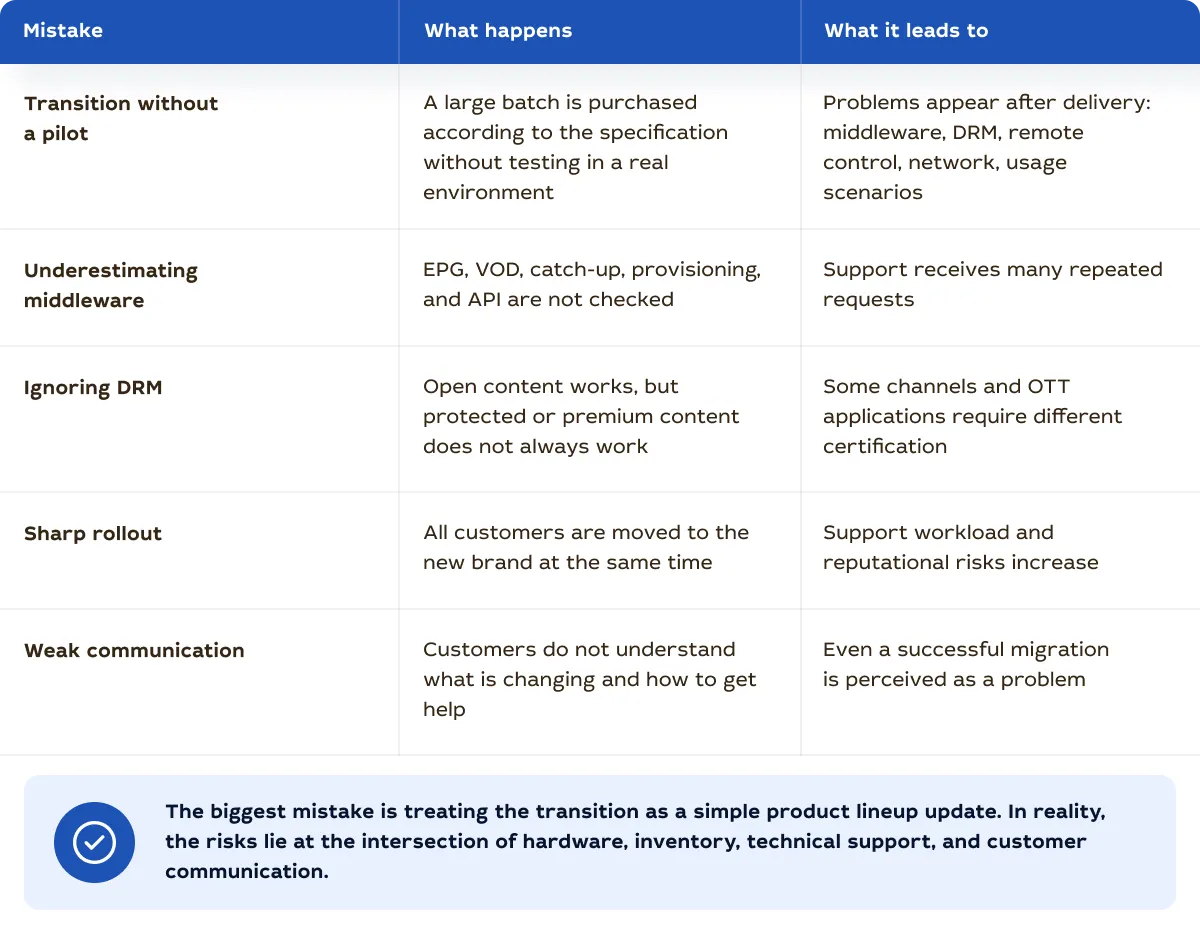
The main mistake is treating the transition as a simple product range update. In practice, IPTV reseller risks appear at the intersection of technology, inventory, support, and customer communication.
A common mistake is purchasing a large batch without a pilot. A device may look suitable according to the specification, but real issues appear only when it works with specific middleware, DRM, remote control, network, and user scenarios.
The second mistake is underestimating middleware integration requirements. If the reseller has not checked EPG, VOD, catch-up, provisioning, and API in advance, support may face a large number of repeated requests.
The third mistake is ignoring DRM. For open content, the device may work normally, but premium content, protected channels, or certain OTT applications may require another level of certification.
The fourth mistake is a sharp transition for all customers at once. Such a rollout increases support workload and creates reputational risks. It's better to start with a pilot, then connect new customers, and only after that plan migration of the existing base.
The fifth mistake is weak communication. Customers must understand what is changing, why it's needed, and how to get help. Without this, even a technically successful migration may be perceived as a problem.
Main mistakes when switching to a new IPTV set-top box brand
Quick table for resellers
Migration checklist for resellers
Before scaling the transition to new user devices, the reseller should go through a practical checklist.
1. Check IPTV middleware compatibility
2. Test set-top box IPTV firmware compatibility
3. Check DRM, CAS, and premium content requirements
4. Assess provisioning, activation, and remote management
5. Check OTA updates, staged rollout, and rollback
6. Compare commercial terms and contractual obligations
7. Define warranty, RMA, and support workflow
8. Plan remaining old-brand stock and a pilot batch of the new brand
9. Prepare instructions for sales and support teams
10. Inform existing customers about possible changes
11. Launch a pilot deployment
12. Evaluate pilot results before mass rollout
When switching to a new brand may not be necessary
While this may be an IPTV reseller guide to switching to a new set-top box brand, it's important to note that a change is not always justified. If the current supplier meets customer requirements, provides stable deliveries, supports the required middleware, releases updates, and fulfills warranty obligations, the transition may create more risks than benefits.
The switch may also be impractical if the customer base is stable, there are no technical limitations, and the potential savings on the device do not cover the costs of integration, training, inventory restructuring, and support.
In this situation, it's better to start with an audit of the current model: what is the reseller not satisfied with, whether the problem can be solved with the existing supplier, and which requirements are truly critical for customers.
Switching to a new IPTV set-top box brand may be useful if the current supplier no longer meets technical, commercial, or operational requirements. But this is not a simple product range update: the reseller needs to check middleware, firmware, DRM, provisioning, OTA updates, warranty, inventory, and support in advance.
The optimal approach is to start with an audit, conduct pilot testing, assess commercial terms, and only then scale the transition. This way, the reseller reduces risks, preserves customer trust, and prepares the business for stable work with a new supplier.
FAQ
1. Is it difficult to switch to another IPTV set-top box brand?
The difficulty depends on middleware, DRM, provisioning, firmware, and the customer base. If the new brand is tested in advance and the transition goes through a pilot, risks can be reduced. Without compatibility checks, the transition may lead to technical failures and an increase in support requests.
2. Will existing customers need to replace their devices?
Not always. Often, the new brand can be used for new connections, while existing customers remain on their current devices. Replacement is needed if old set-top boxes do not support required functions, middleware, DRM, or service requirements.
3. How can compatibility be checked before the transition?
Laboratory testing and a pilot are required. Middleware, provisioning, DRM, OTA updates, VOD, EPG, TV archive, remote control, network, logs, and remote diagnostics are checked. After that, a decision on scaling can be made.
4. What are the main risks for the reseller?
The main IPTV reseller risks are middleware incompatibility, firmware issues, lack of DRM support, delivery delays, weak RMA, increased support workload, and poor customer communication.
5. How long does the transition usually take?
The timeframe to switch IPTV set-top box brand depends on the scale of the customer base, integration complexity, and supplier terms. A small pilot can be conducted relatively quickly, but a full transition with inventory, support, documentation, and customer migration requires phased planning.
Recommended
How to Expand an IPTV Platform to Web, Android, iOS, and Smart TV
For an IPTV operator, launching a service on just one type of device is rarely enough anymore. With users now watching linear channels on a TV, viewing content on a smartphone, opening catch-up content in a browser, or using an IPTV set-top box as the main screen at home, expanding a service across multiple client platforms is not simply a matter of releasing additional apps.
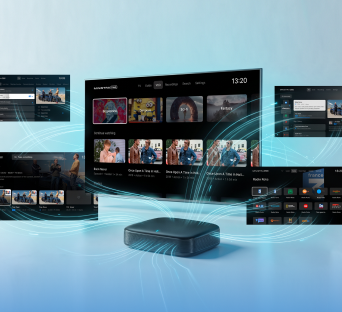
All Content in One Service: Live TV, VoD, Radio, Archive, TimeShift, and EPG in Ministra PRO
A television service has long been more than just a list of channels. Viewers now want to watch live broadcasts, return to a missed program, pause a show, schedule recordings of individual episodes or an entire series using nPVR, or choose a movie from a catalog. At the same time, all these capabilities should feel like parts of a single media environment rather than separate systems.

IPTV and the Modernization of Hospital Digital Infrastructure
Because hospitals operate around the clock, it's essential that their digital infrastructure supports stable departmental operations, data security, internal communications, and patient comfort. As a result, a hospital’s digital infrastructure requires a stricter approach than the infrastructure of a hotel, office, or residential complex.