


Product request
You are looking for a solution:

Select an option, and we will develop the best offer
for you


What is Ministra PRO: how an IPTV/OTT platform helps operators manage their service, devices, and subscriber experience
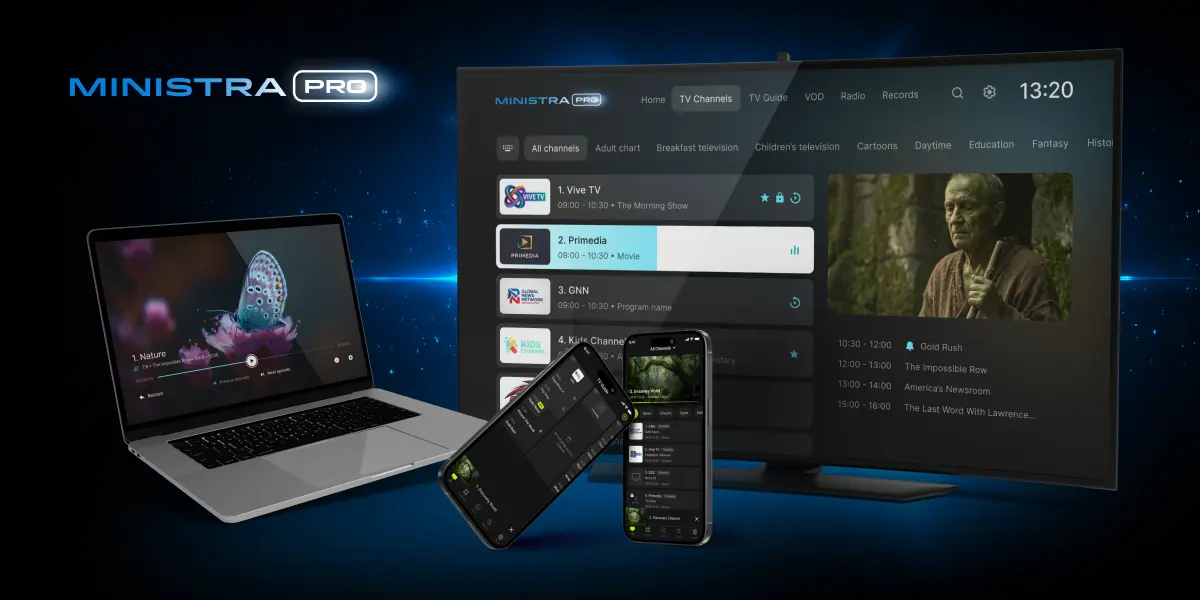
When an operator, internet service provider, system integrator, or hotel chain plans to launch a video service, the first question asked about the project usually sounds simple: “Which devices will the TV service work on?”
In practice of course, things are far more complicated. Yes, it's now essential to be able to play a stream on a number of different devices, including a TV or set top box, but the entire service also needs to be properly managed. This involves the channels, the program schedule, access rights, tariffs, recordings, rights-based restrictions, service quality, and user support.
Ministra PRO is not a standalone video player or a content catalog, it's middleware for an IPTV/OTT service that helps operators manage television, video on demand, applications, subscriber packages, and the user interface from a single environment.
For a potential customer, the main value of the platform lies not in its extensive IPTV/OTT middleware features, but in its ability to reduce operational complexity. The more screens, packages, partners, and content rights there are, the harder it becomes to maintain a stable service manually.
Middleware is the layer that connects content, the network, applications, billing, devices, and support into a manageable system.
What is middleware in IPTV/OTT, and why does an operator need it?
In IPTV/OTT, middleware can be compared to the control center of a video service. Content may come from different sources, subscribers may use different devices, and the commercial model may include subscriptions, paid movies, advertising-supported channels, or hotel-specific scenarios. Without an intermediate management layer, all these elements are difficult to synchronize.
Middleware for streaming platforms determines which channels a subscriber can see, which movies are available in their package, what the home screen looks like, how the TV guide works, which regional or age-based restrictions apply, whether users can pause live TV, record a program, or access the service on a second device.
The use of IPTV middleware for operators is especially important in three situations. The first is launching a new video service from scratch. The second is modernizing outdated IPTV platform software that worked well on set-top boxes but no longer meets the expectations of Smart TV and mobile users, and the third is scaling, when the service already exists but the number of subscribers, partners, tariffs, and integrations is growing.
What is Ministra PRO in simple terms?
Ministra PRO is a platform for managing an IPTV/OTT service, designed for operator-level use cases. It helps organize linear television, video on demand, the TV guide, time-shifted viewing, network recording, parental control, access management, analytics, and application operation across different devices.
An important feature is its focus on cross-platform support. Ministra PRO middleware supports applications and interfaces for iOS, tvOS, Android TV, Fire TV, LG webOS and Samsung Tizen TVs, Roku TV, Web Player, and Android devices. This means an operator can build a service around the subscriber and the screens they already use, rather than a single set-top box.
At the same time, Ministra PRO remains an operator-grade platform. It does not replace the rights holder, CDN, billing system, or access network, but connects them into a working service for the end user. That's why it shouldn't be viewed as a TV viewing app, but as the foundation for managing a commercial video service.
Who is the platform designed for?
For an IPTV/OTT operator, Ministra PRO is useful as a single point of service management. Operators need to quickly add channels, manage the program schedule, control packages, launch new monetization models, and see how subscribers actually use the service.
For an internet service provider, an IPTV middleware platform can become a way to increase the value of its core service. Home internet is often perceived as a commodity with strong price competition. A video service helps expand the offer, improve customer retention, and create an “internet plus television” package without the need to develop the entire ecosystem independently.
For hotels, the scenario is different: guests need a clear interface on the in-room screen, while the hotel needs manageability, branding, a hospitality-focused experience, access restrictions, and the ability to display informational or entertainment materials. Ministra PRO settings include parameters related to language, the start screen, the number of sessions, geo-restrictions, and hospitality mode.
For system integrators, the value in middleware for system integrators lies in the fact that the platform covers a significant part of typical project tasks: client applications, content management, staff roles, integrations, monitoring, the TV guide, and interaction with subscriber devices. This reduces the amount of custom development and makes the project more predictable during implementation.
Why Cross-Platform Support Has Become Critical
In the past, an IPTV service was often built around an operator-provided set-top box, giving the operator control over the device but limited flexibility. Today, users expect the same service to work on the TV in the living room, on a phone, tablet, set-top box, in a browser, and sometimes on a hotel screen.
The market confirms this shift to cross platform IPTV. According to PwC’s forecast, total consumer spending on IPTV/OTT video and pay TV will grow from $291.3 billion in 2024 to $318.5 billion in 2029, while in 2027, OTT video revenue will exceed traditional pay TV revenue for the first time.
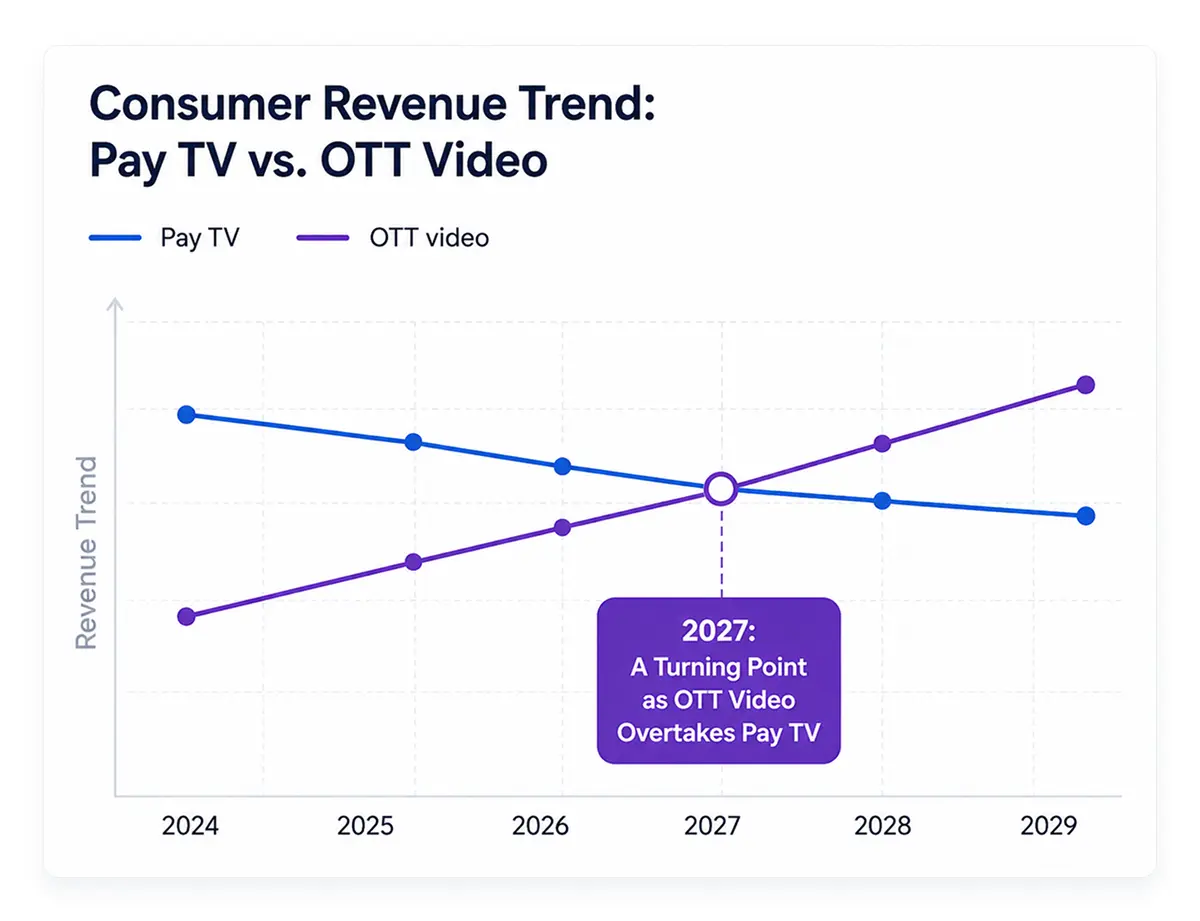
For the operator, this means that the service must be technically available on different devices, but also look recognizable, stable, and logical everywhere. Users don't want to learn the product again when switching from a TV to a smartphone. This is also important for sales, as a potential customer evaluates not the availability of an app, but the completeness of the subscriber experience.
What the subscriber gets: television, recording, search, and viewing control
From the end user’s perspective, the value of Ministra PRO is reflected in familiar viewing scenarios. Users open the home screen and see channels, the TV guide, video on demand, favorites, recommendations, or the sections that the operator considers a priority. The home screen can be customized to display TV channels, the TV guide, VOD, radio, search, and other sections.
Linear television on the platform is not limited to watching content “here and now.” The feature description includes program recording, TimeShift, Catch-UP, and nPVR. nPVR recordings remain available for as long as the user wants.
The main limitation is the amount of available recording storage, which is defined by the tariff plan. There is also support for notifications about favorite programs, favorite channels, program filtering, subtitles, and switching audio tracks. This is important because modern viewers no longer perceive TV as a fully linear experience.
Video on demand gives the operator the ability to offer movies and series under different commercial models: by subscription or as a one-time paid purchase. For the subscriber, this is a familiar logic, allowing them to open a movie, watch a trailer, continue playback from where they stopped, choose audio or subtitles, and have playback quality adapt to the available bandwidth.
EPG: Why It Is Not a Secondary Feature
The electronic program guide is often underestimated at the platform selection stage, but for live TV it's one of the key elements of the streaming service infrastructure and user experience. If the TV guide is incomplete, outdated, or incorrectly linked to channels, it becomes difficult for subscribers to find a program, set a reminder, or use the archive.
As an OTT middleware solution, Ministra PRO includes aggregation, validation, and monitoring of EPG providers. The platform allows operators to connect multiple sources in XMLTV format, check data before applying it, monitor source quality, and match channels with programs. This reduces the risk of a situation where an error in the program guide becomes a large-scale support issue.
For the operator, this is also about cost. The more accurate the EPG is and the less manual work required to match channels, the lower the load on the technical team. And if the service includes catch-up, recording, or archive functionality, the quality of the TV guide directly affects the correctness of these features.
On-Premise Stability: Why Local Deployment Remains in Demand
Despite the popularity of cloud solutions, operators and hospitality projects often still need local deployment. There are practical reasons for this, including control over infrastructure, data requirements, network specifics, predictable latency, internal security policies, and dependence on external communication channels.
The on-premise approach is especially important for internet service providers and operators with their own networks. If the main audience is within a managed network, it makes sense to keep critical service components closer to subscribers and the technical team. This helps control availability, updates, integrations, and system behavior during peak loads.
For hotels and closed environments, local middleware stability also matters. The in-room video service should not depend on external factors more than necessary. When a guest turns on the TV, the interface should open quickly, and basic functions should be available predictably.
Rights Management, DRM, and Blackout: Content Protection Without Unnecessary Complexity
For rights holders and operators, content protection is not an additional option, but a requirement for operation. If the service includes premium channels, movies, sports, or regional rights, the platform must support access control, encryption, and playback restrictions.
Ministra PRO supports Multi-DRM: Widevine, FairPlay, and PlayReady. This covers the key device ecosystems and helps operators work with protected content across different screens.
A separate scenario is blackout management, meaning the management of restrictions on catch-up, archive, rewind, or replay for specific programs and time intervals. This is especially relevant for sports, premium, and regionally licensed content. The platform allows operators to configure restrictions and thereby block playback of specified programs.
Monetization: Subscription, Pay-Per-View, Advertising, and the Partner Model
An operator-run video service rarely relies on just one revenue model. A single project may combine a basic subscription, premium packages, a one-time movie purchase, advertising-supported channels, and partner offers. That's why middleware must do more than simply display content – it must connect access to commercial rules.
Ministra PRO includes VOD models, including subscription-based access, as well as billing integration via API. This makes it possible to synchronize purchases, payments, subscription status, and access to content without manual intervention by the operator.
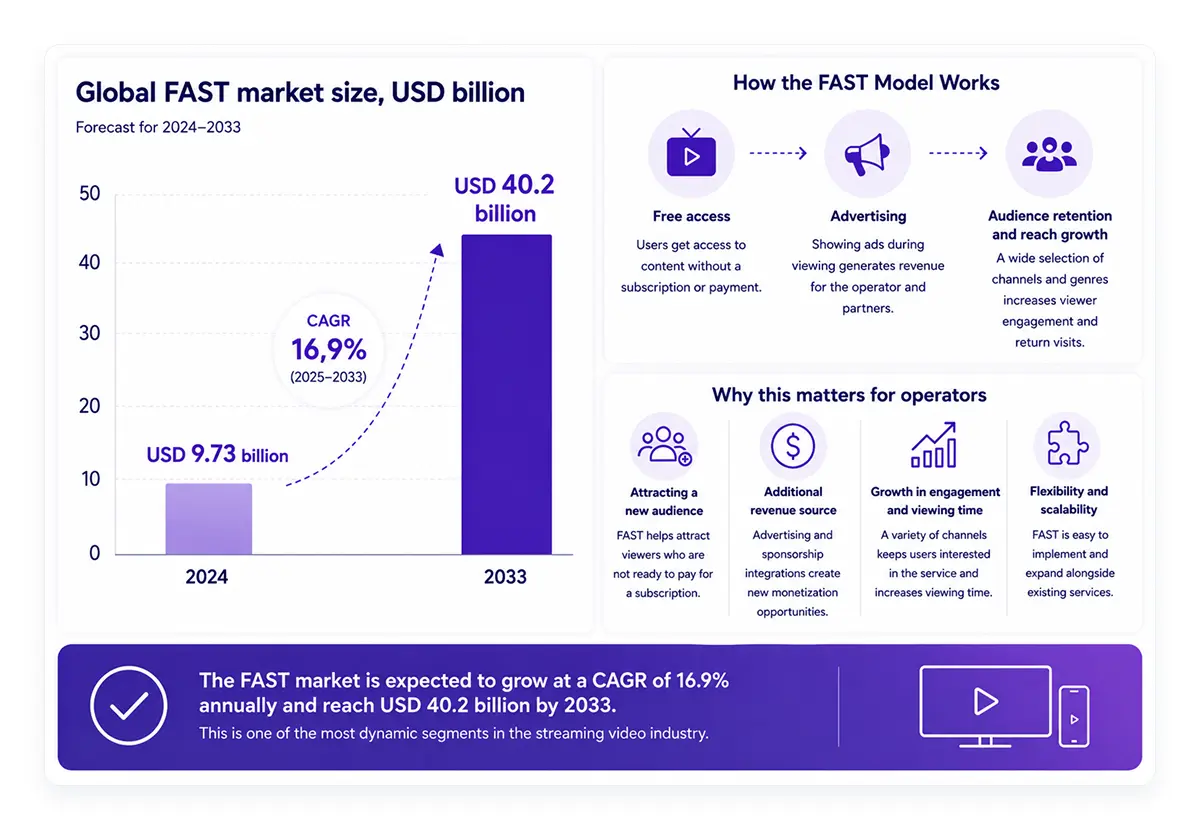
FAST – free ad-supported streaming television channels – are worth noting separately. This format is growing rapidly, with Grand View Research estimating the global FAST market at $9.73 billion in 2024 and forecasting growth to $40.20 billion by 2033, at a compound annual growth rate of 16.9% in 2025–2033.
Analytics and Monitoring: What You Need to Know Before a Subscriber Complaint
In a mature video service, an operator needs to understand not only how many subscribers are connected, but also how they watch content. In other words, knowing which channels are popular, where interest is declining, which devices generate more support requests, and how the load changes during peak hours.
Ministra PRO includes statistics and monitoring, such as tracking the popularity of TV channels, VOD, and recordings, monitoring the status of components, performance metrics, and problem notifications. EPG analytics is also highlighted separately, helping operators see TV guide coverage, age ratings, categories, episodes, genres, subtitles, and other metadata.
For sales and product development teams, this is an important layer of argumentation. Decisions about new packages, promotions, content acquisition, or removing unpopular items should be based not only on intuition, but also on the actual behavior of the audience.
Roles, Support, and Operational Security
When a video service is managed not by one person but by a team, the question of access arises. Technical support needs to see subscriber data, but doesn't always need to change service settings. Marketing may need analytics, but not infrastructure management. An administrator should have full access, but their actions must be deliberate and controlled.
Ministra PRO includes role management, so a technical support employee can view subscriber information but not modify it. This reduces the risk of errors and helps separate areas of responsibility within the team.
This is particularly helpful for system integrators and operators with several departments. The more people involved in operations, the greater the value of a clear permissions system. And while it doesn't replace security policies, it does make day-to-day work far more orderly.
Integrations: Billing, Video Stream Providers, and Third-Party Systems
An IPTV/OTT platform rarely operates in isolation. The operator may already have billing, CRM, a payment system, CDN, stream providers, advertising infrastructure, a TV guide, and subscriber support. That's why the question of integrations is often more important than a single interface feature.
Ministra PRO includes a Billing API and integrations with external solutions, including Movie Database, ChargeBee, Flussonic, Wowza, Nimble, Sonar Billing, and BuyDRM. This shows that the platform is designed to operate as part of a broader technical ecosystem, rather than as a completely closed product.
At the selection stage, it's vital for the customer to describe in advance which systems are already in use and what data should be exchanged between them. For example, billing must understand the subscription status, the platform must apply access rights, and the support team must see enough information to resolve a request without escalating it to developers.
Use in Hotels: More Than Just In-Room TV
For the hospitality business, an IPTV/OTT platform solves a different task. Here, it's important both to provide guests with channels and make the screen part of the hotel service. Ministra Pro can be used as a hotel IPTV middleware solution, with a welcome screen, language settings, informational sections, access to entertainment, restrictions for certain types of content, and centralized management.
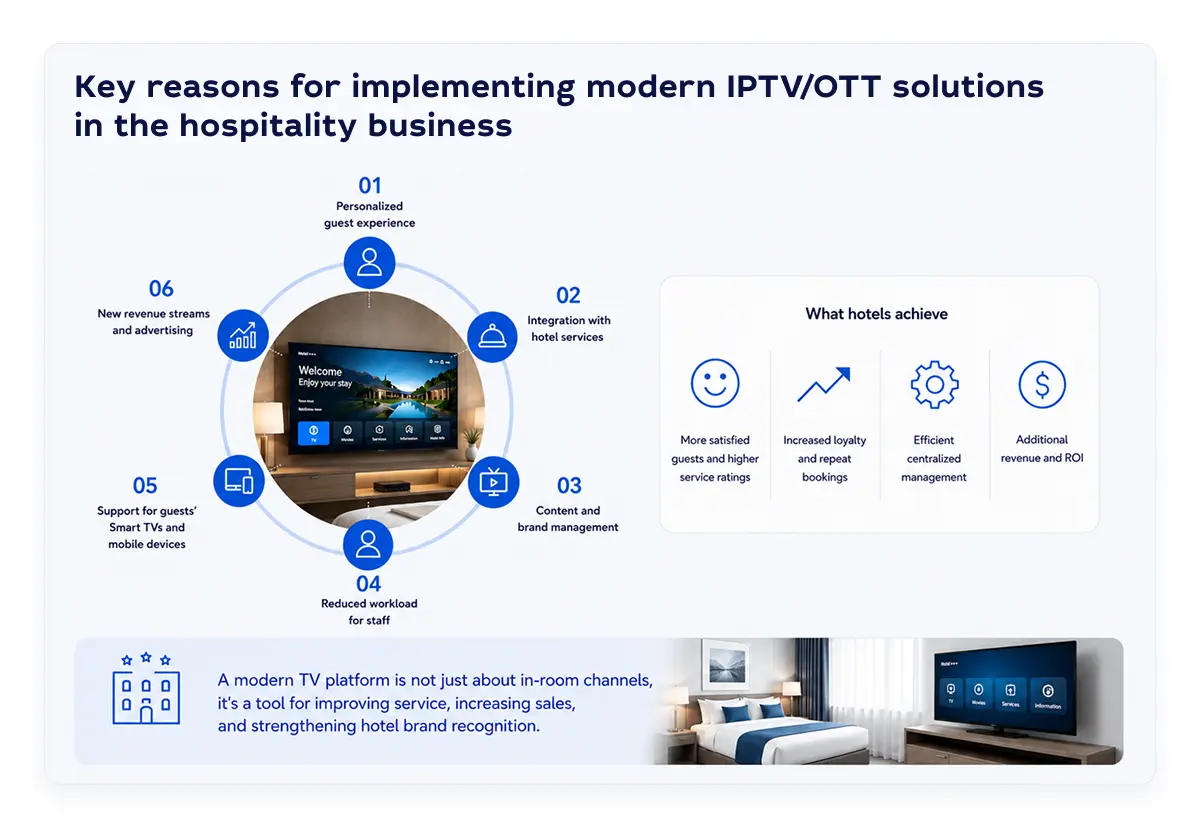
The hotel IPTV systems market is also growing. WiseGuyReports forecasts a compound annual growth rate of 6.3% for the Hotel IPTV System segment in 2025–2035, linking this growth to demand for a personalized guest experience and the digitalization of hotel services.
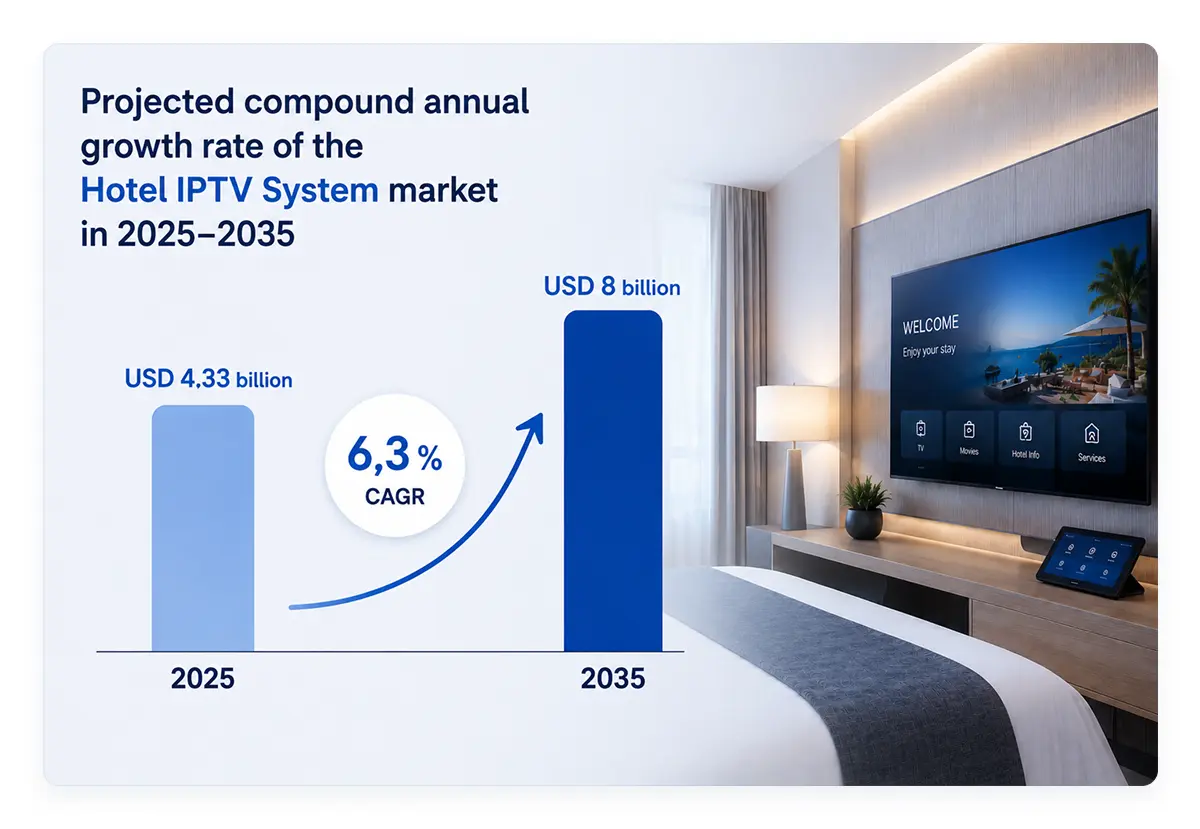
For a hotel, interface simplicity and predictability are especially important. Guests should not have to deal with technical settings, but instead expect to turn on the screen and immediately understand where to find TV channels, hotel information, language options, entertainment, and basic services.
Frequently Asked Customer Questions at the Selection Stage
1. Can Ministra PRO be used without proprietary content?
Technically, the platform is responsible for ITV/OTT service management, but it's not a source of content. Channels, movies, rights, advertising agreements, and regional restrictions remain the responsibility of the operator or content provider.
2. Does the platform replace billing?
No, it's more accurate to view it as a layer that can integrate with billing. This is key because many operators already have a financial system and the task is not to replace the entire stack, but to correctly synchronize subscriptions and access rights.
3. Is an operator-provided set-top box required?
Not always. Cross-platform support makes it possible to work on different devices, but in some projects a set-top box remains a convenient solution e.g. for a managed network, a hotel, older TVs, or customers who need a predictable hardware package. Infomir offers such devices: MAG PRO set-top boxes running Linux, with support for 4K HDR, HEVC, Ethernet and Wi-Fi, integration with Ministra PRO, and CAS/DRM support.
4. What is the most difficult part of implementation?
Usually, it's not installing the interface, but preparing the entire ecosystem, including content rights, streams, EPG, billing, devices, support scenarios, load testing, and access rules. That's why, when evaluating a project, it's recommended to look not only at the list of features, but also at the operator’s readiness to operate the service.
How to Evaluate Ministra PRO Before Implementation
Before choosing a platform for your IPTV deployment, it's useful to define several practical criteria. Which devices must be supported on day one? Are Smart TV apps, mobile apps, a web player, set-top boxes, or hotel screens required? Which monetization models are planned: subscription, packages, one-time purchases, advertising, or a partner network?
Next, it's worth checking the content side: how many TV channels will be included in the service, whether there are multiple EPG providers, and whether archive functionality, recording, blackout restrictions, subtitles, multiple audio tracks, and DRM protection are needed. The more legal and technical conditions there are around the content, the more important manageability becomes.
Finally, the operational side needs to be assessed. Who will administer the platform, who will be responsible for subscriber support, how will billing be connected, which reports are needed by management, where the system will be hosted, and what availability requirements are considered acceptable.
Ministra PRO should be viewed as an operator-grade foundation for an IPTV/OTT service, rather than as a standalone application for watching video and multiscreen streaming. Its value becomes clear when different devices, linear TV, VOD, the TV guide, recording, DRM, billing, analytics, staff roles, and local stability need to be connected into a single manageable system.
For operators, internet service providers, hotels, and system integrators, a stable IPTV backend system is especially important at the stage when a video service is launched, as well as ensuring that it operates reliably, scales, and remains clear and easy to use for subscribers.
Recommended
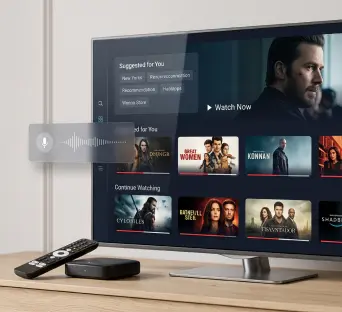
Interactive TV Trends on Google TV: What to Know in 2027
When choosing a television platform for 2027, businesses need to assess more than picture quality and the app selection. Equally important considerations are how viewers will find content, what capabilities the operator will have, and how predictably the equipment will perform after updates.
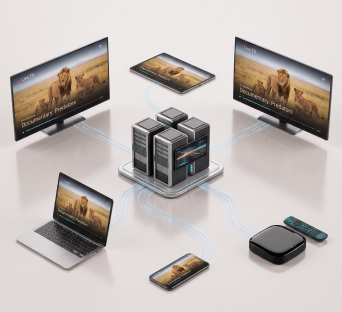
How to Expand an IPTV Platform to Web, Android, iOS, and Smart TV
For an IPTV operator, launching a service on just one type of device is rarely enough anymore. With users now watching linear channels on a TV, viewing content on a smartphone, opening catch-up content in a browser, or using an IPTV set-top box as the main screen at home, expanding a service across multiple client platforms is not simply a matter of releasing additional apps.
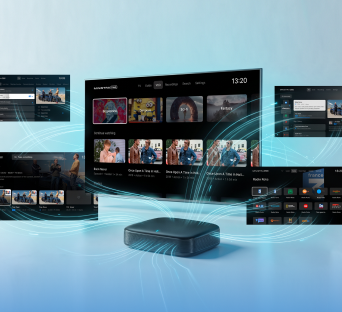
All Content in One Service: Live TV, VoD, Radio, Archive, TimeShift, and EPG in Ministra PRO
A television service has long been more than just a list of channels. Viewers now want to watch live broadcasts, return to a missed program, pause a show, schedule recordings of individual episodes or an entire series using nPVR, or choose a movie from a catalog. At the same time, all these capabilities should feel like parts of a single media environment rather than separate systems.