


Product request
You are looking for a solution:

Select an option, and we will develop the best offer
for you


DRM, Watermarking and Anti-Piracy in IPTV/OTT: What Operators Need to Protect in 2027

An operator acquired the rights to a sports broadcast, implemented DRM and limited concurrent streams. Yet during the match, its feed appeared on a third-party service. This does not necessarily mean the encryption was broken: the source could have been an authorised session from which video was captured and redistributed.
Preparing an IPTV/OTT project for 2027 requires protection across the entire service delivery chain: access rights, stream delivery, device playback and the response to content leaks. DRM, forensic watermarking and pirate stream monitoring address different challenges. Their effectiveness depends on how well they work together.
This article examines practical selection criteria based on data and technical documentation available as of November 2026. Specific requirements depend on the service architecture and the conditions set by rights holders.
What to Protect: Content, Access and Infrastructure
For live broadcasts, the event itself is the critical window. Stopping an illegal stream after the final whistle does not restore the operator’s viewing exclusivity. For VOD, key priorities include protecting content before release, preventing access to unprotected copies and being able to trace the source of a leak.
Protecting access is a separate task. A stolen account or incorrectly granted entitlements can allow someone to use the service as if they were a legitimate subscriber. Video encryption does not replace subscription checks, device management or active session control.
Delivery infrastructure also needs protection. If unauthorised users retrieve media data from the operator’s servers, the company may end up paying for their traffic. Even when a stream is encrypted and cannot be viewed without a DRM licence, uncontrolled downloads create load and costs.
Piracy consumption remains substantial. According to MUSO, tracked piracy websites received 185.6 billion visits in 2025, down 14.2% from the previous year. Television remained the largest category in the study. These figures describe web traffic: they do not represent unique viewers, illegal IPTV subscriptions or lost sales.
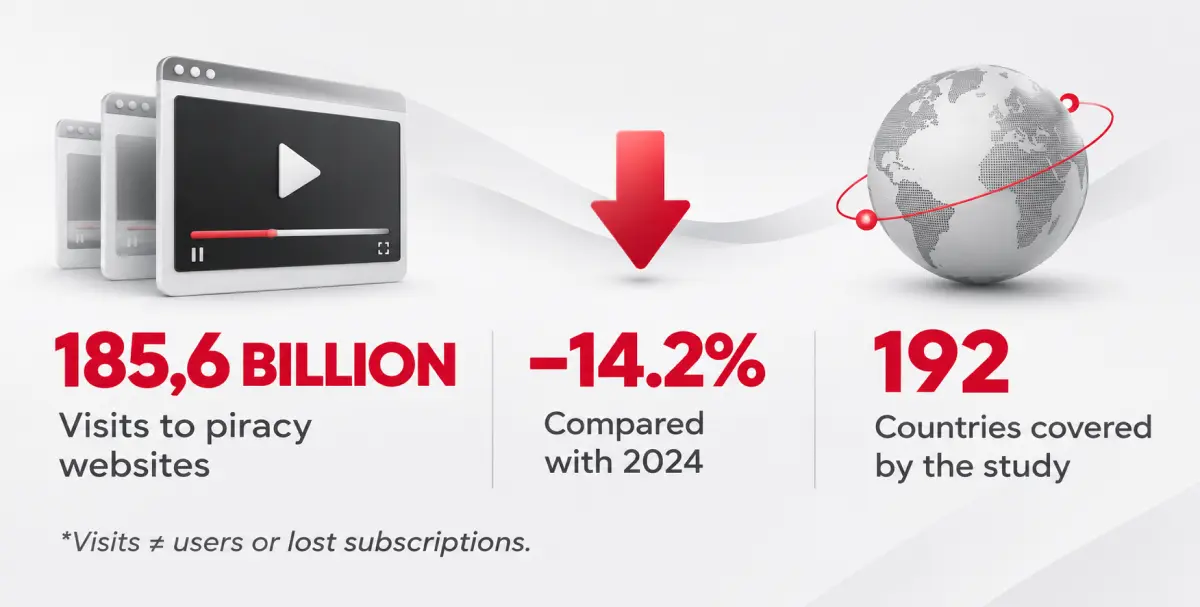
Piracy Web Traffic in 2025
DRM: Controlling Playback on Specific Devices
The protection architecture depends on the delivery method. Managed IPTV networks, including multicast deployments, may use conditional access systems (CAS). OTT services use DRM technologies supported by their client platforms. A hybrid operator needs to align these mechanisms with its overall subscriber entitlement management system. Solutions are available that combine CAS and DRM management across multiple network types.
DRM manages licences and the conditions under which encrypted content can be played. Obtaining media data is not enough: the client needs a valid licence that permits the use of keys in accordance with the defined policy.
In a multiscreen service, the required DRM technologies depend on the device base. Widevine is used on Android and other compatible platforms, FairPlay Streaming provides protected delivery over HLS on Apple platforms, and PlayReady is used on supported devices and in supported software environments. Multi-DRM helps serve different client platforms; the number of DRM technologies deployed is not, in itself, a measure of protection strength.
When purchasing set-top boxes, a claim that a device “supports DRM” is not enough. The specific model, firmware, application, security level and ability to play the required content must be verified. For example, PlayReady SL3000 provides hardware-backed protection using a trusted execution environment (TEE). The licence server can take the client’s security level into account when granting access.
Playing an unencrypted 4K clip does not demonstrate support for protected UHD playback. The operating system name–Linux or Google TV–does not replace testing either. The entire chain must be checked, including the video output, HDCP requirements, television and any intermediate HDMI devices. The required protection measures depend on the terms governing the particular content.
Watermarking: Tracing the Source of a Leak
Even protected video ultimately becomes an image on a screen. DRM makes unauthorised acquisition and use of content more difficult, but it does not provide absolute protection against re-recording.
Invisible forensic watermarking is one method used to trace content leaks. An identifying mark is embedded in the video and designed to remain imperceptible during normal viewing. Depending on the implementation, it may identify a session, a device or a particular copy of the content. For example, the server-side NexGuard Streaming solution supports session-specific watermarking for live and VOD streams.
Unlike a channel logo, this mark helps link a discovered copy to the source from which it was delivered. However, watermarking alone does not stop retransmission. The copy must first be found, the identifier extracted and matched against service records, and a response then selected.
When evaluating a solution, check how much footage is needed to identify the watermark, how quickly results are returned and what happens after transcoding, cropping or changes in resolution. Robustness cannot be assumed to be the same across products: it must be verified against agreed test scenarios.
A session identifier supports an investigation, but it does not automatically establish the identity of the person responsible for retransmission. The account holder’s access may have been compromised. Findings should therefore be cross-checked against authentication, licence issuance and stream delivery logs.
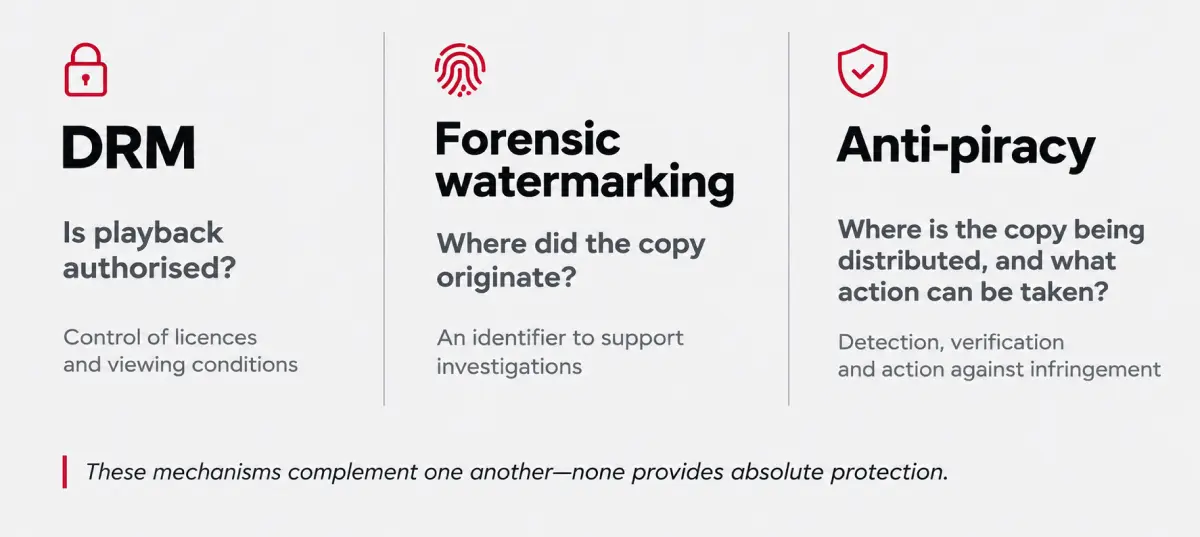
Three Functions of Content Protection
Anti-Piracy: Responding While the Event Is Still Live
Anti-piracy covers the prevention, detection and disruption of illegal content distribution. Its operational activities include monitoring, verification of infringements and response: from restricting the source within the operator’s own service to contacting platforms and hosting providers or taking legal action.
For live content, speed matters across the entire response chain. Finding an illegal stream quickly is not enough if verification and approval take several hours. Before a broadcast starts, operators need to establish who confirms an infringement, what evidence is retained and which actions the responsible staff are authorised to take.
According to an EUIPO summary, more than 27 million notices were sent to intermediaries during monitoring conducted from January 2024 to June 2025. Around 11% resulted in the suspension of illegal retransmissions while the event was still taking place. This is an aggregate result from a specific monitoring exercise, not a universal measure of anti-piracy service effectiveness.
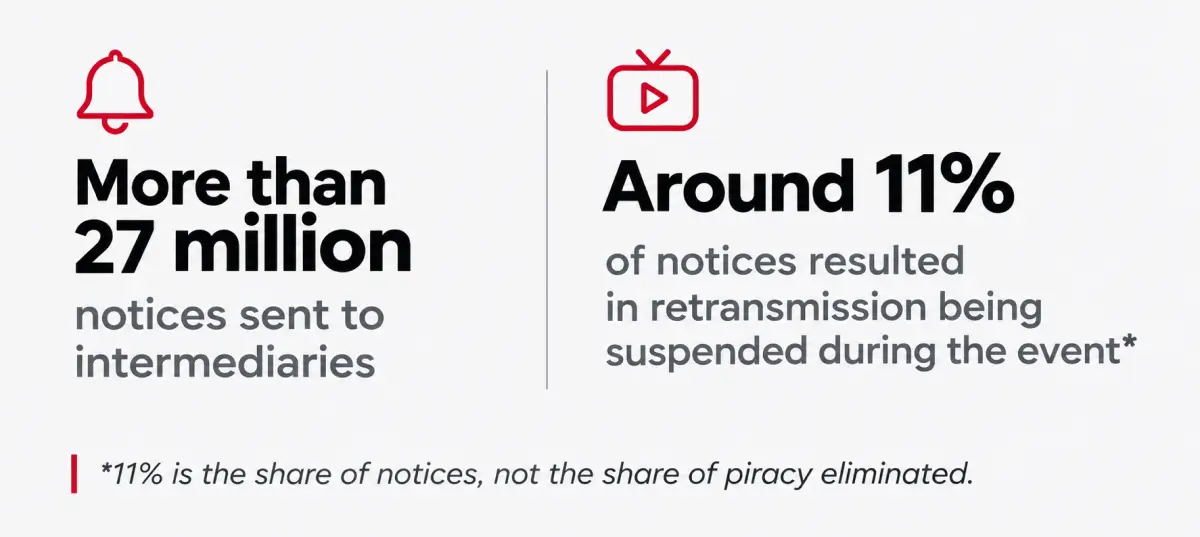
Responding to Pirate Streams
Operators should measure the time needed to restrict a source within their own system separately from the time needed to stop an external retransmission. In the first case, they control their own access mechanisms; in the second, the outcome also depends on third parties. The number of notices sent indicates the volume of work, but it does not replace verification that the infringement has actually stopped.
Connecting Content Protection with Access Management
Successfully signing in to an application does not mean a user is entitled to watch every channel. Access decisions must account for the subscription, specific content, permitted territories and viewing windows. These checks should be linked to DRM licence issuance.
Signed URLs or cookies are used to restrict access to files delivered through a CDN. They do not replace DRM. A signed link can generally be used by anyone who possesses it, subject to its expiry time and other specified conditions, so the parameters governing its issuance require separate configuration.
Direct access to the origin–the source content server–must also be restricted. Otherwise, users may bypass the CDN’s delivery controls. For an encrypted stream, this bypass does not itself provide decryption keys, but it allows media data to be retrieved outside the intended access path. AWS explicitly recommends protecting the origin against this type of bypass.
For investigations, it is useful to correlate the account, device, session, viewing entitlement and licence request. This enables targeted restrictions on a confirmed source of a leak.
However, blocking new licences does not necessarily stop playback immediately under a licence that has already been issued. The delay depends on licensing policies, key rotation, delivery controls and client behaviour. PlayReady documentation, for example, separately addresses persistent licences, expiry during playback and short-duration licences for stream control.
Promises of “instant disconnection” must therefore be tested in the deployed configuration. Rules for detecting suspicious activity must also account for the site’s circumstances: a single public IP address may serve many legitimate viewers in a hotel or on a vessel.
Considerations for Hotels, Vessels and Regulated Networks
In hotels, operator-provided channel access must be kept separate from guests’ personal accounts. At checkout, the relevant sessions should be confirmed as terminated, credentials cleared and casting pairings reset. These functions cannot be assumed to come automatically with every set-top box: the outcome depends on the applications and integration with the hotel system.
For maritime deployments, unreliable external connectivity is a critical scenario. Before equipment is selected, the parties need to agree on support for local storage and offline playback, licence validity periods and behaviour after connectivity is restored. A local server alone does not establish either the right to show content in this way or the technical viability of the arrangement.
In regulated networks, requirements for server location, external connections and software updates depend on the jurisdiction and the project. These restrictions must be clarified before selecting a protection platform.
A closed network reduces some external risks, but it does not rule out a leak through a user device. Distribution rights, protection architecture and actual operating conditions should all be checked for each deployment.
What to Verify Before Procurement and Launch
A pilot should reproduce the intended operating environment: actual protected streams, production-model set-top boxes, production versions of applications, typical televisions and network restrictions. Integrators need component compatibility and clearly defined supplier responsibilities; distributors need consistent results across subsequent equipment batches.
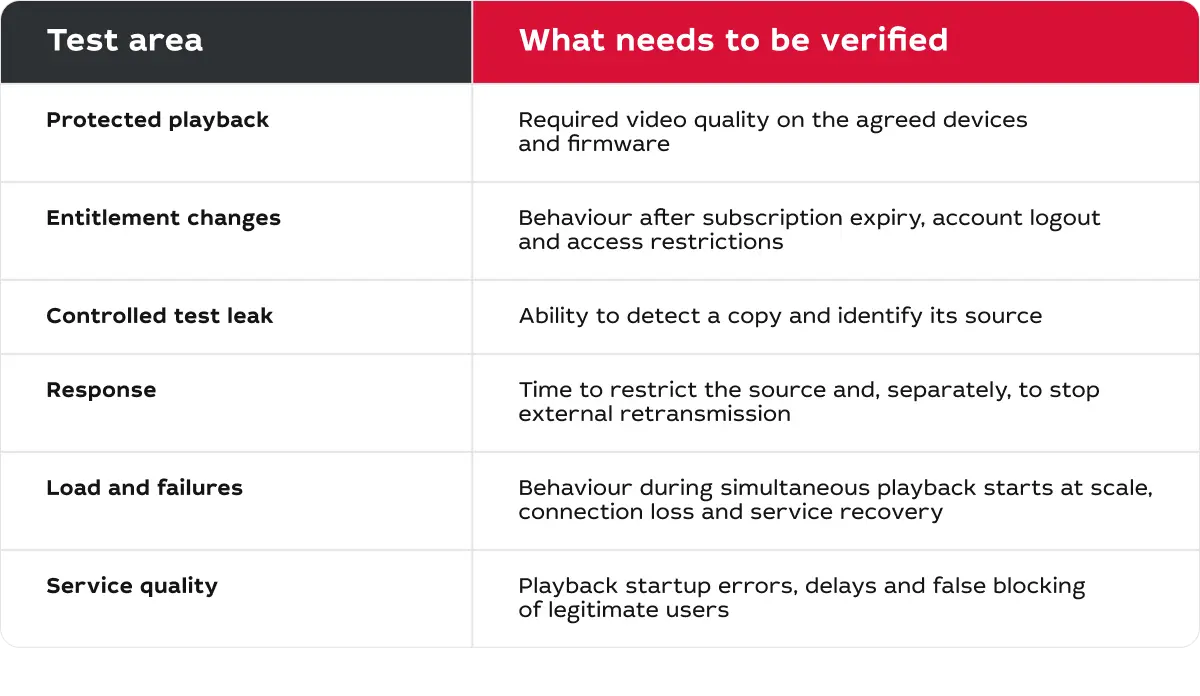
Acceptance criteria should be agreed in advance. For watermarking, these may include extraction time and the rate of successful identification under specified conditions. For DRM, they may include licence issuance and playback startup success rates. For monitoring and response, they may include the time needed to confirm an infringement and the actual outcome of the measures taken.
Project costs should include integration, licensing operations, watermarking and detection, monitoring, support during events and device updates. The set-top box support period and the procedure to follow when security updates end should be agreed separately. MovieLabs ECP provides for client updates and revocation, as well as the ability to restrict content for devices that no longer receive necessary security updates. The applicability of these measures depends on the requirements of the project and the rights holders.
When planning for 2027, operators should assess protection as an operational process: grant access to legitimate users, make leaks more difficult, trace their source and respond in time. Content requirements, testing on real equipment and measurable results should guide selection. A reliable system protects the interests of rights holders and operators while maintaining a predictable viewing experience for legitimate subscribers.
FAQ
Is DRM enough to stop IPTV piracy?
No. DRM stops unauthorised devices from playing a stream, but it cannot follow content after decryption. Live content also needs watermarking to trace leaks and fast enforcement to remove pirate streams.
What is forensic watermarking and how does it differ from DRM?
Forensic watermarking embeds an invisible identifier into the video for each session, subscriber or device. DRM controls who may play content; watermarking shows who leaked it.
Why is live sports piracy so hard to stop?
Because the content loses value within hours. Only 6% of live-event infringements were acted upon within 30 minutes, so most pirate streams stay up for most of the event.
What does the EU recommendation on live event piracy require?
It is a Commission Recommendation: it sets expectations for rights holders, intermediaries and Member States. Its indicators cover the volume of unauthorised retransmission, prompt handling of notices, cooperation and the use of dynamic injunctions.
Which DRM systems should an operator's set-top boxes support?
The ones required by your rights holders and used by your middleware. MAG555 supports Widevine, and Infomir integrates other DRM and CAS systems on request.
How fast must pirate streams be taken down?
The Recommendation asks for prompt treatment of notices. In practice, for live events, minutes matter: a stream removed after the match has already caused the loss.
Recommended

Ministra PRO on Every Device: An Overview of the IPTV/OTT Ecosystem
A modern IPTV/OTT service should be available on more than just a set-top box in the living room. A single household may use a Smart TV, a television connected to a set-top box, smartphones, tablets, and a computer.

QoE vs QoS in IPTV: Why Operators Need More Than Network Monitoring
Every IPTV operator knows the situation: the network dashboard is green, packet loss is within acceptable limits, and latency looks normal–yet complaints keep coming in. Subscribers report that channels take too long to open, the picture freezes during a match, and the app feels sluggish.
IPTV Security: How Ministra PRO Protects Your IPTV Platform
The security of an IPTV service depends on more than protecting the video stream. A vulnerability in a server component can put platform availability, subscriber data, and content access management at risk. IPTV security therefore requires infrastructure updates, API protection, and playback controls working together.