


Product request
You are looking for a solution:

Select an option, and we will develop the best offer
for you


Building a Partner Network: How to Expand Middleware Presence Across Regions

For an IPTV operator, middleware has long since become more than just the technical core of a service. It's the layer through which the operator manages users, devices, tariffs, channels, VoD, EPG, access rights, events, billing integrations, and client applications.
Because of its extensive role within a service, expanding middleware into new regions rarely comes down to direct license sales alone. Growth more often happens through a partner network or program consisting of integrators, local distributors, software resellers, service companies, IPTV/OTT consultants, and providers of related infrastructure.
For those operators looking at how to build a partner network for IPTV and OTT middleware In 2026, this model is becoming particularly important. Because while the video services market is continuing to grow, it's also becoming more mature and competitive.
According to Omdia, the global number of online video subscriptions reached 2.24 billion by the end of 2025, while growth in 2026 is projected at 5.6%, noticeably slower than the previous year. This means that competition for subscribers will increasingly depend not only on the amount of available content, but also on service quality, deployment speed, local support, and the ability to adapt quickly to market requirements.
For middleware providers, this changes the approach to regional expansion. Simply having a product and a multilingual website is no longer enough. Vendors need to build a network of partners who understand the local market, know the operators, can integrate the solution into existing infrastructure, and are capable of supporting projects after deployment.
Why Middleware Is Difficult to Scale Through Direct Sales Alone
An IPTV/OTT platform is rarely sold as an off-the-shelf product. Even when middleware is ready for deployment, every project requires an assessment of the operator's infrastructure: signal sources, headend, CDN, billing, CRM, CAS/DRM, client devices, applications, access network, and monetization model.
In one region, an operator may need to launch a basic IPTV service on set-top boxes quickly. In another, the priority may be migrating from a legacy platform, retaining the existing subscriber base, and integrating with a local billing system. A third market may require a multiscreen OTT service supporting Web, Android, iOS, and Smart TV. A fourth may involve a hospitality or corporate project with specific device management requirements.
A vendor can handle some of these tasks directly, but regional markets still present local barriers, including language, time zones, legal requirements, established procurement channels, local contractors, network characteristics, and operators' support expectations.
This is why IPTV middleware vendors need local partners that become more than resellers, serving as a bridge between the technology and the local market.
This approach is particularly relevant to Ministra PRO because the platform sits at the center of the IPTV/OTT ecosystem and must interact with various service components. The better a local partner understands IPTV operations, the faster they can explain not only what the platform can do, but also how it fits into a specific operator's project.
What Makes a Good Middleware Partner
Knowing how to choose partners for regional expansion is vital. A strong IPTV/OTT partner is not simply a company that adds a product to its price list. For middleware, the ability to support the entire project lifecycle, from initial presales activities to deployment and ongoing support, matters much more.
IPTV middleware partners can generally be divided into four categories:
- System integrators capable of designing infrastructure and connecting middleware with headend systems, DRM, CDN, billing, and devices.
- A reseller network consisting of regional resellers that have established relationships with operators, internet service providers, hotel chains, or corporate customers.
- Service partners responsible for deployment, configuration, training, and first-line.
- Technology partners, such as providers of CDN, CAS/DRM, billing, analytics, client applications, or hardware.
A hybrid model usually works best. One partner may start an IPTV reseller program, generating sales opportunities, another may assist with integration, and a third may support the operator after launch.
Middleware vendors should determine in advance which roles are required in a particular region and ensure that every critical responsibility has a designated owner.
Where to Start With a Regional Partner Strategy
The first mistake in partner recruitment is trying to recruit them everywhere all at once. A middleware product should be promoted based on market maturity and operator profiles rather than geography alone.
Before entering a region, vendors should assess several factors: the number of IPTV/OTT operators and internet service providers, the level of competition, demand for multiscreen services, devices commonly used by subscribers, operators' readiness to migrate to another platform, local integrators already working with video infrastructure, and relevant regulatory requirements.
For example, a region with many small internet service providers may be attractive to partners who can deploy standard IPTV projects quickly and within moderate budgets. A market dominated by large operators requires a different approach, with longer presales cycles, pilot projects, SLAs, custom integrations, and a strong technical team.
Markets experiencing rapid OTT growth often need more than middleware alone, including client applications, CDN, DRM, and analytics, creating a demand for a technology partner program.
Developments in the middleware market itself provide another useful indicator.
According to Mordor Intelligence, the OTT middleware market is expected to grow from USD 1.09 billion in 2025 to USD 1.20 billion in 2026 and could reach USD 1.82 billion by 2031, with a CAGR of 8.7% over 2026–2031. The same market context highlights demand for solutions that connect cloud services with existing IPTV and broadcast systems that operators can't quickly retire.
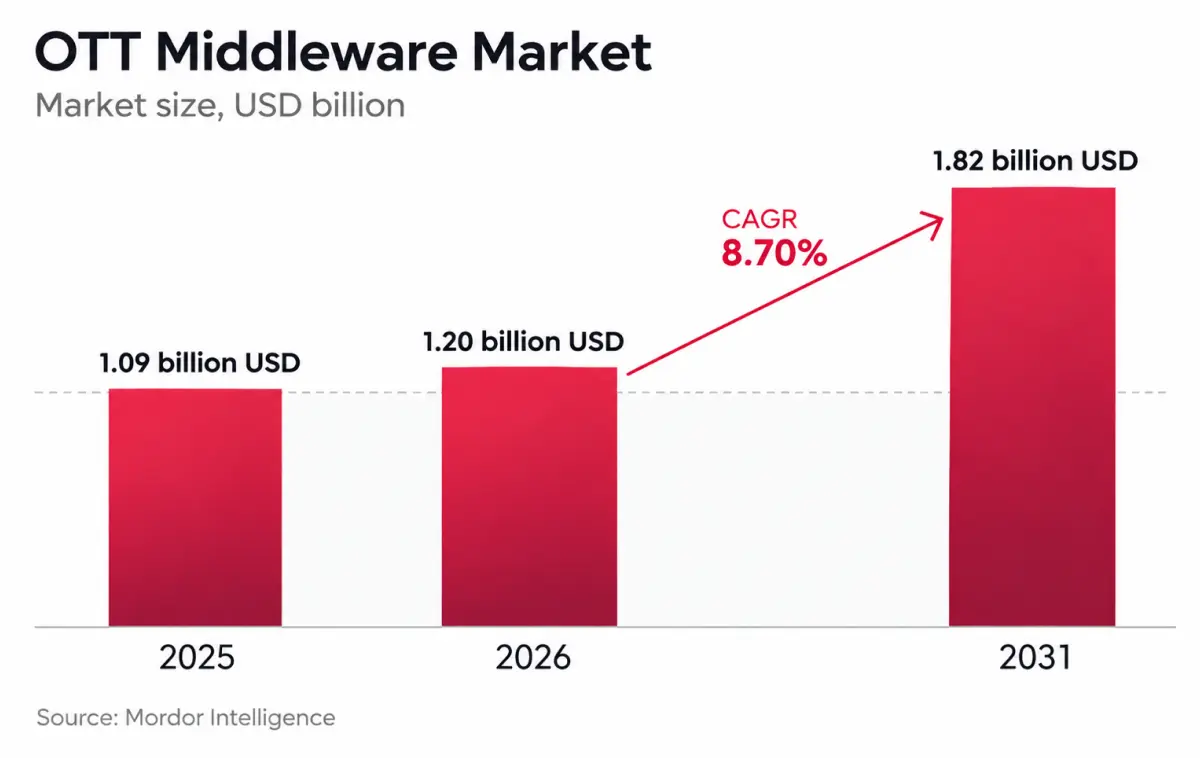
OTT Middleware Market
This leads to an important conclusion for partner strategies, which is that regional markets will need not only new OTT deployments but also modernization projects. OTT middleware partners must be able to discuss gradual migration, hybrid architectures, and the preservation of existing investments with operators.
What Vendors Should Provide to Their Partners
A middleware partner program or network can't be built on discounts and partner margins alone. For a complex product such as IPTV/OTT middleware, commercial terms are important, but they don't automatically help partners explain the platform's value to operators, answer technical questions, design project architectures, or support implementation.
If a partner does not understand the product, cannot prepare a commercial proposal quickly, or is uncomfortable handling complex technical questions, they are unlikely to promote the middleware actively.
Vendors should provide partners with a clear set of tools: product positioning, descriptions of typical use cases, technical documentation, demo access, presales training, basic architecture diagrams, proposal templates, a licensing calculator, operator-facing materials, and a clearly defined procedure for escalating technical issues.
Ready-made deployment scenarios are particularly valuable. Examples include launching IPTV for a local internet service provider, migrating from legacy middleware, implementing a multiscreen OTT service, delivering a hospitality solution, expanding to mobile applications, integrating external billing, and adding VoD and catch-up TV.
Partners find it easier to sell a solution to a specific problem than an abstract platform.
For example, the Ministra PRO team demonstrates not only the platform's features but also its role within the overall architecture. Middleware manages users, devices, tariffs, channels, EPG, VoD, events, and integrations, but it doesn't replace CDN, DRM, headend systems, or the operator's network. Clearly and accurately defining these responsibilities builds trust and helps partners set realistic customer expectations.
How to Prevent Conflicts Between Vendors and Partners
One common problem in partner networks is unclear responsibility. A partner introduces an operator, but the vendor then starts managing the deal directly. Alternatively, a partner promises customization, delivery timelines, or integrations that the vendor has not approved. As a result, the operator receives conflicting information, the partner loses motivation, and the vendor risks damaging its reputation.
Preventing these situations requires transparent rules:
- Who owns the lead?
- How long is a sales opportunity registered to a partner?
- Who is responsible for presales?
- Who signs the contract?
- Who performs the integration?
- Who provides first-line support?
- When should the vendor become involved?
- Which commitments can partners make independently, and which require approval?
This is critical for middleware because unrealistic promises can become expensive during implementation. If an operator is promised a fully operational service in two weeks, but the project actually requires billing integration, subscriber database migration, stream configuration, and device testing, a conflict is almost inevitable.
A good partner program should protect both the vendor and the partner. If a partner invests time in a region, builds relationships with operators, and promotes the platform, they need to understand how they will generate revenue and what support they can expect.
Why Local Expertise Matters More Than the Size of a Partner Network
Partner networks are sometimes evaluated by the number of companies they include. For middleware, this is a weak performance indicator. Ten inactive partners in a region generally deliver less value than one strong integrator who genuinely understands IPTV/OTT and has established relationships with operators.
In 2026, the partner ecosystem is becoming increasingly important across the telecommunications sector. According to Capgemini B2B Pulse 2026, 70% of organizations expect telecommunications providers to collaborate with hyperscalers and partners rather than operate independently.
Although this research covers the broader B2B telecommunications market, its underlying principle also applies to IPTV/OTT: operators increasingly expect an integrated ecosystem of solutions rather than an isolated product.
For regional middleware expansion, this means partners should be capable of bringing together the necessary components of a project, covering platform, devices, applications, CDN, DRM, billing, support, and integration. Vendors that help partners establish these connections can build a stronger and more sustainable regional presence.
How Partners Help Operators Make Purchasing Decisions
IPTV operators rarely select middleware based solely on a feature list. Instead, they are usually more interested in practical questions, such as how long will deployment take? Can existing set-top boxes be retained? How will subscribers be migrated? What happens to the billing system? Which applications are available? Who will help configure video streams? How will support be organized? And how many resources will be needed after launch?
Local partners can answer these questions based on actual market conditions. They understand typical budgets, operator expectations, common network architectures, familiar devices, and the technical capabilities of customer teams.
When partners have a strong understanding of the product and typical deployment scenarios, they can move an operator from initial interest to a concrete next step more quickly, whether that's a demonstration, technical consultation, or pilot project.
A good partner also helps operators define the appropriate project scope. Sometimes there's no need to launch on every platform immediately. An operator may start with set-top boxes and Web, stabilize the service, and then expand to Android, iOS, and Smart TV. In other cases, multiscreen support is essential for competitiveness from the outset.
Partners who know which questions to ask can improve the quality of the deal.
How to Develop Partners After the First Sale
The first deal in a region does not mean a partner network has been established. After deployment comes the even more important stage of supporting partners, developing their expertise, and building a portfolio of local success stories.
After the first sale, vendors should continue developing partner capabilities through regular product training and updates. Partners need to understand new features, API changes, security recommendations, migration scenarios, client application updates, and monitoring and operational practices.
This is particularly important for IPTV middleware because the product evolves alongside the operator's service. Configuration errors, outdated documentation, or misunderstandings about new features can ultimately create problems for subscribers.
It's also useful to establish different partnership levels. At the basic level, partners may sell the product and generate leads. At a higher level, they can conduct demonstrations, design architectures, implement solutions, and provide first-line support. At the expert level, they can manage complex projects, migrations, and custom integrations.
This model prevents less experienced partners from taking on responsibilities beyond their capabilities while encouraging stronger partners to develop their expertise.
Which Metrics Show That a Partner Network Is Working
A partner network should not be evaluated solely by the number of signed agreements. For middleware, indicators of actual partner activity and implementation quality are more important.
Vendors should track the number of qualified leads generated by partners, conversion rates into demonstrations and pilots, the proportion of pilots progressing to commercial deployment, average presales duration, the number of projects undergoing subsequent expansion, support requests after launch, the quality of documentation prepared by partners, and the speed at which routine issues are resolved.
Regional resilience should also be evaluated separately. If every deal in a country depends on a single person at a partner company, that creates a risk. If a partner can sell the platform but can't support implementation, that's another risk. If a partner repeatedly brings in customers for whom the product is unsuitable, the problem may lie in positioning or training.
Building a middleware partner network is not simply about expanding sales, it's a way to bring technology closer to regional operators, reduce implementation barriers, and provide local expertise where the vendor's direct presence is limited.
For IPTV/OTT operators, this creates a clearer path to launch, with a local point of contact and assistance with architecture, integration, migration, devices, and support. In this model, Ministra PRO serves as a manageable middleware core for regional IPTV/OTT projects, from local operators to multiscreen services with different tariffs, devices, applications, and integrations.
However, success depends not only on the platform but also on how effectively the partner network is structured: who sells, who implements, who supports the service, and who is accountable to the operator for the results.
Recommended

All Content in One Service: Live TV, VoD, Radio, Archive, TimeShift, and EPG in Ministra PRO
A television service has long been more than just a list of channels. Viewers now want to watch live broadcasts, return to a missed program, pause a show, schedule recordings of individual episodes or an entire series using nPVR, or choose a movie from a catalog. At the same time, all these capabilities should feel like parts of a single media environment rather than separate systems.

Interactive TV Trends on Google TV: What to Know in 2027
When choosing a television platform for 2027, businesses need to assess more than picture quality and the app selection. Equally important considerations are how viewers will find content, what capabilities the operator will have, and how predictably the equipment will perform after updates.
How to Reduce Video Delivery Costs Without Compromising Quality: CDN, Edge Cache, and Multi-CDN
As an IPTV/OTT service’s audience grows, so do both revenue and video delivery costs. For an operator, this means additional terabytes of outbound traffic. For a hotel, it means greater pressure on its internet connection. And in the case of maritime transport, it means the video service has to compete with other applications for limited bandwidth.