


Product request
You are looking for a solution:

Select an option, and we will develop the best offer
for you


AI in IPTV/OTT Without the Hype: Where It Really Helps Operators and Where It Still Gets in the Way

Artificial intelligence is already being used in video services for content recommendations, viewer behaviour analytics, automated video processing, and technical diagnostics.
However, for an IPTV/OTT operator, the value of AI is determined not by the number of recommendation algorithms implemented, but by the results: whether it helps retain subscribers, increases the profitability of subscription plans, makes more efficient use of content, and reduces operating costs.
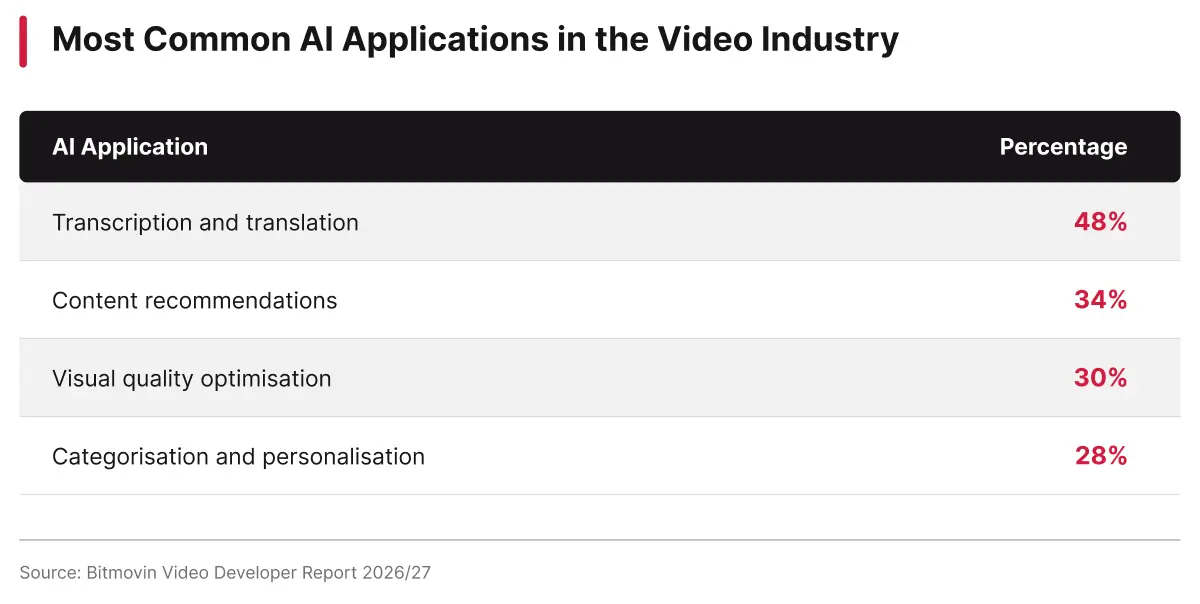
According to the Bitmovin Video Developer Report 2026/27, based on responses from 486 professionals across 94 countries, 98% of respondents already use AI or machine learning in at least one video workflow. Common applications include transcription and translation (48%), content recommendations (34%), visual quality optimisation (30%), and categorisation and personalisation (28%).
These figures represent professionals in the video industry, not the proportion of all IPTV operators that have adopted AI.
Audience habits are also changing. In April 2026, Gracenote, a Nielsen company, published a study on using AI to discover entertainment content.
Among surveyed chatbot users in the United States, 49% of Generation Alpha teenagers aged 13–14 identified AI chatbots as the best source of movie and TV show recommendations. The study also noted however that trust in these recommendations has yet to catch up with their popularity.
For operators, the practical conclusion is clear: audiences expect more convenient search and more relevant offerings, but AI in OTT should only be implemented where reliable data, a clearly defined business objective, and a way to measure results are already available.
Start with Data, Not the Algorithm
Before predicting viewer preferences for content personalisation or subscriber churn, operators need to connect viewing data with subscription plans, devices, and service quality. Statistics on popular channels alone reveal little about why one subscriber renews their subscription while another leaves.
For analysis, it's useful to combine channel and VoD viewing history, service usage frequency, search queries, available packages, subscription changes, support requests, and technical events. It's also important to distinguish between user behaviour and system limitations.
For example, a viewer stops watching sports broadcasts. An algorithm may interpret this as a loss of interest, but the actual reason could be the end of a tournament, the removal of a channel from a package, playback errors, or a switch to another device.
Therefore, data from middleware must be correlated with information from players, billing systems, and customer support. It's useful to establish consistent identifiers for accounts, devices, channels, and sessions, synchronise timestamps, and eliminate duplicate events in advance.
This preparation is necessary not only for complex models. Even basic audience segmentation produces more reliable results when operators understand how many users actually watch specific content, how often they return, and which services they pay for.
Viewing Habits Analytics: What AI Can Learn About Viewers
Traditional video streaming analytics shows viewing counts, channel popularity, and average session duration. Machine learning helps identify consistent patterns in the behaviour of different user groups, such as a system identifying subscribers who regularly watch live sports, prefer series in the evening, primarily use mobile devices, or access VoD only on weekends.
The type of content matters, but so does the context in which it's consumed. Operators benefit from understanding which content categories users watch to completion, what they return to, what they search for unsuccessfully, which recommendations they ignore, and which channels they open after launching the application.
This information can be used to create different types of offers. Sports fans can be shown upcoming broadcasts and relevant packages, series viewers can receive recommendations for continuing playback and discovering new seasons, and users who prefer short evening viewing sessions can be offered selections that match their habits.
However, operators should understand that long viewing sessions do not necessarily indicate satisfaction, and a television may remain switched on for several hours without any active interaction. When analysing viewer interests, it's therefore better to consider several indicators together: how often users return to specific content, whether they watch it to the end, which channels and movies they select independently, what they search for, and how they respond to recommendations.
Household analysis presents another challenge. A single account may be shared by several family members with very different interests. If an operator combines all activity into one profile, recommendations may mix children's content, sports broadcasts, and adult-oriented series. Accurate personalisation requires separate profiles where supported, or a cautious approach to analysing the shared interests associated with an account.
How to Detect Declining Interest and Churn Risk Early
Subscriber churn prediction is one of the most useful applications of AI for subscription-based IPTV/OTT businesses. An algorithm estimates the likelihood that a subscriber will not renew a service or will cancel a particular package.
The scale of the problem is illustrated by Deloitte Digital Media Trends 2026: 41% of surveyed North American consumers had canceled at least one paid SVOD subscription during the previous six months. This figure reflects the US market and subscription video services, not a universal churn rate for IPTV operators.
An IPTV AI model can consider the following indicators:
- declining viewing frequency;
- fewer active days;
- reduced viewing of previously favourite channels;
- unsuccessful search queries;
- frequent playback errors;
- customer support requests;
- an approaching subscription renewal date.
It should be noted that these indicators are not equally important in every case. For someone who watches only football matches, inactivity between tournaments may be normal. For a subscriber accustomed to watching the news every day, a sudden drop in viewing activity may be a more serious warning sign.
Churn risk should therefore be assessed relative to a user's usual behaviour and that of similar audience segments. The model must distinguish seasonal patterns from a genuine decline in interest and account for changes in available content.
A prediction alone does not retain a subscriber. It must lead to a specific action.
If a user stops opening a sports package after the season ends, the operator can offer a temporary switch to another subscription plan. If a viewer frequently searches for movies that are not in the catalogue, they can be shown available alternatives or notified about new additions. If activity drops after a series of playback errors, the correct response is to fix the technical problem rather than send a promotional offer.
This is where customer churn prediction using machine learning helps operators move beyond mass messaging and address the actual reasons why subscribers may cancel their service.
How AI Helps Build More Profitable Subscription Plans
Subscription plan analytics is more complex than movie recommendations. Operators must simultaneously consider subscriber interests, content costs, licensing terms, infrastructure load, and the likelihood of subscription renewal.
Machine learning makes it possible to estimate demand for different combinations of services and identify user groups whose needs are not adequately met by existing plans.
For example, some subscribers pay for an extended TV package but watch only a few channels. Another group actively uses VoD but doesn't purchase additional catalogues. A third regularly watches sports broadcasts but rarely uses the service's other features.
Based on this data, operators can test hypotheses for new offerings: a basic plan with a limited selection of channels, thematic add-ons, family packages, temporary access to sports content, or bundles combining IPTV with an internet provider's services.
However, an algorithm predicting strong demand does not necessarily prove commercial profitability. Operators need to calculate both expected revenue and additional expenses for each option.
When developing a new subscription plan, AI can help operators analyse demand, forecast the number of new subscriptions, and assess the economic viability of the offer. Several indicators should be considered.
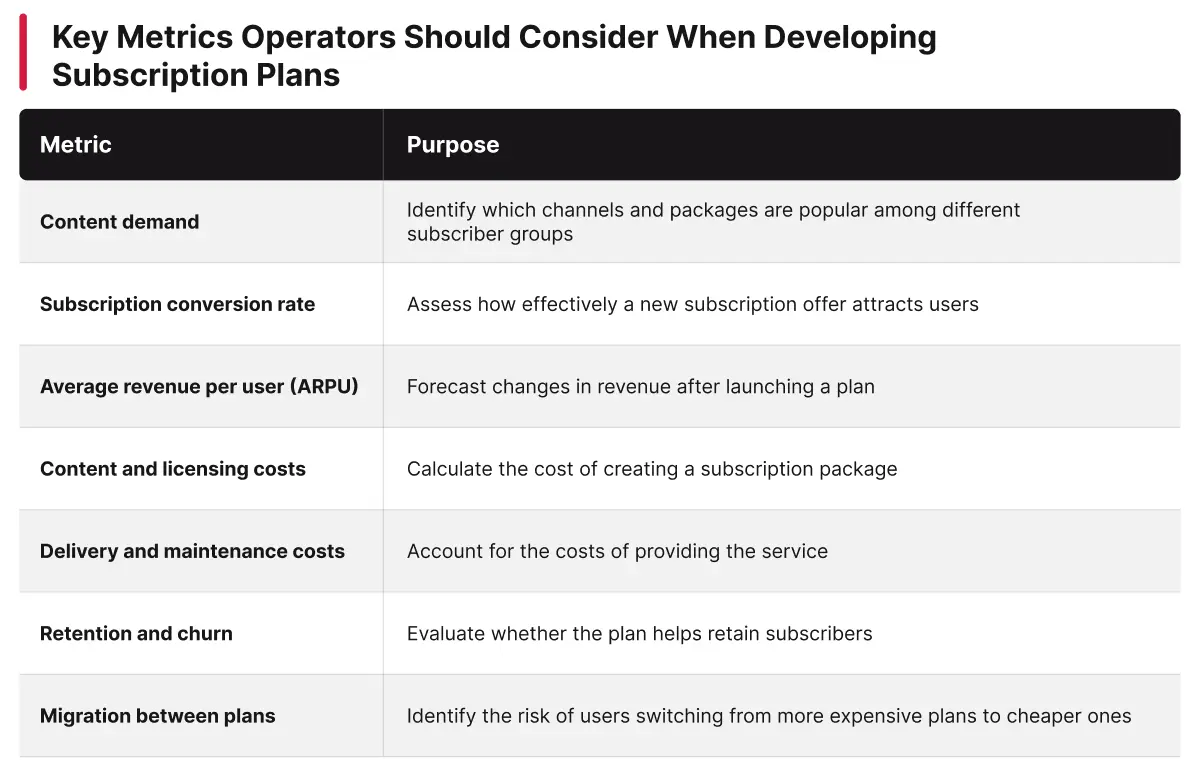
For example, AI may predict strong demand for an inexpensive sports package, but if a significant proportion of potential buyers already subscribe to a more expensive plan, the new product may reduce average revenue rather than increase it.
Subscription plan modeling must therefore account for cannibalisation: how many users will actually generate additional revenue, and how many will simply move to a cheaper offer.
A practical approach is to assess projected contribution margin and subscriber retention rather than focusing solely on the number of subscriptions. The offer should be introduced only after pilot testing with a limited audience.
Personalised Promotions Instead of Mass Discounts
AI is also useful for identifying subscribers who should receive promotional offers, but this is an area where it's easy to confuse successful communication with genuine economic value.
Suppose a model identifies 1,000 users with a high probability of cancelling their subscriptions. The operator offers each of them a 20% discount, after which most renew their service. At first glance, the campaign appears successful.
The problem is that some of these subscribers would have renewed even without the discount. In that case, the operator has simply lost part of its revenue. This is why it's better to evaluate not only the probability of churn but also how likely a specific action is to change a user's decision.
This approach is known as uplift modelling. For one segment, a personalised content recommendation may be more effective. For another, temporary access to a thematic package may work better. A third may benefit from switching subscription plans, while a fourth may not require any additional incentive at all.
For operators, the underlying principle matters most: a personalised promotion should address a specific reason for declining interest and deliver a measurable incremental result.
Where AI Is Useful Beyond Marketing
Video services use AI for more than audience engagement. It can help technical teams detect anomalies in system operation, analyse support requests, and classify errors.
For instance, a model may detect that channel startup times have increased on a particular set-top box model after an application update, even though overall CDN availability remains normal. It may also correlate a rise in buffering complaints with a specific region and changes in network metrics.
This type of analytics is particularly useful for services operating across numerous devices, channels, and client platforms. However, AI should assist in identifying problems rather than independently making critical decisions about switching streams, modifying access, or shutting down servers without validated safeguards.
Another practical application is AI customer service automation, in particular the processing of customer support requests. Automatic classification helps group recurring complaints, identify widespread incidents, and route requests more quickly to the appropriate specialist.
Regardless of AI's assistance, the final diagnosis must still be supported by technical data. If a model incorrectly identifies a network issue as a set-top box malfunction, automated recommendations to restart the device will only increase the number of repeat support requests.
Where AI Still Creates Problems for Operators
The main risk is implementing technology without validating the quality of the underlying data or its economic impact.
An operator may build a sophisticated recommendation system that actively promotes popular movies but has little effect on subscription duration. Alternatively, a churn prediction model may mistake a seasonal decline in interest for a warning sign and offer discounts to users who have no intention of leaving.
The second limitation is a lack of transparency in decision-making and the potential for AI hallucinations. If an algorithm recommends removing a particular channel, changing a package, or offering a subscriber a discount, the team must understand which indicators support that recommendation. Fully automated changes to commercial terms without a review mechanism create operational and reputational risks.
The third problem concerns user experience. Excessive personalisation can restrict choice: a recommendation system may repeatedly display familiar genres and prevent viewers from discovering new content. For IPTV services, it's particularly important to preserve access to the standard channel list, search, categories, and manual selection.
The fourth issue is data protection. Analysing viewing histories and preferences may involve processing personal data. Operators must consider applicable privacy requirements, the legal basis for processing, retention periods, employee access, and rules for sharing information with external AI providers.
Before implementing AI, operators should therefore determine which data is genuinely necessary, whether aggregated or anonymised information can be used, and which decisions must be taken with human oversight.
How Operators Can Launch an AI Project and Measure Its Results
The best starting point for using AI for a content recommendation engine, personalisation, and churn prediction is a single use case for which historical data and a clear success metric are available. One way of doing this would be for an operator to identify users showing signs of declining activity and test whether personalised content recommendations increase subscription renewals.
A pilot can follow a straightforward process:
- Define the objective and baseline metrics: churn, ARPU, viewing frequency, or profitability of a particular package.
- Collect data from middleware, billing systems, applications, and customer support, and verify the completeness and consistency of events.
- Create a control group that does not receive the new offer and a test group in which decisions are made using the model.
- Measure more than clicks and views: include subscription renewals, incremental revenue, contribution margin, discount costs, and support requests.
- Scale the solution only after its impact has been confirmed, while maintaining ongoing model quality control.
If 82% of users in the test group renew their subscriptions after a personalised campaign, compared with 79% in the control group, the difference is three percentage points. The final assessment will depend on sample size, statistical uncertainty, campaign costs, and the actual incremental revenue generated.
It's also useful to monitor whether model performance deteriorates over time. Audience behaviour changes with new content releases, price adjustments, sports seasons, and application updates. An algorithm trained on older data may gradually lose accuracy.
AI should therefore not be treated as a one-time setup project. It requires regular validation of predictions, retraining, data quality checks, and the ability to return to conventional service management rules.
AI in IPTV/OTT is most useful when it helps operators make verifiable decisions: understand viewer interests, identify signs of declining activity, develop suitable subscription plans and promotions, analyse service performance, and reduce manual work.
Where AI delivers real value for IPTV and OTT operators is not the number of automated features, but additional profit, subscriber retention, and viewing quality. If data is incomplete, models are opaque, and results are not tested against control groups, AI can increase costs and complicate service management.
The right approach is to start with a specific business objective, reliable analytics, and a small pilot, scaling only those solutions whose benefits have been demonstrated through measurable results.
Recommended

Why RDK Is Becoming a Key Platform for Operator TV
Choosing an interactive TV platform determines more than just the appearance of menus and the apps available. It also affects how difficult it is to add new set-top box models, update software, troubleshoot problems, and switch hardware suppliers.

Observability in IPTV: Which Metrics Operators Need to Monitor to Identify Problems Quickly
For an IPTV/OTT operator, service stability depends on more than the availability of servers and channels. The platform may be running without critical errors and the CDN is delivering the video stream successfully, but users still experience slow stream startup, buffering, or denied access to content.

Building a Partner Network: How to Expand Middleware Presence Across Regions
For an IPTV operator, middleware has long since become more than just the technical core of a service. It's the layer through which the operator manages users, devices, tariffs, channels, VoD, EPG, access rights, events, billing integrations, and client applications.