

Product request
You are looking for a solution:

Select an option, and we will develop the best offer
for you


Why RDK Is Becoming a Key Platform for Operator TV
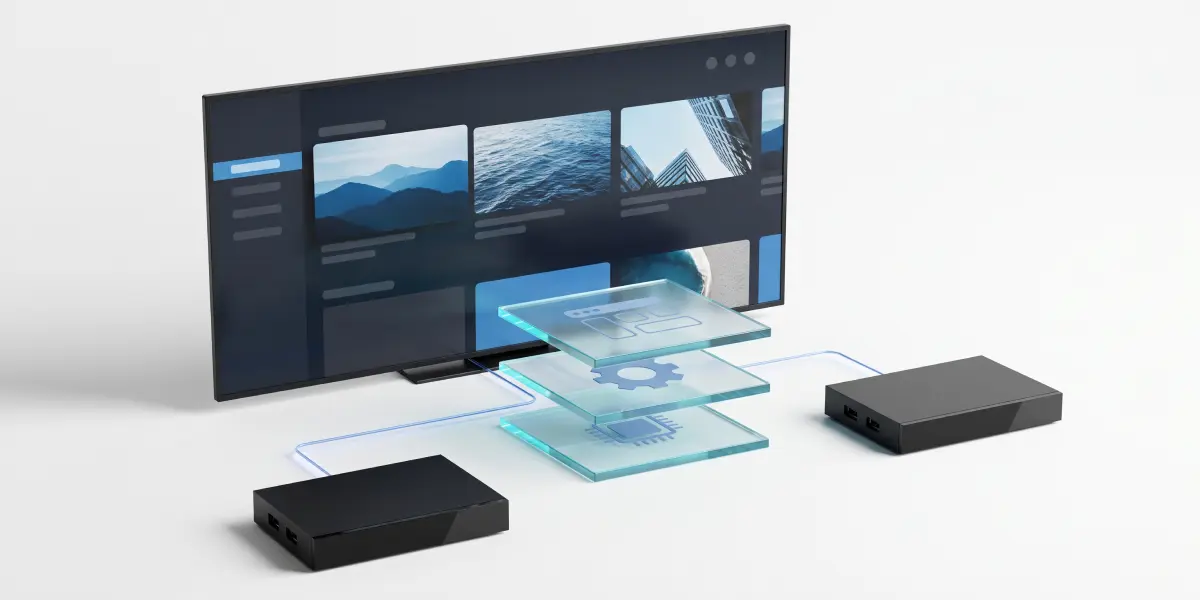
Choosing an interactive TV platform determines more than just the appearance of menus and the apps available. It also affects how difficult it is to add new set-top box models, update software, troubleshoot problems, and switch hardware suppliers.
For operators and integrators, these are questions of cost and service manageability throughout the equipment’s lifecycle.
RDK provides a shared software foundation for addressing these challenges. But while its adoption points to greater standardization across operator equipment, it isn't the sole standard for interactive TV.
Assessing RDK's suitability requires understanding exactly what RDK standardizes, which capabilities remain under the customer’s control, and what implementation work is required.
What RDK Is and What It Standardizes
RDK, or Reference Design Kit, is a modular, open-source software platform. It standardizes the core functions of customer premises equipment and provides a foundation on which manufacturers, integrators, and operators build their own solutions.
The ecosystem includes several branches. RDK-B is designed for broadband equipment, such as home gateways. The video branch has traditionally been known as RDK-V. Since RDK7, released in 2025, the documentation has also used the name RDK-E, or RDK for Entertainment. When selecting equipment for middleware integration, it's therefore important to confirm the platform version, device profile, and supported feature set.
RDK is not a replacement for a complete IPTV/OTT system. The software foundation of a set-top box, the subscriber platform, and the content delivery infrastructure serve different purposes. Billing, subscriptions, the content catalogue, the programme guide and integrations with the customer’s systems must all be addressed in the project.
In addition, having RDK on a device doesn't confirm compatibility with this entire infrastructure.
Why Operators Choose a Shared Software Foundation
In September 2025, RDK Management reported that cumulative shipments of RDK-based devices (broadband and video equipment combined) had exceeded 200 million items, and that the ecosystem included more than 700 technology companies. These ranged from device and chipset manufacturers, to software developers, integrators, and service providers.
For businesses, the key principle is that common technical functions can be developed on a shared foundation while retaining a proprietary interface and product logic. This creates opportunities to reuse existing development work and reduce the effort required to expand the hardware range.
This is how the RDK platform contributes to the standardisation of operator TV, standardizing software components and interfaces. Despite its popularity however, it should be noted that it isn't a mandatory industry standard amongst operator-grade TV solutions for every market participant.
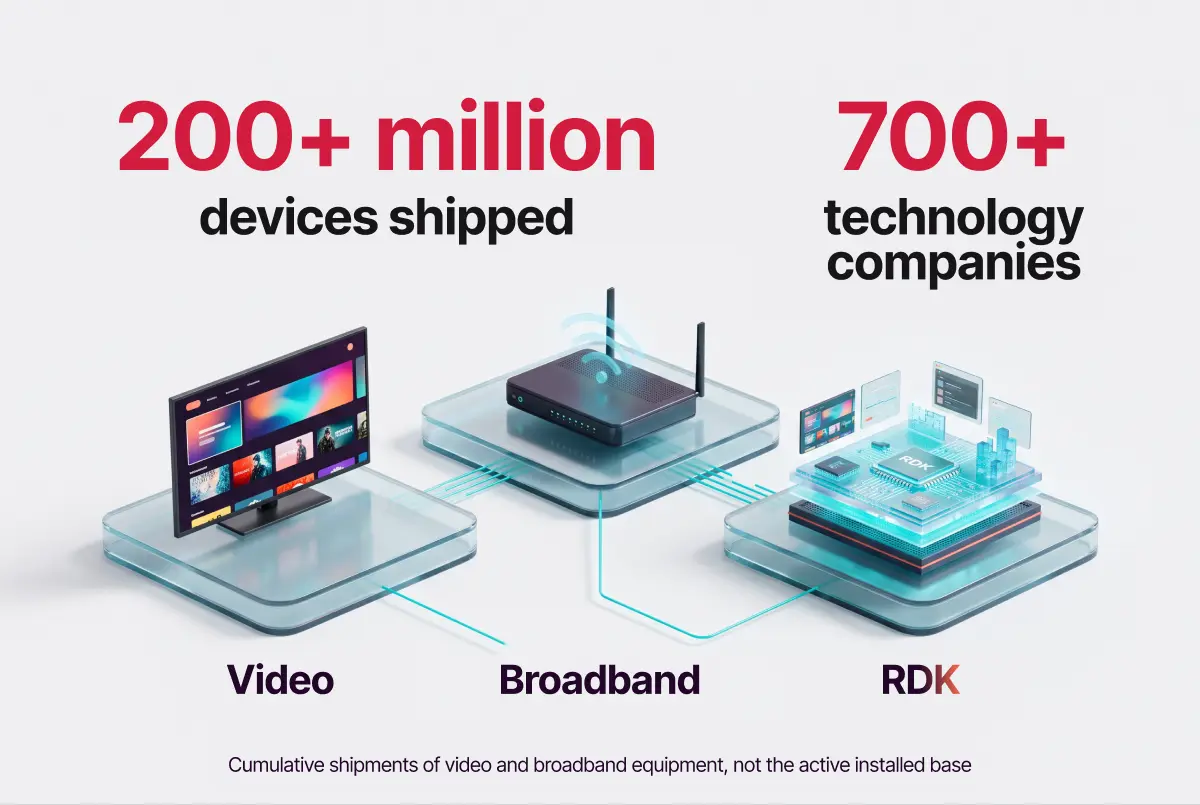
The Scale of the RDK Ecosystem
How RDK’s Architecture Supports Different Hardware
One challenge in an operator’s project is supporting several generations of set-top boxes. Differences between chipsets and manufacturers’ implementations can affect video playback, diagnostics, the user interface, and updates. The greater these differences, the harder it becomes to roll out consistent changes across the entire device fleet.
RDK7 is organised into three main layers: applications, middleware, and a hardware-specific vendor layer. Standardized hardware abstraction interfaces separate common functions from the specifics of individual hardware platforms.
For integrators, this creates an opportunity to reuse parts of the software implementation when adding a new set-top box model. For operators, it provides a basis for more consistent service development across devices from different manufacturers.
However, portability doesn't mean complete interchangeability. A new chipset or new drivers require testing of playback, content protection, peripherals, and overall system stability. RDK for operator TV can therefore reduce repeated development work, although it doesn't guarantee a fixed reduction in costs or implementation time.
Meanwhile, the platform continues to evolve. The official page presents RDK8 for Video as a Development Preview that builds on RDK7’s modular foundation and application delivery mechanisms. This status should be distinguished from the readiness of a particular implementation for commercial deployment: the version chosen for a project should reflect its maturity and hardware support.
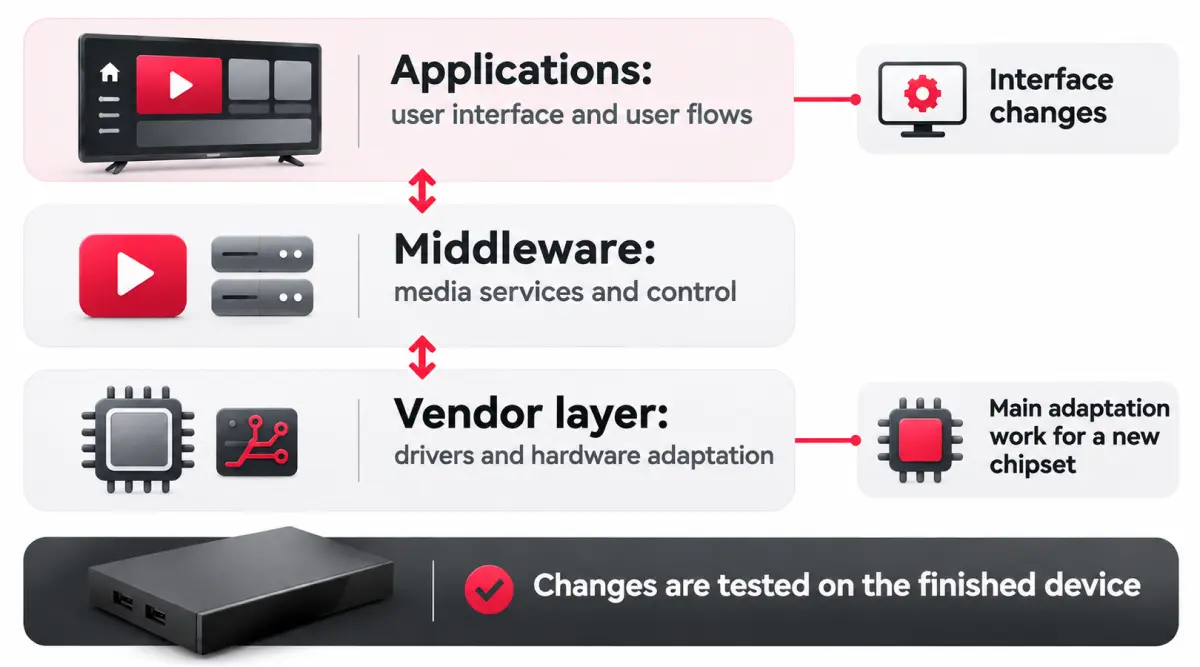
The Three Layers of RDK7: A Simplified Architecture
Who Controls the Interface and Applications
RDK middleware is of interest to operators who want to define their own home screen layout, content presentation, and user flows. The RDK Video documentation describes the use of Lightning, HTML5 and native applications. Firebolt provides standardized mechanisms for applications to interact with platform functions.
The specific runtime environments and capabilities available depend on the RDK version and the device implementation.
Customers need to distinguish between the ability to integrate an application and the availability of a ready-to-use app. Supporting a popular streaming service requires checking the service owner’s requirements, technical compatibility, and necessary certifications.
Even pre-certification on a reference platform doesn't always satisfy the requirements for the final product. The RDK FAQ explicitly states that additional application testing may be required after IPTV and OTT integration by the operator. The list of mandatory services should therefore be agreed before selecting a set-top box.
How Updates and Support Are Managed
For a large device fleet, managing updates is just as important as the initial launch. It's essential to understand which devices will receive a new version, when they will restart, and what to do if installation fails.
The RDK ecosystem uses XConf. The server provides devices with information about the appropriate firmware and how to download it; the documentation supports configuring the timing of update checks and deferring restarts. Installation also involves hardware-specific steps and mechanisms provided by the manufacturer.
This means that using RDK will still require the customer to agree on a maintenance process regarding software update management. The project must define who builds and signs firmware, tests changes, approves releases and resolves failures. Safe rollback and recovery capabilities must be verified separately for the selected model.
Control over the platform delivers practical value when the operator or its partner has the resources to implement these processes.
Comparing RDK, Specialised Linux and Google TV
Framing the choice as “RDK or Linux” is technically inaccurate: A Linux-based TV platform is part of RDK’s software foundation. In practice, customers compare a manufacturer’s specialised Linux firmware, an RDK-based solution, and a Google TV device. These represent different approaches to building and maintaining a product.
Google TV runs on Android TV OS and uses its application ecosystem. The availability of individual services, content, and features depends on the country and device.
The comparison should start with the project’s priorities:
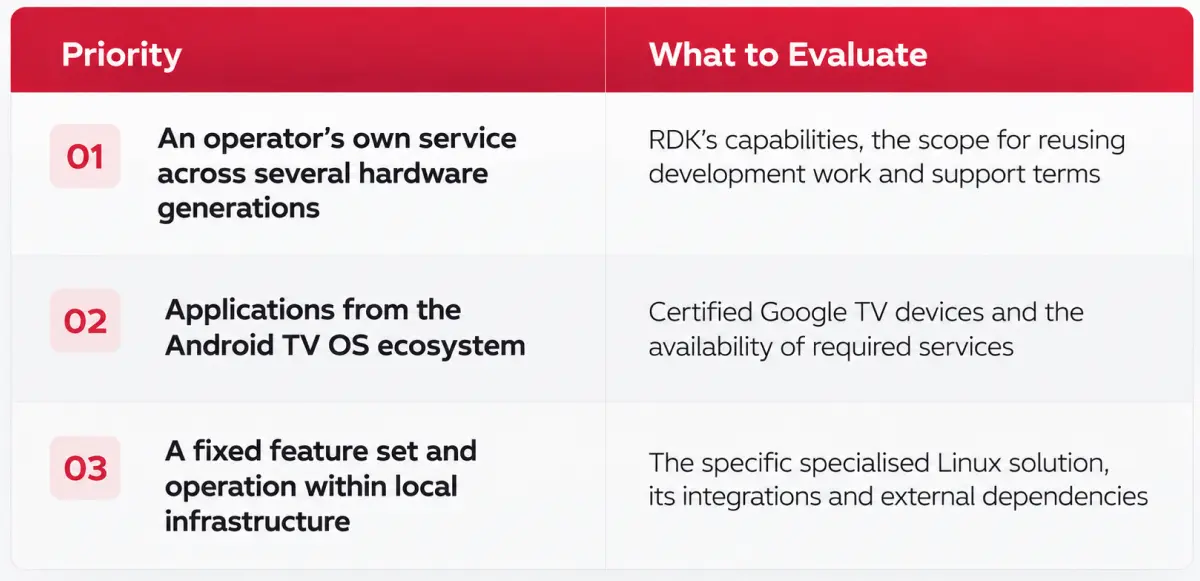
While this table helps frame questions for suppliers, it doesn't establish rigid boundaries. A custom interface is not exclusive to RDK technology, and offline operation isn't an inherent feature of a Linux set-top box. The comparison must focus on actual implementations.
How Suitable Is RDK for Hotels, Maritime Networks and Regulated Environments?
For an operator with several set-top box models and a long-term service development programme, RDK is worth evaluating as a means of standardization. This is particularly relevant when maintenance is handled by an in-house engineering team or an integration partner.
In hotel projects, the choice depends on scale and the required features. For a single property, a ready-made system with TV channels, operator branding on menus, and information sections may require less development work. For a hotel chain, evaluating a shared platform can be useful, but integration with hotel systems, guest data deletion, and restrictions on settings must be addressed separately.
These are criteria for selecting a solution for the project, rather than guaranteed benefits of RDK deployment.
In maritime and isolated networks, operation without external connectivity is a critical test. Set-top box startup, authentication, access to local content, DRM behaviour and recovery after a reboot all need to be checked. Open-source code alone is not sufficient to establish that a solution can operate offline.
For regulated infrastructure, access control, telemetry processing, key storage, and vulnerability remediation require similar verification. Compliance is established for the final product and its configuration, rather than inferred from the name of the software platform.
What Does Implementation Cost, and Can Existing Set-Top Boxes Be Retained?
While RDK’s software foundation is available at no charge, there may still be costs associated with a finished product. The terms of use and distribution must be checked for the selected version and component set. Official materials distinguish between the terms for RDK6.1 and earlier releases and those for versions after 6.1, including RDK7.
The project cost estimate should include hardware procurement, adaptation, third-party technologies, certification, server components, and testing and maintenance. Potential savings from standardization should be weighed against these costs over the same operating period.
Retaining the existing fleet of IPTV/OTT or cable operator set-top boxes will not always be possible. As stated in the published RDK FAQ, migrating a device from another platform requires the involvement of the chipset supplier, equipment manufacturer, and operator, including work on the bootloader, initial setup, and updates. The FAQ doesn't provide a universal, publicly available migration mechanism.
This means that having an SDK or access to the bootloader doesn't, by itself, demonstrate that a safe migration is possible. The first step in device provisioning is to assess the technical requirements and preliminary budget, followed by testing the implementation on a limited group of devices. The pilot results help refine cost estimates and compare migration with phased replacement.
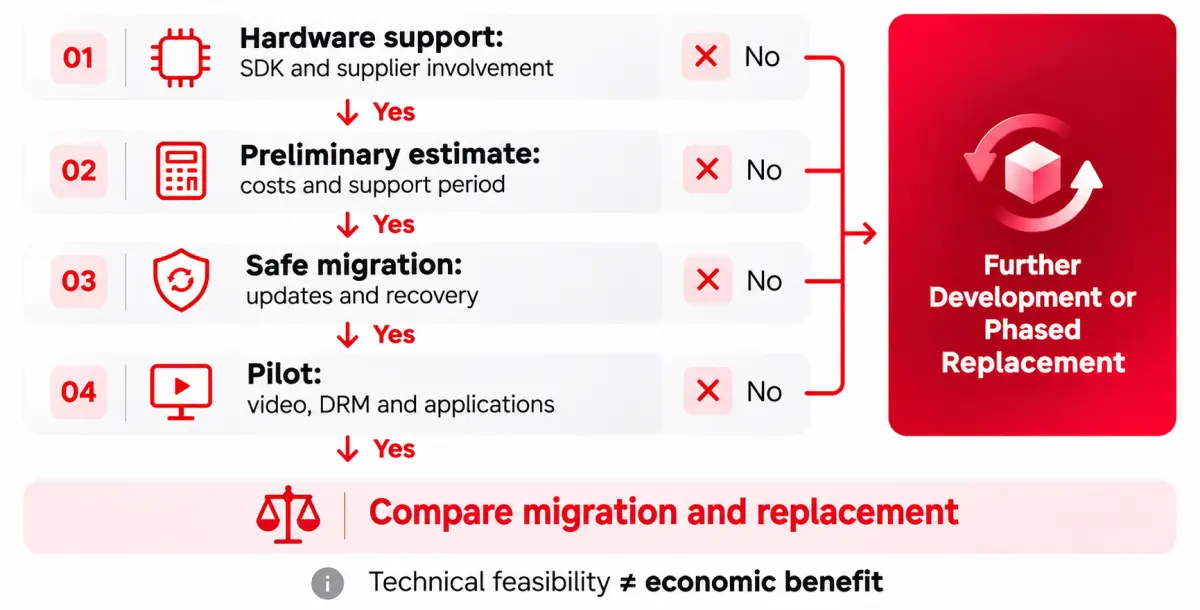
Keep Existing Set-Top Boxes or Replace the Fleet?
What to Check Before Purchasing
The pilot should use the selected production model with actual streams and the customer’s systems. Acceptance criteria should be defined in advance for the following:
- Compatibility: RDK version, hardware platform, video formats, DRM, and required applications.
- Integrations: authentication, subscriber platform, content catalogue, programme guide, and device management.
- Performance: startup and channel switching times, playback errors and stability during extended sessions.
- Maintenance: timelines for fixes, update and recovery procedures, support availability, and each party’s responsibilities.
Basic certification is not a replacement for these tests. For example, the RDK Ready programme checks a hardware platform against specific Core RDK requirements, but explicitly retains the need for operator testing of the final product.
RDK is gaining importance in operator TV services thanks to its shared software foundation, standardized interfaces, and opportunities to reuse development work. For customers, its customizable set-top box software offers a potential way to simplify service development and device management.
The platform is worth choosing when its benefits as part of the operator-controlled TV ecosystem are backed by verified compatibility, pilot results, cost estimates, and clearly defined responsibilities throughout the support lifecycle.
Recommended

Building a Partner Network: How to Expand Middleware Presence Across Regions
For an IPTV operator, middleware has long since become more than just the technical core of a service. It's the layer through which the operator manages users, devices, tariffs, channels, VoD, EPG, access rights, events, billing integrations, and client applications.
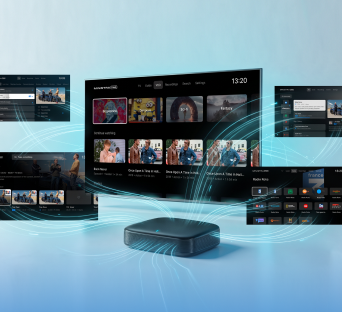
All Content in One Service: Live TV, VoD, Radio, Archive, TimeShift, and EPG in Ministra PRO
A television service has long been more than just a list of channels. Viewers now want to watch live broadcasts, return to a missed program, pause a show, schedule recordings of individual episodes or an entire series using nPVR, or choose a movie from a catalog. At the same time, all these capabilities should feel like parts of a single media environment rather than separate systems.
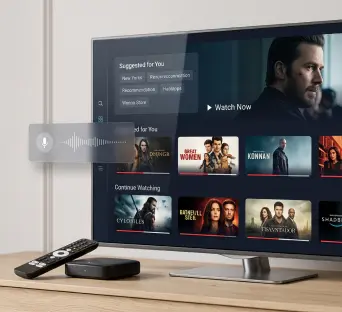
Interactive TV Trends on Google TV: What to Know in 2027
When choosing a television platform for 2027, businesses need to assess more than picture quality and the app selection. Equally important considerations are how viewers will find content, what capabilities the operator will have, and how predictably the equipment will perform after updates.