

Product request
You are looking for a solution:

Select an option, and we will develop the best offer
for you


FAST Channels for IPTV Operators: When Free Ad-Supported Channels Can Strengthen a Service

FAST channels are free linear TV streaming channels distributed over the internet and monetized through advertising. Viewers don’t pay for a subscription and don’t choose a specific movie as they would in a classic VOD model. Instead, they simply open a channel with a pre-scheduled programming lineup: news, movies, series, sports, lifestyle content, children’s content, music, thematic selections, or niche programs.
For an IPTV operator, FAST is not a replacement for paid packages, but an additional content layer. It can solve several tasks at once by expanding the basic offering, lowering the entry barrier for new users, keeping the audience inside the operator’s interface, creating advertising inventory, and helping users gradually move from free viewing to paid services.
Why FAST has become a noticeable format
Interest in FAST is driven by two factors. The first is user fatigue from having too many paid subscriptions. The second is the growth of the advertising model in streaming. Users are increasingly willing to watch ads if they receive free or cheaper access to content in return.
According to Nielsen, among viewers aged 18–49, 63.8% of TV viewing time is spent on content monetized through advertising. Within this segment, streaming video already accounts for 66.7%, while FAST platforms receive around 19% of viewing time among ad-supported streaming services. Nielsen also notes that FAST is especially effective at holding the attention of audiences aged 35–64.
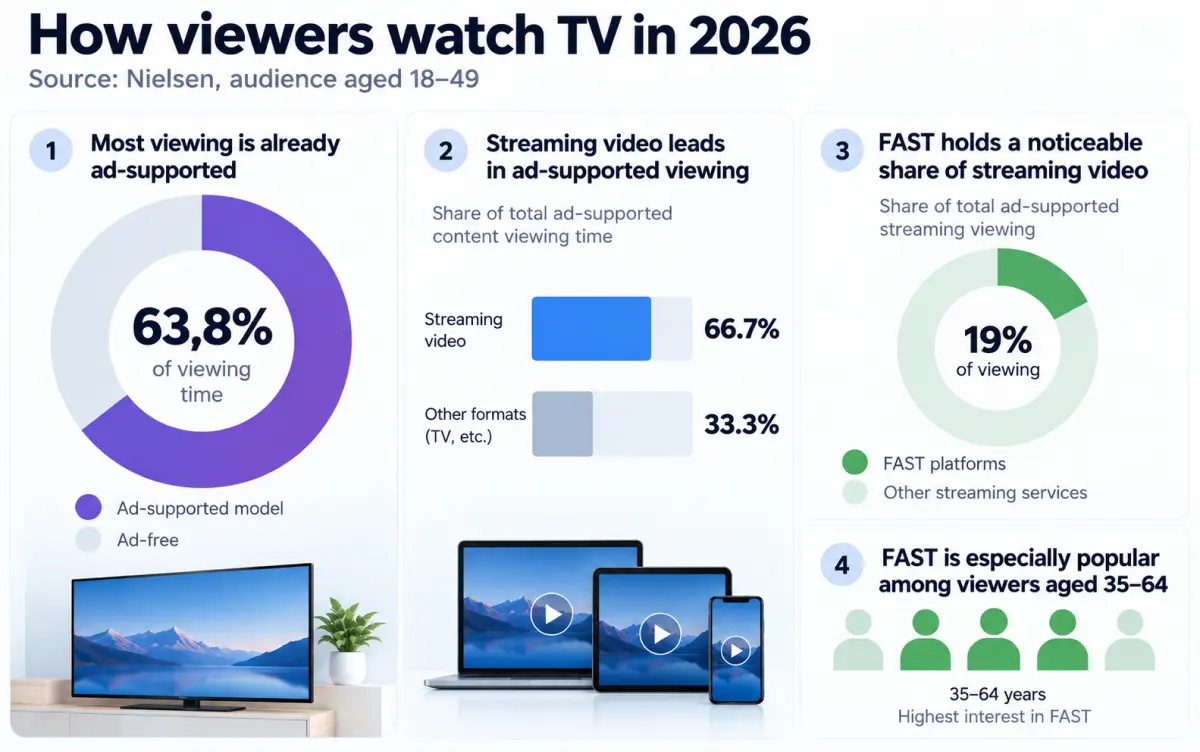
This matters for IPTV operators: FAST is not limited to younger audiences that have long since moved to mobile applications. The format is popular with viewers who are used to linear television but already consume video through connected TV, Smart TV, set-top boxes, and OTT platforms and applications.
Another important signal is the growth in viewing time. According to EMARKETER, citing Comscore, total FAST viewing time in the United States reached 1.8 billion hours in August 2025, up 43% compared with the same period of the previous year. This doesn’t mean that the same scale will automatically repeat in every local market, but it shows the direction of travel, with free ad-supported TV becoming a stable part of video consumption, not a temporary promotional mechanic.
Who watches FAST channels
The FAST audience is not homogeneous. Some users watch these channels as a replacement for part of traditional TV: news, movies, series reruns, documentaries, sports, and local content. Others use FAST as background television, turning on a channel without choosing a specific movie, leaving content “playing” on the screen, and quickly switching between genres.
For IPTV operators, this is especially useful in segments where users are not always ready to buy an expensive package right away. For example, a new subscriber may start with free channels, get used to the interface, evaluate the quality of the application, EPG, switching speed, archive, or recommendations, and then move on to paid TV, VOD, a sports package, or a premium offer.
FAST can also increase viewer engagement for users who rarely watch linear streaming channels but don’t want to pay for yet another subscription. For them, free channels become a “comfortable entry point” into the service. The operator gains contact with the audience even if the user is not yet ready to pay.
How FAST is monetized
The main FAST monetization model is connected TV advertising. The channel is free for the viewer, while revenue is generated through ad impressions. Depending on the cooperation model, the operator may receive a share of advertising revenue, sell part of the inventory independently, work through advertising platforms, or use FAST as a tool for retention and promotion of paid products.
For an IPTV operator, it’s important to determine in advance what role FAST will play in the service economy. There are three basic scenarios.
The first is FAST as an advertising product. The operator connects channels, receives advertising inventory, and monetizes the audience through impressions. This model is most interesting as part of an IPTV monetization strategy if the operator has sufficient reach, viewing data, advertising partners, or the ability to connect to an external ad sales system.
The second is FAST as a retention tool. Even if direct advertising revenue is not high, free channels can increase the time users spend inside the application. This reduces the risk of users leaving for third-party services and makes the operator’s interface the main entry point for viewing.
The third is FAST as a funnel into paid services. Free channels give users a reason to install the application, create an account, return to the service, and try basic scenarios. After that, the operator can offer extended packages, VOD, sports, archive, premium channels, or an ad-free subscription.
How profitable it is to broadcast FAST
The profitability of FAST depends not on the mere presence of free channels, but on how they are integrated into the product and infrastructure. If the operator simply adds dozens of random channels without clear navigation, an advertising model, and analytics, the effect may be weak. The user will not understand the value, and the platform will receive additional load without noticeable return.
FAST becomes more useful when the operator understands what tasks it solves. For example, a free news or local channel can increase daily return visits. Thematic channels can serve the interests of niche audiences. Movie or series FAST channels can retain viewers in the evening. Children’s or lifestyle content can strengthen a family package.
From a cost perspective, FAST is usually cheaper than purchasing rights to premium content, but it still requires work: agreements with suppliers, stream integration, EPG, quality control, advertising logic, analytics, and support. That's why the operator should evaluate not only advertising revenue, but also the indirect effect, such as growth in viewing time, lower churn, more registrations, transitions to paid packages, and increased value of the basic tariff.
How to include FAST in packages
FAST TV channels don’t have to be shown to all users in the same way. For an IPTV operator, they are a flexible packaging tool.
In the basic scenario, FAST can be added to a free or starter package. The user receives access to a limited set of channels without payment, but inside the application sees paid categories, VOD, archive, thematic selections, and additional offers. This approach helps introduce the subscriber to the service without a strict subscription barrier.
The second scenario is to add FAST to low-cost tariffs as an extension of value. For example, a basic TV package may include a limited set of paid channels and a large block of free ad-supported TV channels. For the user, the offer looks broader, while the operator doesn’t increase cost as significantly as when adding premium rights.
The third scenario is thematic packages. FAST channels can be grouped by genre: movies, series, news, sports, music, kids, documentary content, and local channels. This helps avoid overloading the general list and makes free content part of clear navigation.
The fourth scenario is promotional access. The operator can use FAST as a permanent free layer and show limited promotional offers next to it. This could be something like “watch free movie channels, while the full VOD catalog is available in the premium package.” It’s important that the transition to a paid service feels logical rather than intrusive.
Why FAST matters in the long term
The main long-term value of FAST for an IPTV operator is not only targeted advertising revenue. The format helps build a relationship with the user before they become a paid subscriber or purchase an expensive package.
A user may start with free channels because they are not ready to pay, want to test the service quality, or are simply looking for background content. If the application works reliably, channels open quickly, the structure is clear, and relevant paid offers are nearby, free viewing can become the first step toward a subscription.
This logic is already visible in the broader streaming market. In its FAST Report materials, Amagi notes that 75% of survey participants are willing to stay with a cable or premium service if it offers FAST channels, with the same share watching ad-supported content several times a week and willing to create a free profile on a paid streaming service to try FAST.
For operators, this is an important conclusion: free channels don’t necessarily take audience away from a paid subscription. Streaming revenue models have shown that, when packaged correctly, they can increase engagement and help keep users within the ecosystem.
What risks need to be considered
FAST should not be treated as a free catalog expansion without any possible downside. The first risk is content distribution quality. If the channels are weak, repetitive, or irrelevant, users will quickly stop perceiving them as valuable.
The second risk is ad load. According to One Touch Intelligence, in 2026 the average ad time on FAST platforms is about 11.7 minutes per hour, compared with 12.4 minutes in 2025; at the same time, excessive ad load remains one of the main irritants for viewers. For an IPTV operator, this means that monetization must not damage the user experience.
More advertising doesn’t always mean more long-term revenue if retention decreases because of it.
The third risk is weak integration into the service. FAST channels should be integrated into EPG, search, categories, recommendations, analytics, and the package model. If they exist separately and are not linked to user scenarios, the operator loses part of their value.
The fourth risk is rights, regions, and advertising restrictions. Before launch, it’s necessary to check where the channel can be broadcast, which ad insertions are allowed, who is responsible for monetization, and what data can be used for targeting.
How an operator can evaluate a FAST launch
Before connecting FAST channels, the operator should answer several practical questions. Which audience would watch these channels? Will they be part of a free layer, a basic tariff, or thematic packages? Who sells the CTV advertising? How is viewing measured? Which channels truly complement the paid offer, and which simply increase the list without adding value?
It’s also important to define metrics in advance, including the number of active users of the free layer, viewing time, return frequency, transitions from FAST streaming services to paid packages, advertising revenue per user, ad inventory fill rate, complaints about advertising, and impact on churn. Without this data, the operator will not understand whether FAST strengthens the service or simply adds another content block.
FAST channels can be a useful tool for IPTV operators if they are treated not as “free channels for the sake of quantity,” but as part of a product and commercial strategy. They help lower the entry barrier, expand the basic offer, retain users in the application, create advertising monetization, and gently lead the audience toward paid packages.
The effectiveness of FAST depends on content quality, clear packaging, moderate ad load, correct integration into the IPTV/OTT platform, and regular analytics.
In the long term, free ad-supported channels can become the first level of the operator’s relationship with the user, not simply a replacement for subscription – from free viewing to more valuable paid services.
Recommended
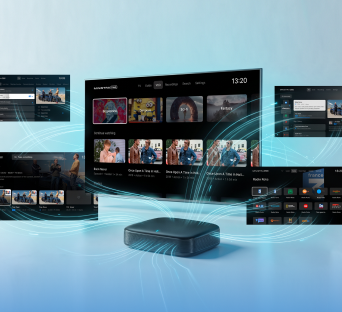
All Content in One Service: Live TV, VoD, Radio, Archive, TimeShift, and EPG in Ministra PRO
A television service has long been more than just a list of channels. Viewers now want to watch live broadcasts, return to a missed program, pause a show, schedule recordings of individual episodes or an entire series using nPVR, or choose a movie from a catalog. At the same time, all these capabilities should feel like parts of a single media environment rather than separate systems.
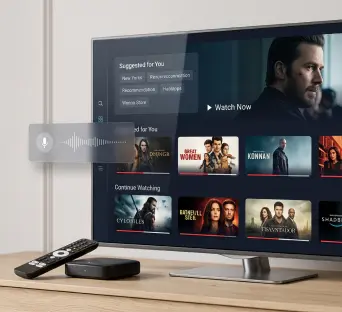
Interactive TV Trends on Google TV: What to Know in 2027
When choosing a television platform for 2027, businesses need to assess more than picture quality and the app selection. Equally important considerations are how viewers will find content, what capabilities the operator will have, and how predictably the equipment will perform after updates.
How to Reduce Video Delivery Costs Without Compromising Quality: CDN, Edge Cache, and Multi-CDN
As an IPTV/OTT service’s audience grows, so do both revenue and video delivery costs. For an operator, this means additional terabytes of outbound traffic. For a hotel, it means greater pressure on its internet connection. And in the case of maritime transport, it means the video service has to compete with other applications for limited bandwidth.