

Product request
You are looking for a solution:

Select an option, and we will develop the best offer
for you


How to Expand an IPTV Platform to Web, Android, iOS, and Smart TV
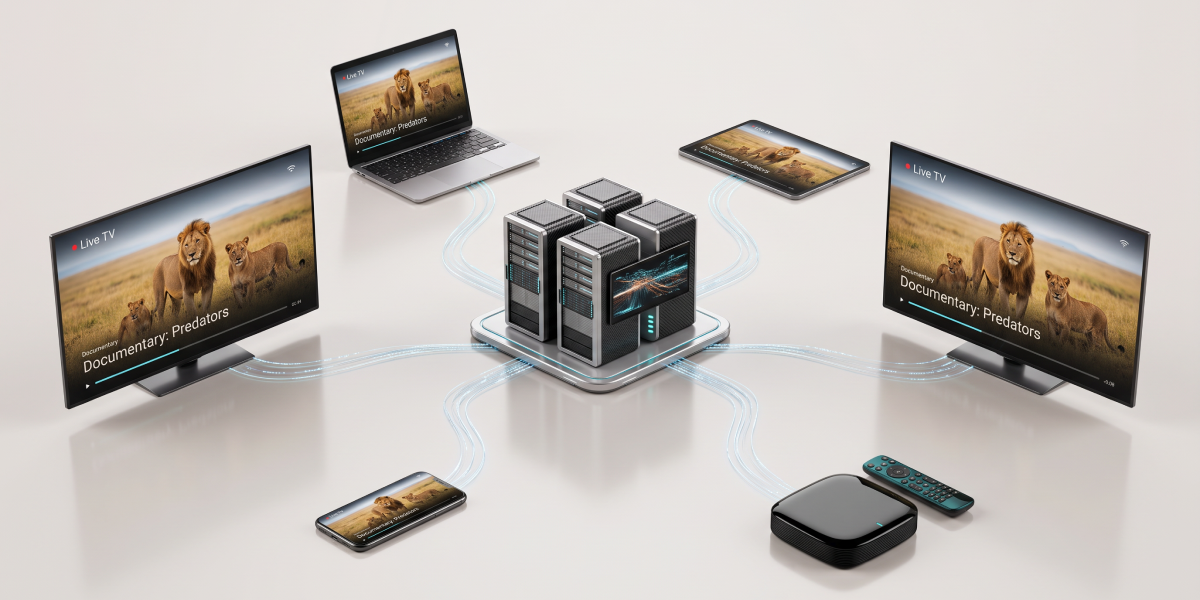
For an IPTV operator, launching a service on just one type of device is rarely enough anymore. With users now watching linear channels on a TV, viewing content on a smartphone, opening catch-up content in a browser, or using an IPTV set-top box as the main screen at home, expanding a service across multiple client platforms is not simply a matter of releasing additional apps.
Providing a service to users through numerous devices significantly changes the architecture, IPTV platform development processes, and operating model of the entire service.
At the same time however, the TV screen is not losing its importance. According to Ofcom, the average time spent watching YouTube directly on TV screens in the UK increased from 9 minutes per day in 2022 to 19 minutes in 2025, more than doubling. Meanwhile, total YouTube consumption across all devices in the home increased from 33 to 41 minutes per day.
These figures illustrate a broader trend: video services need to support both the big screen and personal devices at the same time.
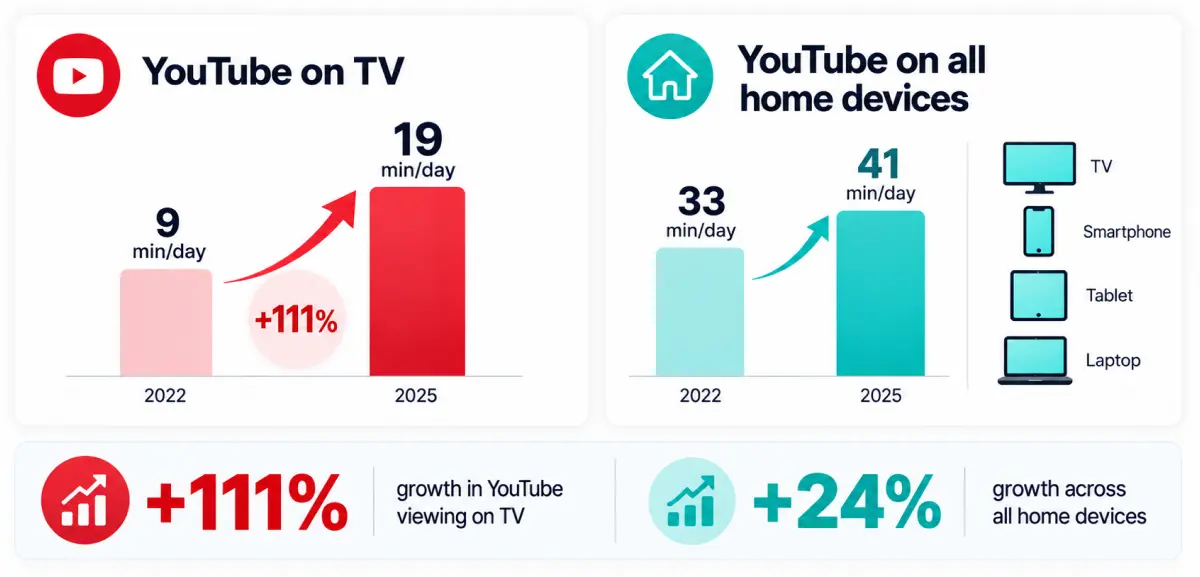
Video is moving beyond a single screen
Architecture of a Multi-platform IPTV Service
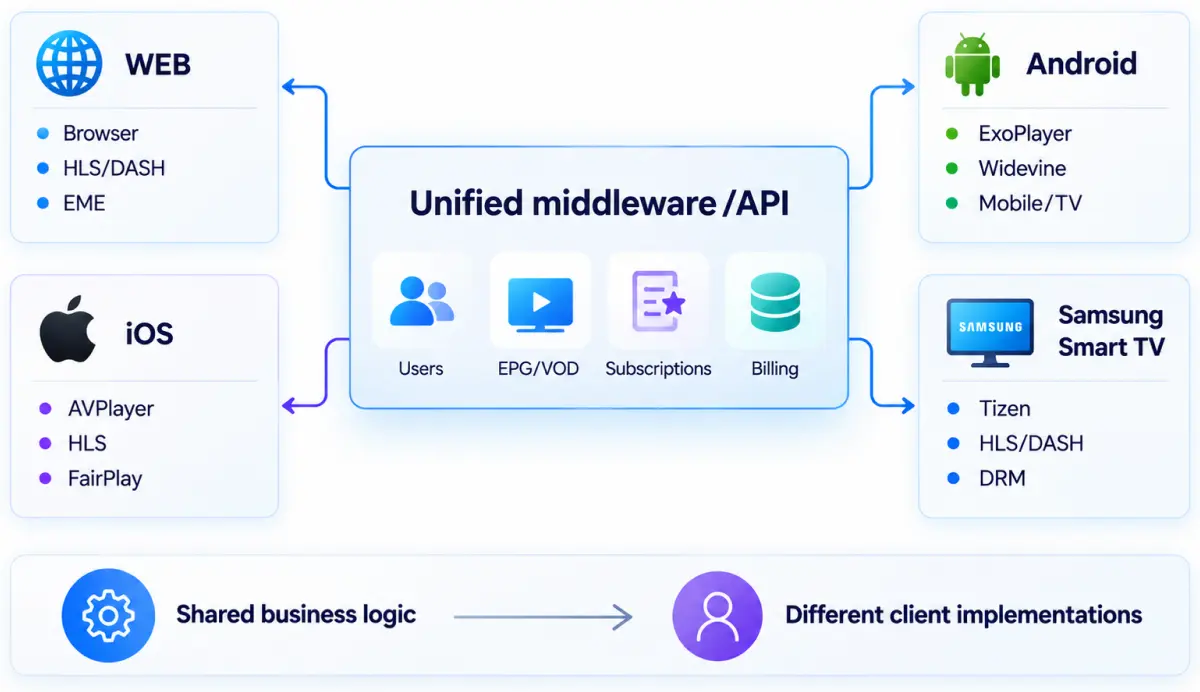
One of the main mistakes in IPTV scaling is to treat every new application as a separate service. If Web, Android, iOS, and Smart TV each receive their own business logic, separate catalogs, and different authentication mechanisms, support costs quickly increase. A more sustainable approach is to keep service management within a shared server-side environment and make the applications clients of one common platform.
The workflow on an IPTV multi-device platform starts with video sources: satellite and terrestrial channels, IP streams, proprietary content, and VOD libraries. Encoding and transcoding are then performed, converting the source video into multiple resolution and bitrate variants suitable for different connection speeds and devices.
Adaptive formats such as HLS and MPEG-DASH are especially important for multiscreen services because they allow the client player to switch quality depending on network conditions.
Once the streams are prepared, content is distributed through a CDN. This approach prevents every request from being sent to a central server and instead serves users through distributed delivery nodes. As the audience and geographic reach of the project grow, bandwidth capacity, CDN placement, and peak loads during sports, news, and other high-demand live events become increasingly important.
The central management layer of IPTV platform architecture is middleware. The platform stores channel and catalog structures and manages users, subscriptions, tariff plans, devices, access rights, and billing integrations. Client applications receive the required data through APIs, allowing Android, iOS, Web, and Smart TV to work with one system instead of maintaining separate server-side logic.
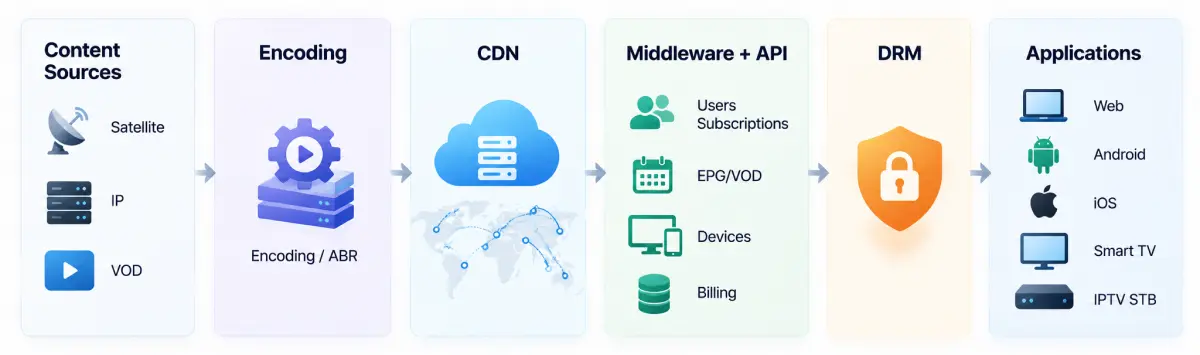
IPTV platform architecture
Web Player: The Fastest Way to Expand Access to the Service
Web is often the first additional platform introduced after IPTV set-top boxes. Users don’t need to install an application, while the operator can update the interface and functionality centrally. However, an IPTV web player should not be treated as just a webpage with HTML video. A full IPTV service needs to support adaptive playback, authentication, EPG, catch-up TV, subtitles, and protected content.
HLS and MPEG-DASH are used for adaptive video delivery in browsers. Modern web architectures use Media Source Extensions to handle segmented streaming video and Encrypted Media Extensions to interact with DRM systems. Support for specific combinations of format, codec, and protection system depends on the browser and operating system, so testing should be performed not only in Chrome but also in Safari, Edge, and other target browsers.
The interface for video streaming infrastructure also requires special attention. The same Web client may be opened on a 13-inch laptop, a large desktop monitor, or a tablet. Channel grids, the player, EPG, and controls therefore need to adapt to both screen size and input method.
Android: One Ecosystem, Different Usage Scenarios
Android covers smartphones and tablets as well as TV devices. However, Android TV and mobile Android require different user scenarios. On a smartphone, users interact with a touchscreen and may often watch video vertically or while on the move. On a TV, the interface needs to be designed for a remote control, focus-based navigation, and viewing from several meters away.
Modern Android projects commonly use Media3 ExoPlayer for video playback. It supports HLS and MPEG-DASH, adaptive bitrate switching, and DRM. Current Android documentation specifies Widevine support for DASH and HLS, while Android TV also supports certain PlayReady scenarios.
The real complexity of Android lies in device fragmentation. Different OS versions, hardware decoders, TV manufacturers, and codec support levels can result in a stream working reliably on one device but poorly on another. Google recommends testing media applications on physical devices because an emulator does not always reproduce the behavior of the real hardware media stack.
In addition to the issue of device compatibility, application publishing is also part of the development process. Store requirements, marketing assets, privacy policies, test accounts, and future update procedures all need to be considered. This is why “the code is ready” and “the app is available to users” are usually not the same milestone.
iOS: A Controlled Environment with Its Own Video and Publishing Requirements
Apple devices offer developers a narrower hardware matrix than Android, but they have their own requirements for the media stack and application distribution. Video playback is handled through AVFoundation and AVPlayer, which support HTTP Live Streaming.
Protected content in the Apple ecosystem uses FairPlay Streaming. It works with HLS and is intended for secure video delivery to Apple devices. This means that an operator already using Widevine for Android will usually need a multi-DRM architecture rather than trying to use one protection system across every client.
Another layer of complexity is the App Store. Every version of an application goes through a review process, and services offering subscriptions and digital video content must take monetization rules and access to previously purchased subscriptions into account. Apple also provides separate rules for reader apps and multi-platform services, so the sales model should ideally be defined before client-side development begins.
Samsung Smart TV: A Separate Television Platform
Samsung Smart TV apps should not be considered simply larger versions of a Web client. Samsung TVs use Tizen and have their own APIs, media capabilities, and application requirements. The interface must be designed for remote-control navigation, while performance should be tested on real TV models from different generations.
Modern Samsung TVs support HLS and MPEG-DASH, but media capabilities and DRM support vary depending on the Tizen version and the device’s year of release. Samsung specifications for 2025–2026 include Widevine, PlayReady, AES-128, and different streaming format combinations. Samsung also indicates that PlayReady will no longer be supported on new models starting with the 2027 model year and recommends planning a transition to Widevine.
Before installation, a Tizen application must be properly signed with a certificate, while commercial releases go through Samsung’s ecosystem. This is one reason Smart TV client development often takes longer than Web or mobile development: programming is accompanied by testing on physical TVs, remote-control verification, and the publishing process.
Why One Application Cannot Simply Be Ported to Every Platform
At first glance, all IPTV clients appear to perform the same tasks: authenticate the user, display the catalog, and start a stream. In practice, the video player and the surrounding infrastructure create the main differences between platforms.
The first issue is DRM. Android generally relies on Widevine, Apple on FairPlay, while TV platforms may support several systems with differences between device generations. The license server, content packaging, and key distribution rules should therefore be designed from the outset for multiple DRM systems.
The second issue is the interface. Users interact with smartphones through touch, Smart TVs through a remote control, and Web through a mouse and keyboard. Simply reusing one layout across platforms may result in an application that technically works but is inconvenient to use.
The third issue is hardware compatibility. H.264, HEVC, HDR, multichannel audio, subtitles, and different containers are supported differently across devices. These differences are especially noticeable on Smart TVs and low-cost Android devices, where the client depends not only on the OS version but also on the specific hardware media decoder.
Finally, every application has its own release lifecycle. A server-side API or interface change cannot be considered complete until updated clients have passed store review and been installed by a significant share of the audience. APIs should therefore be designed with backward compatibility in mind.
One IPTV service — different requirements
How Long Development Takes
Development timelines depend less on the number of screens than on the readiness of the server-side infrastructure. If middleware, APIs, the catalog, authentication, DRM, and stable video streams already exist, application developers can focus on the client side. If these components need to be built at the same time, the project timeline increases significantly.
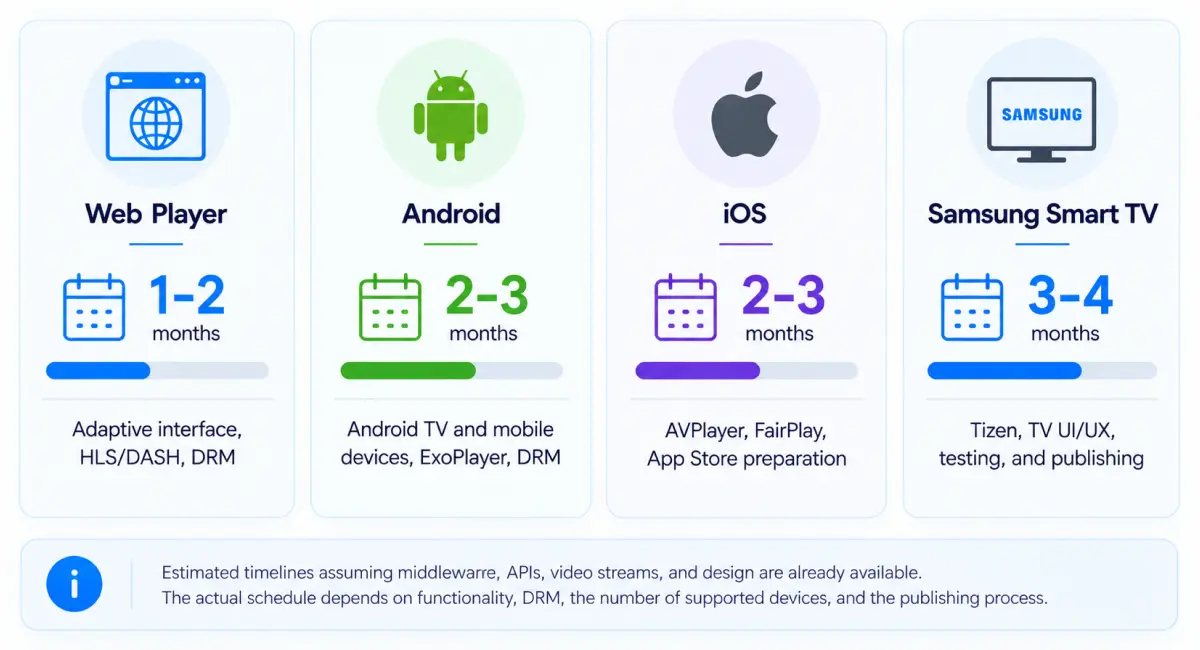
As a baseline estimate, the following ranges can be used: Web player — 1–2 months, Android — 2–3 months, iOS — 2–3 months, Samsung Smart TV — 3–4 months. These are not fixed development standards but approximate ranges for a project with existing server infrastructure and a moderate feature set.
Development of multiple clients can run in parallel, but the overall calendar timeline only becomes shorter when separate specialists and shared technical leadership are available. If one team develops Web, Android, iOS, and Tizen sequentially for the OTT service launch, the total project may take substantially longer.
Estimated Development Timelines for IPTV Client Platforms
The Role of Middleware in Multi-platform IPTV
Middleware becomes particularly important once several client applications appear. If subscription logic or channel access is implemented inside every application, each change has to be repeated four or five times. When these rules remain on the server side, applications receive the same information about the user, tariff plan, content, and available functions through the API.
Middleware makes it possible to centrally manage devices, authentication, profiles, channels, EPG, VOD, subscriptions, and billing integration. Applications are then responsible for presenting the data and playing content according to the requirements of each particular platform.
In this type of architecture, a platform such as Ministra PRO can be used. Ministra Pro serves as a unified management layer for content, users, and client devices and provides applications with the required data through APIs. It’s important to note however that an IPTV middleware platform does not replace CDN, DRM, or transcoding. A stable multi-platform service emerges only when all these components are properly integrated.
Another advantage of a shared server platform is more manageable product development. If the operator adds a new tariff plan, channel, or VOD category, the data can be updated centrally rather than requiring a new version of every application. A client update is only necessary when its own functionality or interface changes.
Building a Proprietary Platform or Using a Ready-Made One
Both approaches can be valid. The decision depends on the size of the operator, the available team, the need for product uniqueness, and which components already exist.
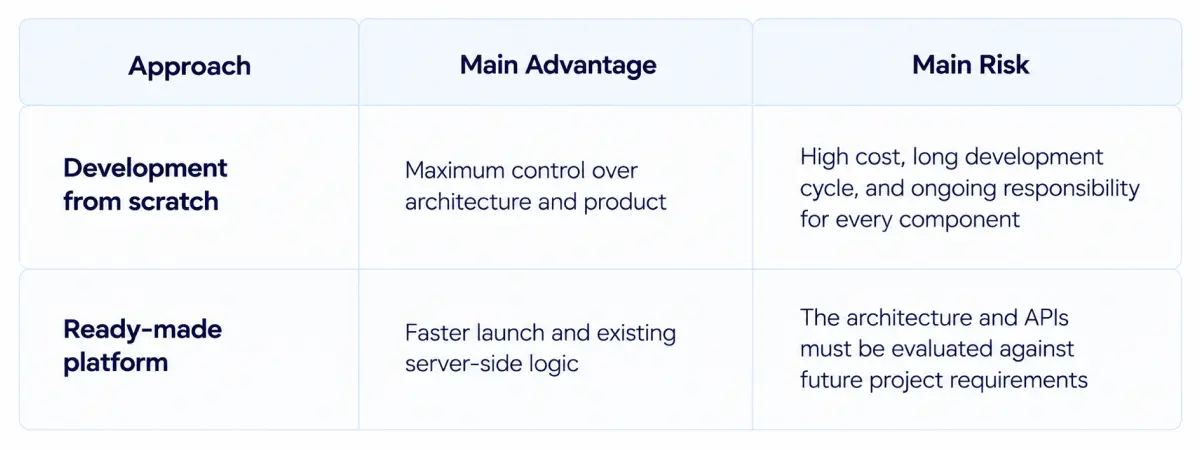
Proprietary development makes sense when the service has specific business logic, a large technical team, and a long-term development budget. Costs do not end after release: applications need to be updated for new Android, iOS, and Tizen versions, DRM must be maintained, device-specific issues need to be resolved, and store policy changes must be monitored.
An IPTV middleware solution reduces the amount of basic development because user management, content management, subscriptions, and APIs are already implemented. However, this does not mean the service is completely “ready to use.” The operator will still need integration, branding, stream configuration, testing, application preparation, and infrastructure operations.
The choice should therefore not be based only on the speed of the initial launch. It’s more important to understand how many resources will be required two or three years later, when new device types, application versions, features, subscription models, and additional integrations appear.
Which Platforms Should Be Launched First
There is no universal order. Priorities should be determined by the actual subscriber base rather than the overall popularity of platforms. An operator focused on a home audience may reasonably prioritize IPTV set-top boxes and major Smart TV platforms, while a service with a mobile-heavy audience may consider Android and an IPTV iOS app more important.
Web is useful as a universal additional access point and often allows operators to test new user scenarios faster. However, it doesn’t always replace a native application because DRM capabilities, background playback, remote-control interaction, and OS integration differ.
A practical approach is to identify the two most important platforms, stabilize the API and video streaming infrastructure on them, and then expand the device matrix. Attempting to launch five clients simultaneously while the server architecture is still changing creates many parallel issues and can slow down the entire project.
Expanding IPTV to Web, Android, iOS, and Smart TV shouldn’t begin with the development of four separate applications, but with a unified server-side architecture. Shared middleware, APIs, DRM infrastructure, and delivery systems make it possible to manage the service centrally, while each client is adapted to its own player, interface, and platform requirements.
This approach makes the launch of new screens more predictable and, more importantly, reduces the complexity of maintaining the service as the audience and number of devices grow.
Frequently Asked Questions
1. How long does it take to launch a multi-platform IPTV service?
If the backend, middleware, DRM, and video streams are already operational, the first additional applications can be launched within several months. In a typical project, Web takes around 1–2 months, Android and iOS around 2–3 months each, and Samsung Smart TV around 3–4 months. If the server side also needs to be built or significantly redesigned, the overall timeline will be longer.
2. Which devices should be supported first?
The devices already used by the operator’s main audience. For home IPTV, this often means set-top boxes and Smart TVs, while Android, iOS, and Web play a significant role in an OTT multi-device platform and its services. The decision should ideally be based on analytics from the existing subscriber base and the expected consumption model.
3. Do Android and Android TV need to be developed separately?
They can share a common technological foundation, but the interface and control scenarios for the streaming platform architecture will differ. A mobile IPTV Android app is designed for a touchscreen, while Android TV is designed for a remote control and viewing from a distance. A completely identical client rarely delivers a good user experience on both platforms.
4. Does an IPTV service need its own set-top boxes?
Not necessarily. Smart TV, mobile, and Web applications make it possible to operate a content delivery network without proprietary set-top boxes. However, a managed set-top box ecosystem remains useful when the operator needs a predictable hardware platform, centralized device updates, and controlled quality for the home TV service.
5. Can one DRM system be used across all platforms?
Not usually. Apple uses FairPlay, Android widely uses Widevine, while Smart TV platforms have their own DRM protection and support matrices. A multi-platform IPTV service should therefore be designed from the start to support multiple protection systems.
Recommended
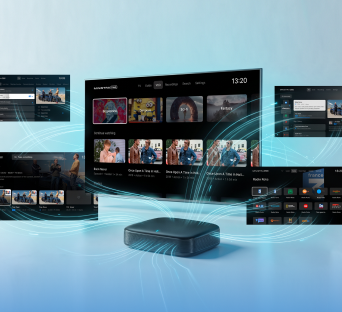
All Content in One Service: Live TV, VoD, Radio, Archive, TimeShift, and EPG in Ministra PRO
A television service has long been more than just a list of channels. Viewers now want to watch live broadcasts, return to a missed program, pause a show, schedule recordings of individual episodes or an entire series using nPVR, or choose a movie from a catalog. At the same time, all these capabilities should feel like parts of a single media environment rather than separate systems.
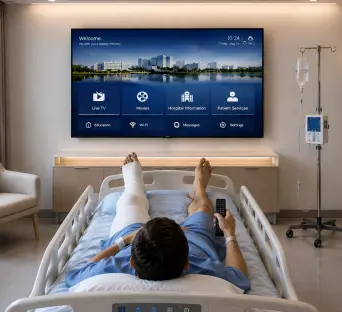
IPTV and the Modernization of Hospital Digital Infrastructure
Because hospitals operate around the clock, it's essential that their digital infrastructure supports stable departmental operations, data security, internal communications, and patient comfort. As a result, a hospital’s digital infrastructure requires a stricter approach than the infrastructure of a hotel, office, or residential complex.
Bulk Purchase of IPTV Hardware
A bulk purchase of IPTV hardware is not just a way to reduce the unit price through higher volume. For many operators, integrators, distributors, and those involved with hospitality projects, this method of procurement becomes an essential part of a successful operating model.