

Product request
You are looking for a solution:

Select an option, and we will develop the best offer
for you


All Content in One Service: Live TV, VoD, Radio, Archive, TimeShift, and EPG in Ministra PRO
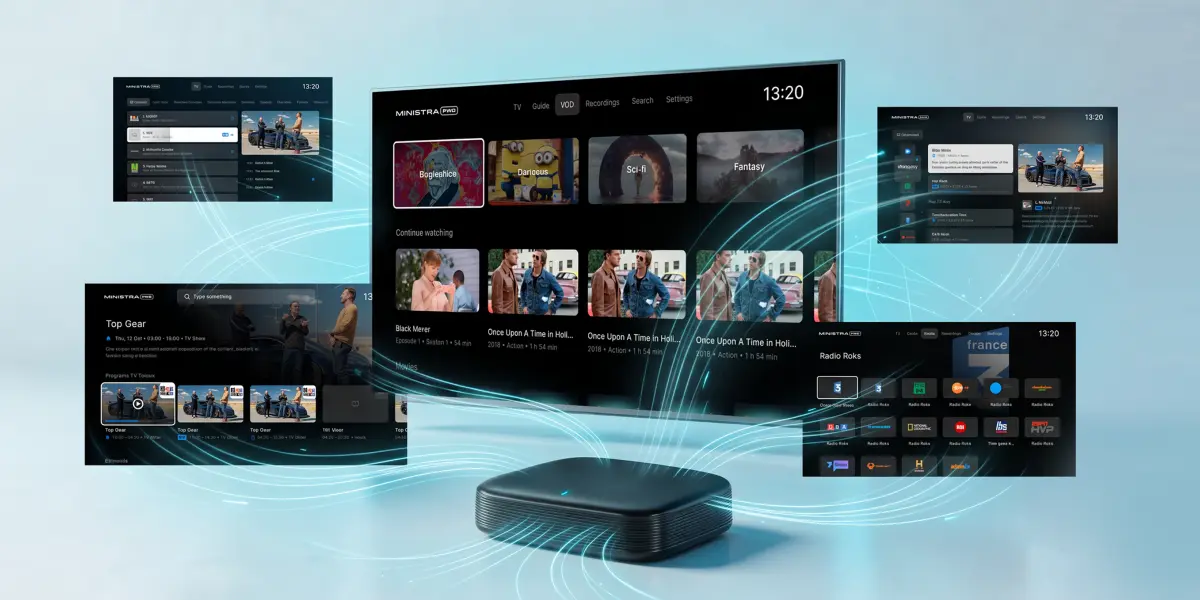
A television service has long been more than just a list of channels. Viewers now want to watch live broadcasts, return to a missed program, pause a show, schedule recordings of individual episodes or an entire series using nPVR, or choose a movie from a catalog. At the same time, all these capabilities should feel like parts of a single media environment rather than separate systems.
For an operator, the task is significantly more complex. Behind the familiar user interface are linear streams, recordings, storage systems, metadata, access rights, tariff plans, servers, and client devices. The more types of content a project includes, the more important it becomes not only to deliver each of them, but to manage them according to common rules.
This is exactly the role of the middleware layer in an IPTV/OTT infrastructure. In Ministra PRO, an operator can manage IPTV channels, video on demand, and internet radio, as well as TV-related recorded programs and time-shifted viewing features from a single environment. Ministra Pro is an all-in-one IPTV platform that determines which content is available to a specific subscriber, through which servers it’s delivered, and which features the user can access.
Why Content Integration Is Becoming More Important Than the Number of Channels
Only a few years ago, the competitiveness of a television offering was often assessed primarily by the size of the channel package. Today, that’s no longer enough. Linear television still plays an important role, especially for news, sports, and live broadcasts, but audience habits have changed significantly: with catch-up TV, viewers expect content to be available when it’s convenient for them.
This shift is clearly visible in the U.S. market. According to Nielsen, in May 2025, streaming video accounted for a larger share of total TV viewing than broadcast and cable television combined for the first time: 44.8% versus 44.2%. Compared with May 2021, streaming usage increased by 71%.
While these figures can’t automatically be applied to every region, they clearly show the direction in which the market is moving, with linear viewing becoming part of a broader content consumption model.
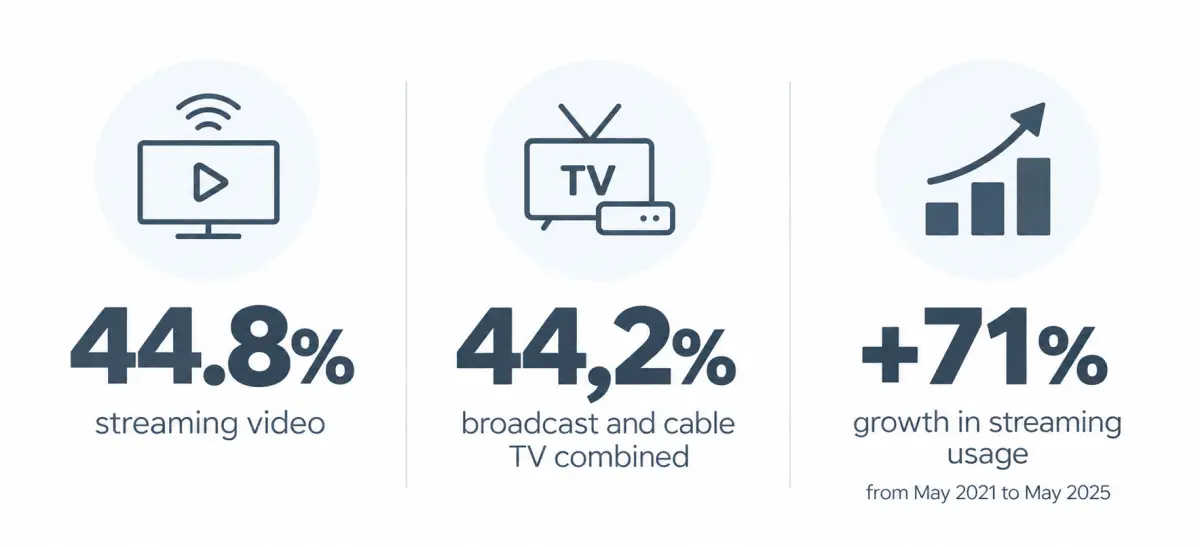
Share of total TV viewing in the United States, May 2025
For operators, the conclusion is not that traditional television should be abandoned. On the contrary, what’s becoming increasingly important is to combine live broadcasting and on-demand viewing so that subscribers can move freely between them within a single service.
Live TV Remains the Foundation of a Television Service
Live TV is linear television in which programs are broadcast according to a predefined schedule. This is where users watch news, sporting events, premieres, regional programming, and other content whose value is closely tied to the moment of broadcast.
For subscribers using a live TV streaming platform, linear television looks simple: they open the list of TV channels and select what they want to watch. For the operator, however, this involves signal reception, encoding or transcoding, stream generation, network delivery, and access management.
In Ministra PRO, IPTV channels are added to the management system and then included in the relevant service packages. A single channel can have multiple streams configured, for example when different client platforms require different delivery formats or protocols. This is especially important on a multiscreen content platform where the service operates not only on IPTV set-top boxes, but also on TVs and other devices.
Modern linear television becomes much more convenient when it’s supplemented by a TV guide, archive, and live playback controls.
EPG Turns a Channel List into an Easy-to-Use Service
EPG, or Electronic Program Guide, shows users what’s currently on and what will be broadcast next. At first glance, it may seem like a supplementary feature, but in practice the TV guide connects several key elements of a television service.
Without accurate EPG data, users can see a channel but have limited information about what it’s showing. With an EPG, they can see program titles, start and end times, descriptions, and other metadata. This allows users to choose content based not only on the channel name, but on the specific program.
An IPTV platform with EPG is even more important for archive functionality. If the system knows the exact boundaries of a program, viewers can open a specific news bulletin, movie, or show instead of searching for the right moment within hours of recorded content. In Ministra PRO, EPG is also a required component for DVR functionality.
Ministra PRO can automatically correct EPG data, for example by removing duplicate programs or adjusting program start and end times when entries in the source EPG overlap. These mechanisms help improve the accuracy of the TV guide display, but they don’t eliminate the need for a reliable and up-to-date EPG source.
Archive: Live Broadcasts No Longer Have to Be One-Time Events
Linear television traditionally requires viewers to be in front of the screen at a specific time. Archive functionality changes this model, with previously broadcast content being stored on a server so users can return to a program after it has ended.
For news channels, this means being able to watch yesterday’s bulletin. For sports channels, it means returning to a completed event. For entertainment television, it means opening an episode that was missed. As a result, the same linear stream continues to deliver value even after the original broadcast has ended.
In Ministra PRO, you can configure archive recording to a DVR Storage server for any stream. A maximum archive retention period can also be set for each channel.
The technical side of a TV and video streaming platform is important here. Archive depth is directly connected with storage capacity, the number of channels, recording throughput, and retention policies. Therefore, offering “7-day archive” or “14-day archive” is not simply a tariff feature, it’s also an infrastructure requirement that must be considered when sizing the project.
Content rights are equally important. The technical ability to store a program does not automatically mean the operator has the right to make it available after the original broadcast. For sports events, movies, and premium channels, permitted usage models may differ from the rights granted for standard linear broadcasting. In addition, the Blackout feature allows you to block the display of a specific set of programs (a time period from the Archive).
TimeShift Gives Users Control over the Current Broadcast
Archive allows users to return to content that has already ended, while TimeShift works with the current broadcast. A viewer can pause live TV or rewind to an earlier point and then continue watching.
A typical example is a sports broadcast. A viewer may need to step away briefly but does not want to miss an important moment. Instead of waiting for the program to become available as a complete recording, they pause the live stream and continue watching later.
Ministra PRO supports pausing and rewinding linear TV. The duration of the available TimeShift window depends on the DVR and storage settings configured for the specific channel.
For operators, Archive and TimeShift are logical to consider together. Both rely on storing the television stream, but they solve different user needs: Archive provides access to previously broadcast programs, while TimeShift gives users control over content that is still being broadcast.
VoD Adds On-Demand Content to Television
Video on demand is fundamentally different from linear television. The user chooses from a content catalog what to watch and when to watch it, all stored independently of the broadcast schedule.
This may include movies, TV series, educational materials, event recordings, local video content, or a specialized media library. For a hotel, the catalog may include informational videos and media for guests; for a regional operator, local programming; and for a corporate or university network, proprietary video content.
Ministra PRO allows operators to manage VoD as a separate content type alongside IPTV and internet radio. Access to content can also be linked to service packages and tariff rules.
The key advantage of this architecture is that users don’t need one application for movies and another for the operator’s television service. Linear and non-linear content become different sections of the same service.
Radio Expands the Service Without Complicating the User Experience
Internet radio usually requires significantly less bandwidth than video, but it can substantially expand the media offering. Music, news, talk, and local radio stations can be useful not only for operator services, but also for hotels, campuses, and private networks.
Ministra PRO allows operators to manage streaming services, including radio stations, alongside IPTV and VoD. For the user, this means switching from a television channel to online radio without changing the platform, account, or device.
Radio on its own is rarely the main factor when choosing an IPTV/OTT platform. Its value becomes more apparent as part of a broader service, with the operator gaining another type of content while retaining the same access and service management system.
What “All Content in One Place” Means for the Operator
Combining Live TV, VoD, Radio, Archive, TimeShift, and EPG within a multi-service IPTV platform does not mean that all these technologies physically run on one server. Streams may come from different sources, video may be stored in separate systems, archives may reside on DVR servers, and program schedules may be imported from an external source. What becomes unified is the management layer.
Ministra PRO links information about streaming servers, storage systems, accounts, and devices, determines which resources are used, and defines which users are allowed to access specific content. Through the administrative interface, the operator manages the relevant objects and service rules as part of a unified IPTV content management system.
This is why middleware should not be viewed as a replacement for the entire IPTV/OTT infrastructure. A complete project still requires content sources, encoding or transcoding, delivery, storage, content protection, network infrastructure, and client devices. The platform connects these components at the management level, but service quality depends on the entire chain.
One Service, Different Usage Scenarios
For an internet or television operator, the service model is usually built around subscriber packages. A basic tariff may include linear channels and EPG, an extended tariff may add archive and live playback controls, while optional packages may include thematic channels and VoD.
For an IPTV content provider, the focus may shift toward catalogs, thematic channels, and direct delivery of content to the audience. For a system integrator, the priority may be the ability to assemble a manageable solution from several infrastructure components and connect it with the customer’s existing systems.
The hospitality sector is another distinct scenario. Here, the television system is both an entertainment delivery channel and part of the guest’s digital experience. According to the J.D. Power 2025 North America Hotel Guest Satisfaction Index, 40% of surveyed guests considered Smart TV or the ability to stream content an essential in-room feature, compared with 21% in 2019. Smart TV was available in the rooms of 72% of survey participants, and 60% of guests used it.
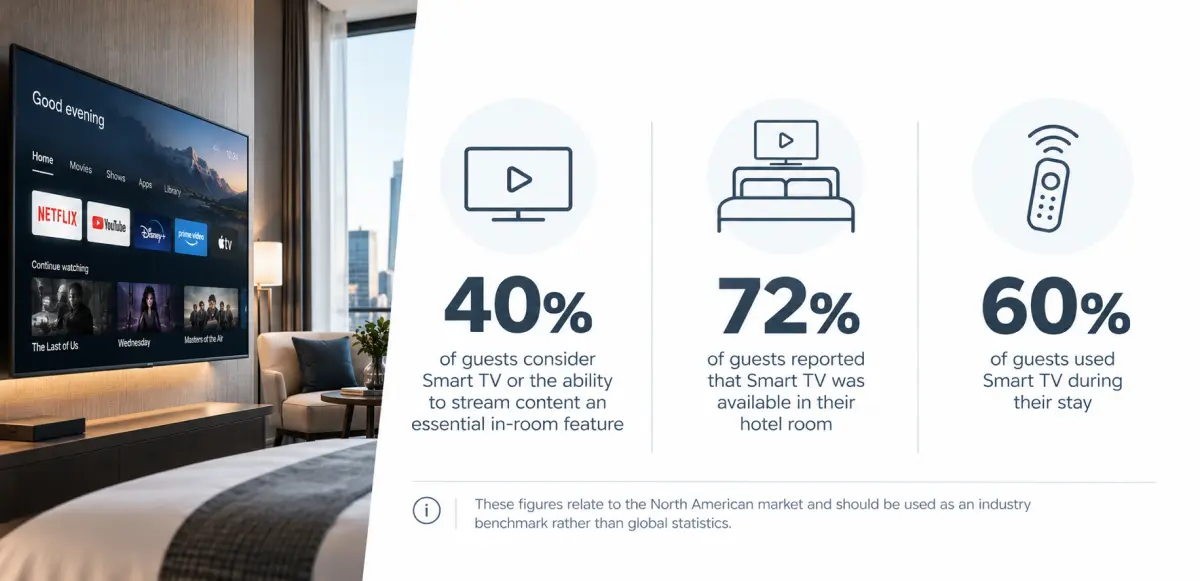
What Matters to Hotel Guests in 2025
For hotels, the principle of a unified interface is especially important: guests should not have to understand which server provides the live stream, where the video is stored, or where the program guide comes from. They interact with a single television environment.
What Needs to Be Defined Before Deployment
The fact that a platform supports all these features doesn’t mean that every project should launch them all at once. The composition of the service depends on content rights, the business model, available infrastructure, and the actual needs of the audience.
Before deployment, it’s worth defining the archive depth, the set of channels with TimeShift, EPG sources and quality, the structure of the VoD catalog, access rules, and the requirements of different client platforms. Only then can the operator calculate storage capacity, bandwidth, server infrastructure, and redundancy requirements.
This approach helps avoid a common mistake: enabling the maximum number of features first and only later discovering that some of them are not supported by the available rights, server resources, or metadata quality.
Live TV, VoD, Radio, Archive, TimeShift, and EPG serve different purposes, but their value to users becomes most apparent when they work together.
Live broadcasting provides immediacy, Archive brings back missed programs, TimeShift gives users control over the current broadcast, VoD frees content from the schedule, Radio expands the offering, and EPG turns the television schedule into a clear navigation system.
Ministra PRO is a leading IPTV middleware solution where these capabilities become part of a common management layer for an IPTV/OTT project. This allows operators to build services around the way audiences actually consume content rather than around the limitations of individual technologies.
Recommended
Interactive TV Trends on Google TV: What to Know in 2027
When choosing a television platform for 2027, businesses need to assess more than picture quality and the app selection. Equally important considerations are how viewers will find content, what capabilities the operator will have, and how predictably the equipment will perform after updates.
How to Reduce Video Delivery Costs Without Compromising Quality: CDN, Edge Cache, and Multi-CDN
As an IPTV/OTT service’s audience grows, so do both revenue and video delivery costs. For an operator, this means additional terabytes of outbound traffic. For a hotel, it means greater pressure on its internet connection. And in the case of maritime transport, it means the video service has to compete with other applications for limited bandwidth.
How to Expand an IPTV Platform to Web, Android, iOS, and Smart TV
For an IPTV operator, launching a service on just one type of device is rarely enough anymore. With users now watching linear channels on a TV, viewing content on a smartphone, opening catch-up content in a browser, or using an IPTV set-top box as the main screen at home, expanding a service across multiple client platforms is not simply a matter of releasing additional apps.