

Product request
You are looking for a solution:

Select an option, and we will develop the best offer
for you


Interactive TV Trends on Google TV: What to Know in 2027
When choosing a television platform for 2027, businesses need to assess more than picture quality and the app selection. Equally important considerations are how viewers will find content, what capabilities the operator will have, and how predictably the equipment will perform after updates.
Google TV’s development in 2025–2026 highlighted several directions: conversational AI search, a more personalized TV experience, integration of app content into the home screen, and the coexistence of different viewing models. These developments create opportunities for operators and integrators, but also introduce additional requirements for software, support, and device selection.
This article examines the outlook and likely interactive TV trends for 2027 based on published data and announcements. The platform’s expected development should not be interpreted as a guarantee that any particular feature will become available on every Google TV set-top box.
From Choosing an App to Finding Content
The television is becoming a gateway to several viewing options at once, including linear channels, video libraries, live streams, and free ad-supported services.
According to Nielsen, streaming accounted for 44.8% of total TV viewing in the United States in May 2025, surpassing broadcast and cable combined for the first time, at 44.2%. While this is a US market figure, not a global statistic or Google TV’s market share, it illustrates why operators increasingly have to compete for viewers’ attention beyond the familiar channel list.
For an IPTV/OTT service, the practical takeaway is clear: installing an app on a set-top box is not enough. Users need to find the program they want quickly, resume unfinished viewing, and understand which content their subscription includes.
Google TV is developing precisely this approach to navigation with interactive TV technology. However, the scale of the Google TV ecosystem should not be confused with the audience of an individual product. In September 2025, Google reported more than 300 million active Google TV and other Android TV OS devices combined. This figure does not mean 300 million Google TV set-top boxes or Gemini-compatible devices.
 Why the TV
Interface Is Changing
Conversational AI Changes Search but Requires Compatibility Checks
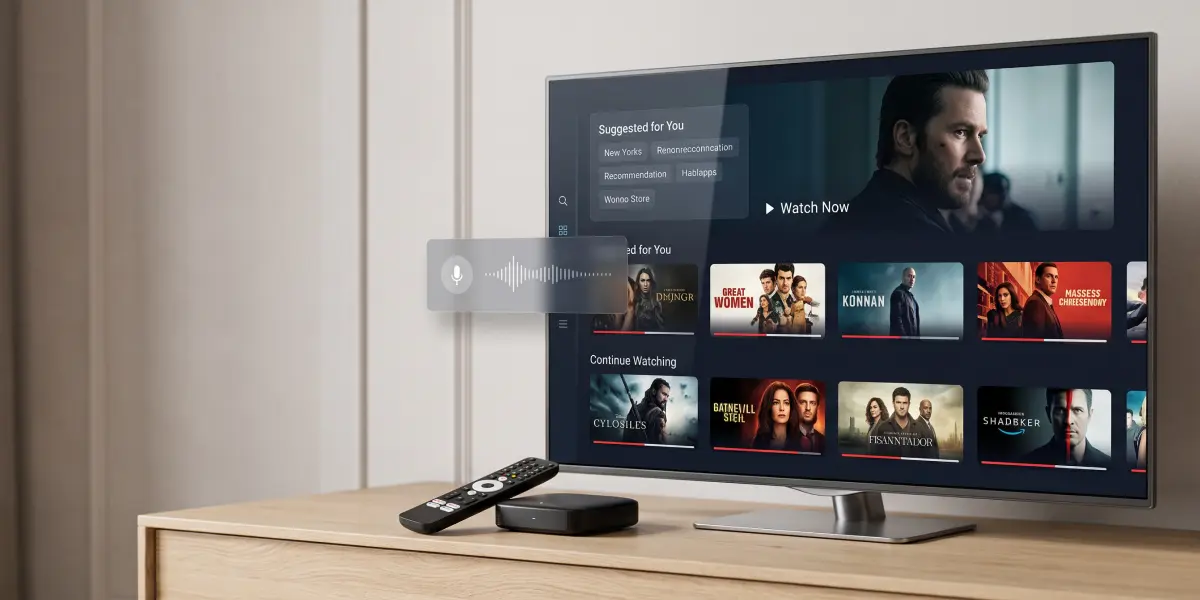
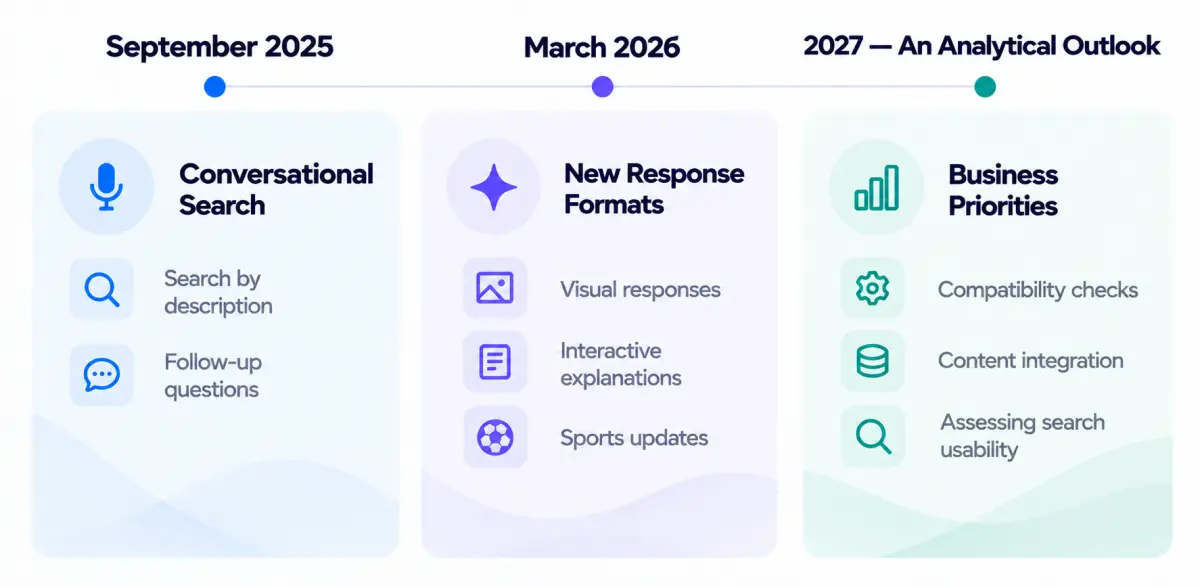
In September 2025, Google began rolling out Gemini on Google TV. Users gained the ability to search for content through conversation, using voice control TV to describe their preferences, refine requests, and ask questions about movies and series.
This marks a shift to a more personalized TV experience, moving from commands that specify an exact title to searches based on meaning.
In March 2026, the company announced the rollout of additional capabilities regarding interactive TV on Google TV. These include more visual responses featuring images and video, interactive explanations, and sports updates. Availability varied by feature and region.
Google also specified related requirements and limitations, notably a supported device, country and language, an internet connection, a Google Account, and Android TV OS 14 or later. It should be noted that meeting the OS version requirement alone does not guarantee access to Gemini.
It's reasonable to expect conversational interfaces and interactive content on TV to develop further in 2027. Businesses should assess their value through specific use cases and whether search helps viewers find a program faster, understands the audience’s language, and opens the correct content.
When purchasing devices in bulk, capabilities and interactive TV features demonstrated on a new television should not be assumed to apply to a different set-top box model. Gemini support must be confirmed for the specific device and target market. A microphone on the remote or Google TV in the specifications is not enough to justify that promise.
Integrating Operator Content Becomes a Separate Task
Google TV can help users return to a service’s content from the home screen. The Engage SDK for TV documentation provides for recommendation and continue-watching integrations. However, these require development work, compliance with program requirements, and checks on service availability. Installing an app does not create this integration automatically.
For operators, this means catalog quality becomes part of the user experience. Titles, descriptions, images, episode identifiers, and playback links must be consistent. If a content card leads to an unavailable movie or a series starts at the wrong episode, the additional entry point only increases frustration.
When designing a service, it's important to distinguish three layers: the Google TV interface, the operator’s app, and the backend platform. Subscription plans, access rights, billing, catch-up TV, and the video library remain the responsibility of the operator’s solution. The Google TV platform provides an environment for interacting with viewers, but it does not replace IPTV/OTT middleware.
The 2027 budget should therefore cover not only set-top box procurement but also ongoing app maintenance, including integrations, testing navigation to content, synchronizing viewing progress, and handling subscription changes.
Free Content and Subscriptions Coexist on One Screen
Ad-supported viewing already has a significant presence in the television landscape. In May 2025, Pluto TV, The Roku Channel, and Tubi together accounted for 5.7% of total TV viewing in the United States, according to Nielsen. This figure covers viewing across the three services as a whole and should not be interpreted as the share of linear FAST channels alone or as a profitability forecast for a new project.
Google TV for operators has free ad-supported channels which can complement subscriptions and increase IPTV user engagement. These channels allow viewers to explore a service or expand the offering without increasing subscription fees. However, the economics must be assessed separately, taking into account content rights, video delivery, advertising demand, and integration costs.
Furthermore, Google TV does not provide the same selection of free channels in every country. For example, Google lists Google TV Freeplay as a US service, while the availability of the Live tab and partner content depends on the market.
For distributors, this supports the case for a localized offering. Package contents, feature descriptions, and demonstration materials should be prepared for the country of sale rather than copied from another market.
For Hotels and Closed Networks, Manageability Matters More
Home users and hotel guests interact with televisions differently. At home, a personal profile may remain in use for years. In a hotel room, the system needs to provide an easy sign-in process, delete data after checkout, and present a predictable start screen to the next guest.
A Google TV set-top box is therefore not a complete hospitality solution on its own. Integrators need to verify session termination, data clearing, settings restrictions, and device management. If casting from a phone is supported, room-specific pairing and the prevention of access to neighboring screens must be tested separately.
Apps only mode should not be considered a full replacement for a hospitality interface either. According to Google’s help documentation, it hides personalized recommendations on the home screen but retains promotional content and teasers. Some features also become unavailable, while privacy settings do not change automatically.
For maritime transport and regulated networks, the selection process starts with a different set of questions: which functions must work without external internet access, which connections are permitted, and who controls updates.
If a project requires local content and minimal dependence on external services, Google TV should be compared with a dedicated Linux solution.
Offline operation and manageability must still be verified across the entire system, as the operating system alone does not guarantee either.
Viewing Quality Remains More Important Than New Features
Conversational search and interactive content cannot compensate for slow channel startup, licensing errors, or unstable playback. Selecting Google TV set-top boxes for 2027 must therefore be based on compatibility with the actual IPTV/OTT platform.
The Android Media3 documentation explicitly links media support to device and platform capabilities. In particular, HDR decoding and output depend on hardware and software support. This leads to a practical rule that a “4K” label is no substitute for testing specific streams, codec profiles, DRM, audio, and televisions.
A pilot should be conducted under the conditions expected in deployment. For a hotel, this will focus on concurrent usage and the characteristics of the network in guest rooms; for an operator, popular channels, catch-up TV, video-on-demand, and protected content; for a vessel, limited connectivity and recovery after a connection is lost.
Before a bulk purchase, the following should be agreed with the supplier:
Compatibility: the app, DRM, target video streams, audio, subtitles, and required services in the country of operation.
Support: update timelines, procedures for testing new firmware, diagnostics, and equipment replacement.
Management: available interface restrictions, device configuration, and recovery procedures.
Acceptance criteria: video startup time, channel switching time, the proportion of failed playback attempts, and behavior during network failures.
These checks help assess the total cost of ownership. A lower purchase price does not always mean lower overall costs if the equipment requires frequent site visits, manual configuration, or unplanned replacement.
What to Consider When Planning for 2027
The main trend in cloud-based TV platforms is a shift toward a service in which search, recommendations, and continue-watching features are more closely connected. Google TV is developing tools to support this interaction, including AI-powered TV recommendations and interactive advertising, but their practical value depends on availability on a specific device and the quality of integration.
For operators, the priority is convenient access to their own content. For distributors, it's accurate claims and support for the models they supply. For hotels, it's guest session management. And for maritime and regulated projects, it's verified system behavior under connectivity and access restrictions.
A platform should be chosen based on how fully it addresses these needs during the pilot. Announced capabilities and smart TV trends can inform a development strategy, but commitments to customers for a next-generation TV experience are better built on confirmed functionality, a clear equipment lifecycle, and measurable viewing quality.
Recommended
How to Expand an IPTV Platform to Web, Android, iOS, and Smart TV
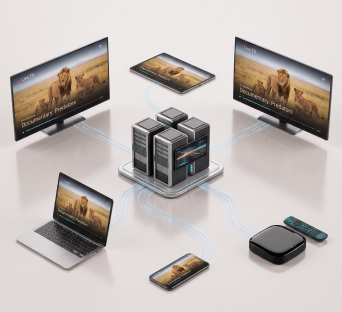
For an IPTV operator, launching a service on just one type of device is rarely enough anymore. With users now watching linear channels on a TV, viewing content on a smartphone, opening catch-up content in a browser, or using an IPTV set-top box as the main screen at home, expanding a service across multiple client platforms is not simply a matter of releasing additional apps.
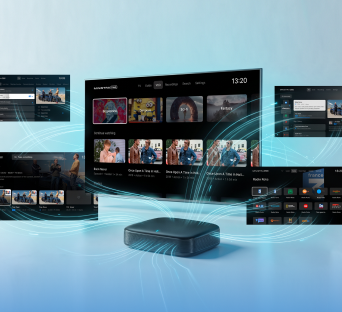
All Content in One Service: Live TV, VoD, Radio, Archive, TimeShift, and EPG in Ministra PRO
A television service has long been more than just a list of channels. Viewers now want to watch live broadcasts, return to a missed program, pause a show, schedule recordings of individual episodes or an entire series using nPVR, or choose a movie from a catalog. At the same time, all these capabilities should feel like parts of a single media environment rather than separate systems.
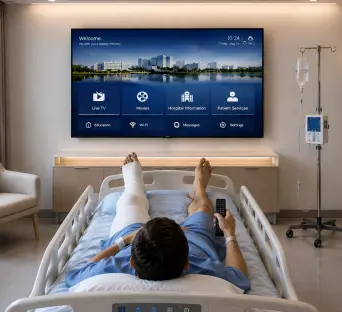
IPTV and the Modernization of Hospital Digital Infrastructure
Because hospitals operate around the clock, it's essential that their digital infrastructure supports stable departmental operations, data security, internal communications, and patient comfort. As a result, a hospital’s digital infrastructure requires a stricter approach than the infrastructure of a hotel, office, or residential complex.