


Product request
You are looking for a solution:

Select an option, and we will develop the best offer
for you


How to Reduce Video Delivery Costs Without Compromising Quality: CDN, Edge Cache, and Multi-CDN
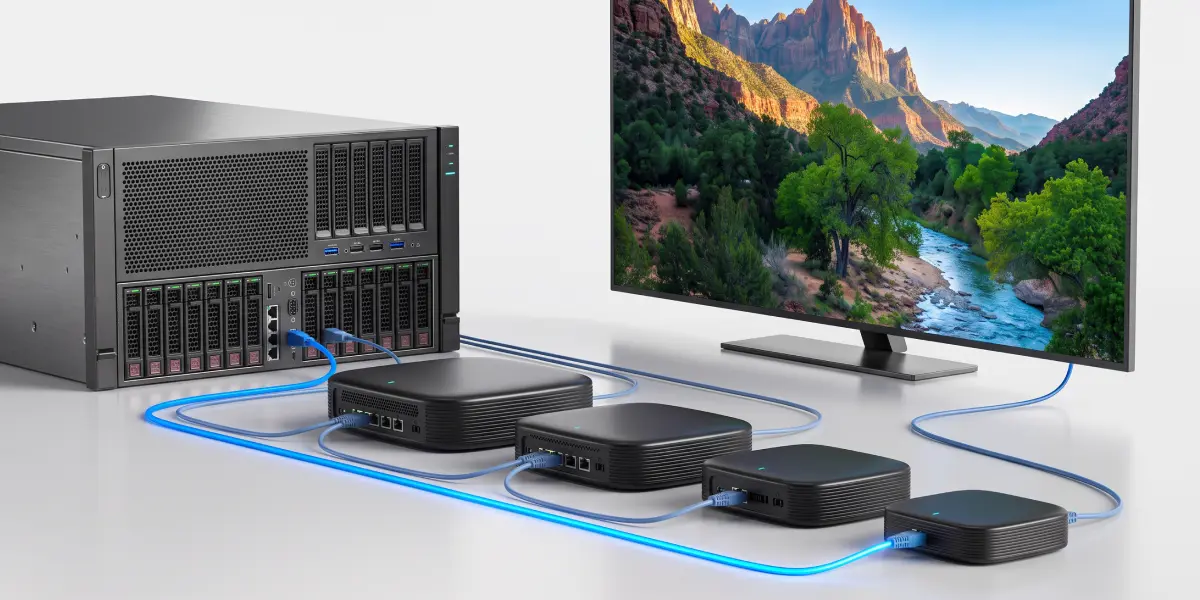
As an IPTV/OTT service’s audience grows, so do both revenue and video delivery costs.
For an operator, this means additional terabytes of outbound traffic. For a hotel, it means greater pressure on its internet connection. And in the case of maritime transport, it means the video service has to compete with other applications for limited bandwidth.
However, reducing resolution is not the only way to cut the costs associated with IPTV content delivery.
A content delivery network (CDN), local caching, and multi-CDN architectures can optimize the delivery path while preserving the original video streams, but they address different challenges: reducing the load on the origin server, avoiding repeated transfers over an expensive connection, or distributing traffic between providers.
Put simply, it's possible to reduce CDN costs by choosing the video delivery infrastructure that addresses a specific cost item.
What Makes Up the Cost of Video Delivery?
Traffic volume depends primarily on viewing time and the average bitrate delivered. At 6 Mbps, one hour of viewing consumes approximately 2.7 GB. If a service delivers 100,000 viewer-hours per month, this amounts to around 270 TB, excluding protocol overhead, repeated downloads, and segments that are preloaded but never watched. This calculation uses decimal units: 1 GB = 10⁹ bytes.
The price per gigabyte is only part of the budget. Depending on the contract, requests, origin server egress traffic, additional caching layers, logging, and support may be charged separately. Operating your own infrastructure adds equipment, hosting, connectivity, and operational costs.
Offers should be compared with included allowances and minimum commitments in mind: CloudFront, for example, offers both pay-as-you-go pricing and bundled plans.
A useful metric is therefore the total delivery cost per hour of actual viewing at an agreed quality level. It enables comparisons between architectures even as audience size changes. Absolute spending must also be monitored, as a lower unit cost does not necessarily mean a lower total bill.
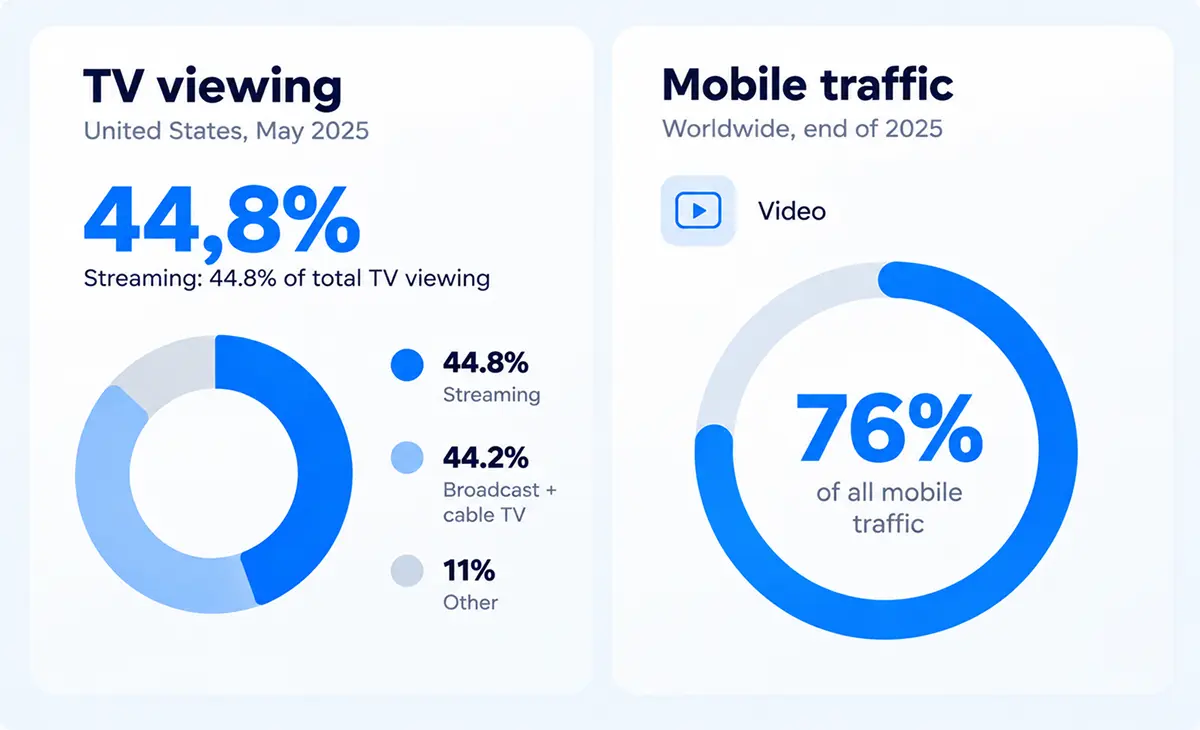
The scale of video consumption explains why this issue matters. According to Nielsen, streaming accounted for 44.8% of total TV viewing in the United States in May 2025, exceeding the combined share of broadcast and cable television—44.2%—for the first time. This measures viewing on television screens, not the share of internet traffic.
The Scale of Video Consumption
CDN: How Caching Affects Costs
In typical HTTP-based IPTV/OTT delivery, the origin server provides video manifests and segments. A manifest describes the available stream variants, while segments contain short portions of a recording or live broadcast.
A video CDN stores copies of cacheable content on distributed servers. If the required segment is already stored on a node, the next viewer receives it from there. The origin server no longer needs to handle every request itself.
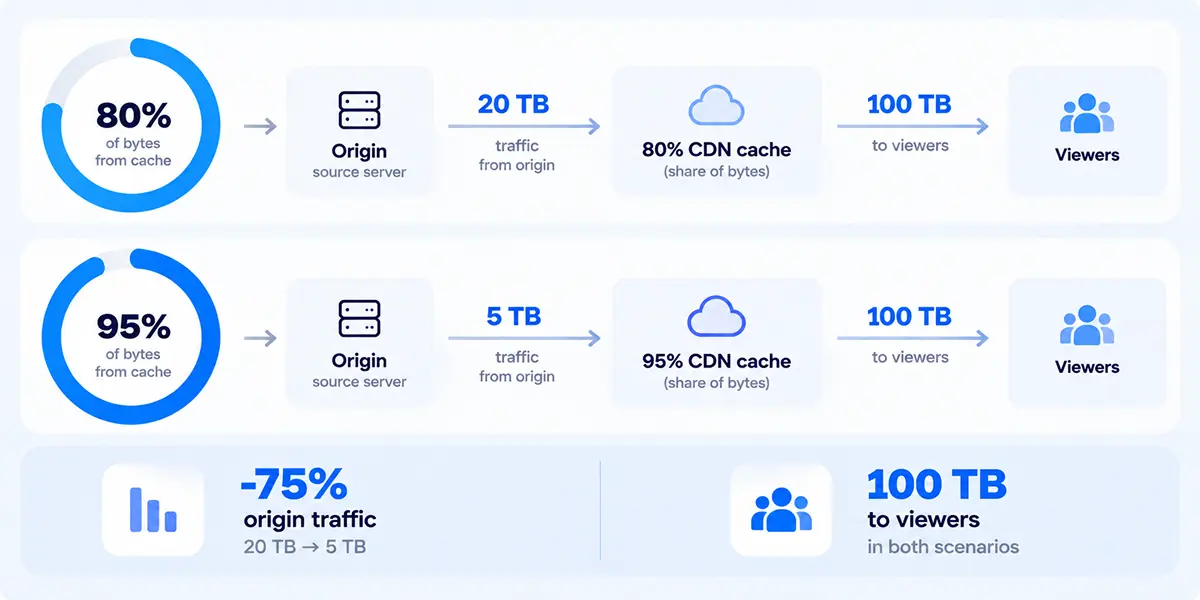
There is, however, a fundamental distinction, which is that less traffic due to origin server offloading does not translate into an equivalent reduction in the cost of delivering content to viewers. This is because when a commercial CDN charges for gigabytes delivered to users, content served from its cache generally still counts towards the bill.
Content caching helps reduce the load and costs associated with the origin infrastructure; the cost of the final delivery leg depends on the provider’s terms.
An additional layer, known as an origin shield, consolidates requests from different CDN nodes before they reach the origin server. It's particularly useful when many nodes request the same new segments simultaneously. CloudFront documentation describes both additional caching and the consolidation of simultaneous requests for the same object.
When considering this layer of video streaming infrastructure, its cost should be weighed against the savings at the origin.
For a service with a geographically distributed audience, a public CDN can be a sensible foundation for streaming quality optimization. However, the number of points of presence in a provider’s presentation is no substitute for testing in the networks used by actual viewers.
Why a Cache May Underperform
Caching efficiency depends on more than content popularity. The rules used to determine whether two requests refer to the same object also matter.
For example, the same video segment may be requested using different session identifiers in the URL. If these identifiers are included in the cache key, the system may store multiple copies of an identical segment. AWS explicitly notes that unnecessary parameters, headers, and cookies in the cache key can create duplicates and increase requests to the origin.
The solution is to coordinate caching with authorisation. Viewer access checks must remain in place, while parameters that don't change a segment’s content shouldn't unnecessarily cause separate copies to be cached. Simply removing tokens from request processing is not an option: doing so could compromise access protection.
Different objects also require different rules. Immutable VoD segments can be cached for long periods when versioning is handled correctly. A live manifest is updated regularly, so caching it for too long can result in an outdated segment list being served.
Personalised manifests, advertising, and individual content variants require separate policies.
When assessing results, it's useful to distinguish between the cache hit ratio by request and the share of bytes served from the cache. For traffic economics, the latter is often more informative because numerous hits for small files do not necessarily mean that large video segments are no longer being fetched from the origin.
Caching Reduces the Load on the Origin
Edge Cache: When Bringing Content Closer to a Site Pays Off
An edge cache is a caching node located closer to viewers. It may be a server within an operator’s network, a hotel, or a vessel. The concept is not separate from a CDN: edge nodes are already part of CDN architecture. For a local deployment, the key is to place the cache on the viewer side of an expensive or capacity-constrained external connection.
Suppose 100 televisions in a hotel are showing the same channel simultaneously at 6 Mbps. With separate external unicast delivery to each television, the total stream would be approximately 600 Mbps. If a local node integrated with the video service retrieves each segment once and serves all screens, external traffic for that channel variant could approach 6 Mbps. Unicast distribution within the hotel network would still require around 600 Mbps.
This is an illustration, not a promise for every site. Different channels, bitrates, audio tracks, playback positions, and personalisation increase the volume of data fetched. When initial requests arrive simultaneously, it also matters whether the node can consolidate requests for a segment that has not yet been retrieved.
Local caching makes sense where the same content is requested repeatedly and external delivery is expensive. With a small audience and infrequent repeat viewing, server and maintenance costs may exceed the savings.
Installing a cache also does not automatically localise traffic from every Google TV app. Third-party HTTPS video requires integration supported by the service or cooperation with its delivery system. Open Caching, for example, defines specific interfaces for delegating requests between an IPTV CDN and an operator’s network.
Multi-CDN: When Several Providers Are Better Than One
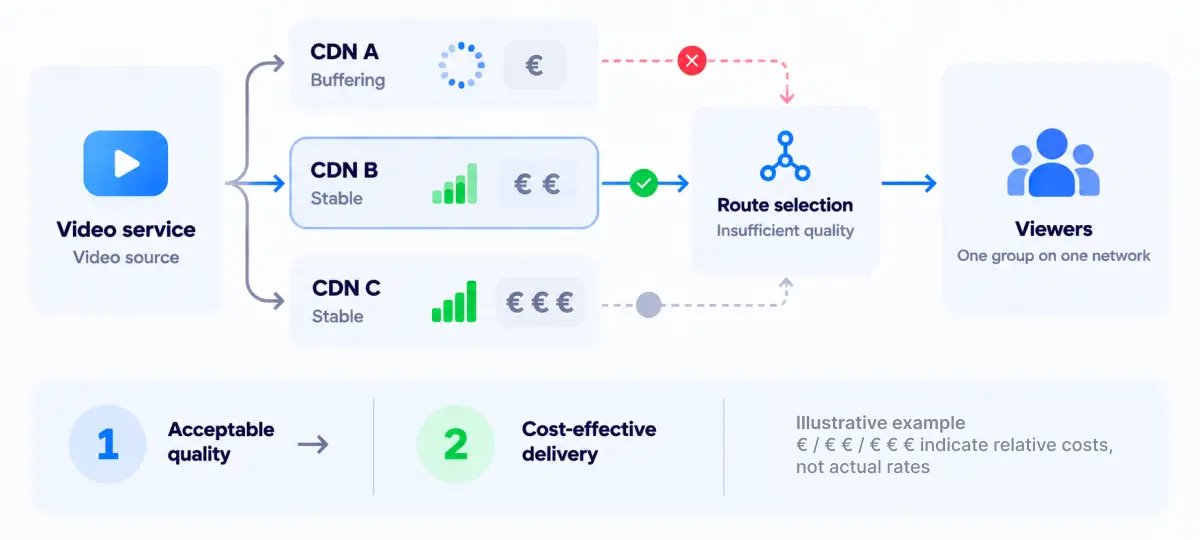
Multi-CDN uses several delivery networks and a mechanism for selecting the delivery path. One audience can be served through the CDN that performs best in its region, while another uses an alternative provider. If quality deteriorates, multi-CDN load balancing results in some of the traffic being moved to an available path.
The economic logic is straightforward: traffic routing should first exclude paths that fail to meet quality requirements, then choose the most cost-effective option from those remaining. The lowest price per gigabyte is of little value if viewers experience playback interruptions or sharp drops in resolution.
Multi-CDN: Choosing by Quality and Cost
Selection may take place when a session starts or be updated during playback, depending on the architecture and player. HLS Content Steering, for example, allows clients to receive priorities for different delivery pathways. Support must be verified in the specific player and app version; HLS support alone does not guarantee it.
Multi-CDN does not necessarily mean lower costs. Splitting traffic may reduce volume discounts from the primary provider. Route management, analytics, and integration introduce additional costs. Several CDNs populate their caches independently, potentially increasing requests to the origin.
During emergency CDN failover, the backup provider may need to absorb the traffic and fetch missing content at the same time.
A backup must therefore be tested under load, not just by checking whether a test URL is accessible. Shared dependencies must also be considered, as two CDNs using a single origin or a shared licence server do not eliminate failures in those components.
How to Choose an Architecture for a Specific Project
The choice depends on viewer geography, repeated demand for the same content, external connectivity costs, and availability requirements.
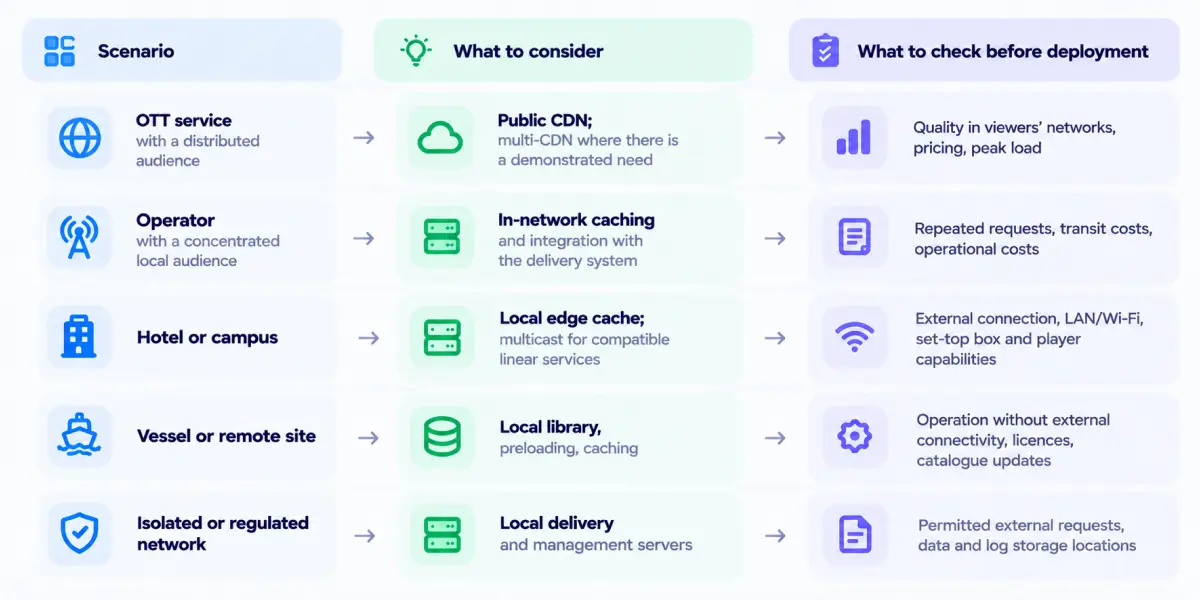
Multicast and HTTP caching address different challenges. In a managed network, multicast allows a shared linear stream to be transmitted to a group of receivers, but it requires support from the network infrastructure and client devices. It doesn't replace individual delivery for VoD or viewing with seeking.
On a vessel, the distinction between caching and offline operation is particularly important. A cache stores data that has already been received, but it can't create new live segments when connectivity is lost. Offline VoD requires preloaded content, an accessible local catalogue, and a functioning authorisation scheme.
Stored encrypted files don't guarantee playback without internet access either. If playback requires a new DRM licence, the external server remains an essential dependency. This distinction is reflected, for example, in Shaka Player documentation on offline storage and persistent licences.
How to Maintain Quality on Linux and Google TV Set-Top Boxes
Caching does not itself transcode video: when it works correctly, viewers receive the same segments. However, service quality and video latency reduction depends on the entire chain, from the origin server to the player.
Savings cannot be considered successful if they result from more frequent switches to a lower bitrate. An adaptive player can mask delivery problems by reducing picture quality. The absence of playback interruptions alone is therefore not enough.
When CDN performance monitoring during a pilot, track time to first frame, the proportion of failed playback starts, buffering duration relative to viewing time, and the distribution of resolutions and bitrates. For live services, latency relative to the source and channel switching time are also important.
Results should be broken down by access provider, site, device model, and app version. A service-wide average can hide problems at a particular hotel or on a subset of set-top boxes. For startup time, it's also useful to examine the 95th percentile—the threshold below which 95% of measured sessions start.
When selecting Linux or Google TV set-top boxes, test the specific combination of device, firmware, and player, specifically protocols, codecs, DRM, token handling, local addresses, and backup delivery paths.
The operating system’s name does not establish compatibility with the entire delivery architecture, and for integrators and distributors, this is a reason to test samples before purchasing a batch.
How to Validate the Economics Before Scaling
To validate the economics of scalable video delivery, start by measuring the existing service over a period that includes both normal and peak loads. You need data on viewer-hours, bytes transferred, content demand, requests to the origin, and playback quality.
Next, choose a hypothesis that addresses the identified problem. Frequent repeated downloads from the origin are a reason to review cache keys and retention periods. An overloaded external connection at a site supports piloting a local node. Inconsistent quality across networks is a reason to test an alternative CDN.
To ensure CDN optimization, the pilot should verify not only normal operation but also recovery after failures. Test a local node restart, CDN unavailability, token expiry, and loss of the external connection. You can then estimate the cost of scaling and formalise supplier requirements.
There is no universal architecture for reducing video delivery costs. In one project, correctly configuring the existing CDN for IPTV operators will have the greatest effect. In another, it will be serving popular content locally, and in a third, it will be managing multiple delivery networks.
The basis for choosing is measurable savings while preserving quality on the devices and networks that viewers use.
Recommended
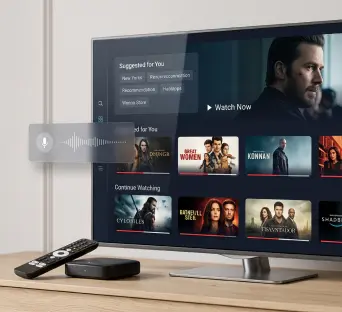
Interactive TV Trends on Google TV: What to Know in 2027
When choosing a television platform for 2027, businesses need to assess more than picture quality and the app selection. Equally important considerations are how viewers will find content, what capabilities the operator will have, and how predictably the equipment will perform after updates.
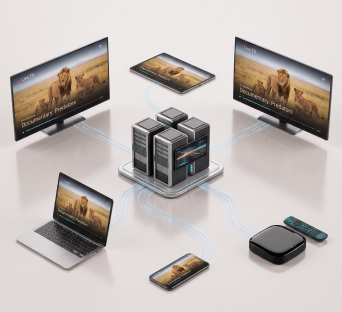
How to Expand an IPTV Platform to Web, Android, iOS, and Smart TV
For an IPTV operator, launching a service on just one type of device is rarely enough anymore. With users now watching linear channels on a TV, viewing content on a smartphone, opening catch-up content in a browser, or using an IPTV set-top box as the main screen at home, expanding a service across multiple client platforms is not simply a matter of releasing additional apps.
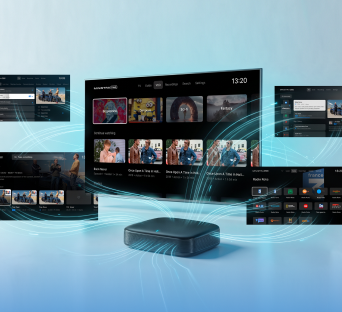
All Content in One Service: Live TV, VoD, Radio, Archive, TimeShift, and EPG in Ministra PRO
A television service has long been more than just a list of channels. Viewers now want to watch live broadcasts, return to a missed program, pause a show, schedule recordings of individual episodes or an entire series using nPVR, or choose a movie from a catalog. At the same time, all these capabilities should feel like parts of a single media environment rather than separate systems.