


Product request
You are looking for a solution:

Select an option, and we will develop the best offer
for you


Authorization, Content Protection, Stability, and Caching: How an IPTV/OTT Platform Keeps a Service Under Control
For an IPTV/OTT operator, service quality is determined not by the simple fact that a channel is accessible, but by how predictably the entire chain works: authorization, rights verification, stream launch, content protection, video delivery, and playback stability.
Behind every video launch is a series of checks and decisions. These will involve who is logging in, from which device, which tariff is assigned to the account, which channels and materials from the VOD catalog are available to the user, whether a specific stream URL can be used, and how stable the delivery infrastructure is.
For the user of course, all of this logic remains hidden. What they see is the result, whether the application opens or not, the channel starting quickly or with a delay, archive content being available or not working, or video that either plays smoothly or keeps buffering.
For the operator, each of these scenarios is connected to specific management layers: authorization, rights verification, stream protection, server availability, and delivery stability. That's why authorization, content protection, and stability are not just technical terms, but mechanisms that help control access, service quality, and the causes of possible failures.
This topic is especially relevant because of the growing risks related to credentials. In its 2025 Data Breach Investigations Report, Verizon analyzed more than 22,000 incidents and 12,195 confirmed data breaches. Credential abuse was listed among the leading initial attack vectors, accounting for 22% of confirmed breaches.
For IPTV/OTT, this is an important signal, highlighting that access to the service, APIs, devices, and secure video streaming must be manageable and verifiable, rather than built on trust in static logins, permanent links, and manual processes.
Why These Layers Cannot Be Separated
Authorization, IPTV content protection, stability, and caching are closely connected. A user logs in to the service, the platform checks the account and device, determines the available packages, selects the appropriate stream, applies protection rules, and sends playback data to the application. After that, the delivery infrastructure must provide stable video, while monitoring must show where a problem occurred if something goes wrong.
An error at any layer affects the entire service. If authorization works incorrectly, the user may not receive access to paid content or, conversely, may retain access after the subscription ends. If link protection is configured weakly, the stream becomes easier to use outside the controlled environment. If monitoring does not show the state of streams and servers, the team learns about the failure from subscribers. And if content caching doesn't take access rights into account, the user may see outdated or incorrect information.
This is why Ministra PRO plays a central role in IPTV/OTT operations. It doesn't replace broadcasting servers, the network, CDN, DRM/CAS, or the billing system, but connects them with the service logic. For the operator, this means that the technical infrastructure and commercial model work together through a shared management layer for IPTV performance optimization.
IPTV Authentication and Authorization: Two Levels of Managed Access
In IPTV/OTT, authorization is responsible for user access to the application and connects the account, device, tariff, list of available services, and rules for using the service. If this layer is configured weakly, it becomes harder for the operator to control the number of connected devices, disable access after a subscription ends, investigate support requests, and prevent unauthorized use of the service.
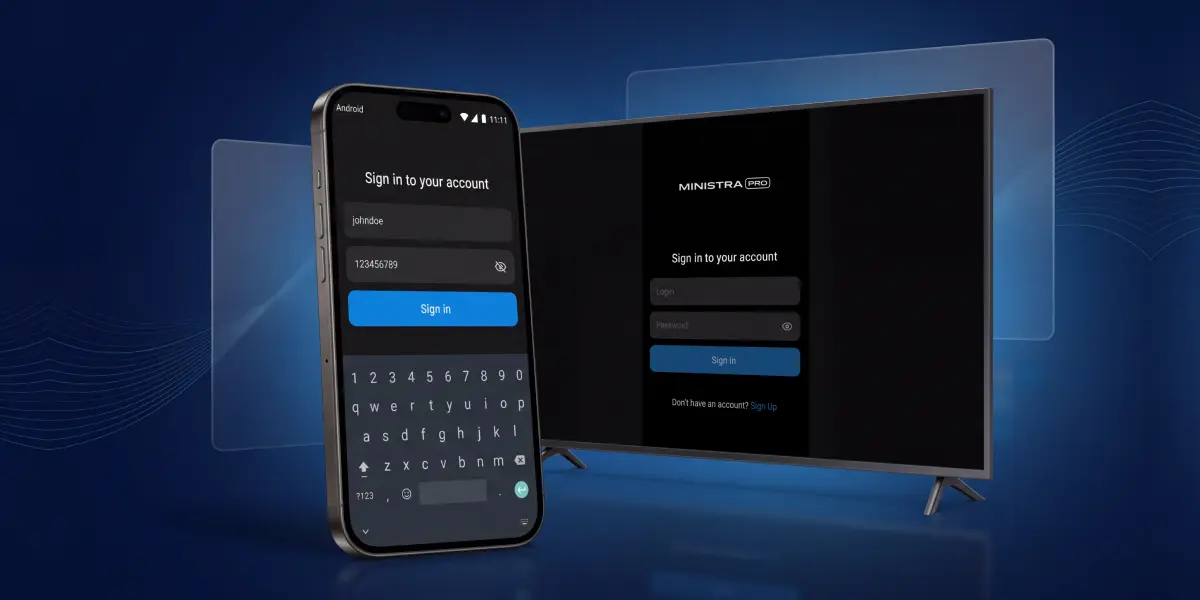
In Ministra PRO, during the first login to the portal, the user enters the login and password created by the administrator. After successful authorization, the platform generates an authorization key and stores it on the device, so on subsequent launches the system checks the validity of this key.
When the same login and password are used on a new set-top box, the platform checks the device authorization limit in the household. If there is a free slot, the set-top box is authorized and added to the account. If the limit has already been reached, the user or operator can remove one of the previously linked devices and free up space for the new one.
For the operator, this matters as part of managing the household and linked devices, not as a separate login and password check. This is how a secure IPTV platform helps control how many devices one account can use and whether this matches the tariff conditions.
For diagnostics and support, the device list, statuses, event logs, and other tools are also needed to show what is happening with the account and connected devices.
Content Protection Starts Before Playback
Content protection in IPTV/OTT is often associated only with DRM or CAS. In practice, protection starts earlier, with checking the user’s rights, subscription validity period, linked devices, available packages, and correctness of the stream URL. If the user is unable to see a channel, the platform must stop this scenario before playback begins.
To reduce the risk of unauthorized viewing or copying of streams, Ministra PRO security can use temporary HTTP links with a token. In this scenario, the base stream address remains the same, but when the link is issued to a device, a unique temporary token is added to it. The streamer checks this token through Ministra PRO, so only a link obtained through the platform should be played. By default, such a link is valid for 5 seconds, and the operator can change this value in the settings if needed.
This mechanism helps make direct use of the link outside the controlled service more difficult, but it should not be seen as a replacement for digital rights management, proper configuration of broadcasting servers, a protected network, and device control for secure content delivery. In addition, temporary links must be supported by the streamer being used.
To select the appropriate stream, Ministra PRO uses Multi-Filters. This mechanism makes it possible to define conditions under which a specific broadcast link will be available, for example, taking into account the device type, connection parameters, or IP address.
This is especially important in multiscreen services, where one TV channel may have several technical delivery options. Thanks to filters, the platform directs the user to the stream that matches their device, service settings, and access rules.
Service Stability Depends on Manageability
The streaming stability of an IPTV/OTT service cannot be ensured only by a “powerful server.” Problems can occur at different levels: a stream URL is unavailable, the broadcasting server is overloaded, the device has not updated the channel list, the account is linked to the wrong tariff, an external integration has passed an incorrect subscription status, or part of the infrastructure is not responding.
In addition to video delivery infrastructure, the operator needs tools for centralized management of devices, events, and service state. In Ministra PRO, Events are used for this purpose, allowing operational actions to be performed remotely on client devices and their state to be synchronized with the platform.
This matters in large-scale projects because hundreds or thousands of devices must receive updates and service commands according to unified rules, without manual work with each subscriber.
Another level of IPTV service stability is the constant checking of channel and broadcasting server availability. If the project uses load balancing across several servers, the platform can track whether a channel is available on each of them and display the check result in the interface. This helps the technical team understand more quickly where the problem occurred: in the channel settings, the link to a specific stream, the broadcasting server, or the load balancing scheme.
If the check does not detect any problems, the channel will be automatically enabled again. The faster the team localizes the source of a failure, the less time is spent on support and the lower the risk of mass subscriber dissatisfaction.
Caching: Acceleration Without Losing Control
Caching in IPTV/OTT accelerates video delivery, helps reduce the number of repeated requests, lowers the load on individual components, and makes the interface more responsive. However, caching must be approached carefully, because if it doesn't take access rights, roles, and data relevance into account, acceleration can lead to errors.
In Ministra PRO, caching is used at several levels to reduce unnecessary load and speed up the work of individual platform components. On the backend side, administrative panel data, EPG, and requests to the Billing API can be cached. On the client application side, EPG and the channel list are cached so the interface can open frequently used data faster and avoid requesting it again unnecessarily.
At the same time, caching must not violate service relevance. If the EPG or channel list changes, an event is sent to the device that invalidates the cache, after which the application requests new data. This approach helps speed up the interface and reduce the load on the platform, while maintaining connection with current settings, access rights, and service changes.
For IPTV/OTT, this gives an important practical conclusion, which is that only data that doesn't break access logic can be cached. For example, accelerating the administrative interface mustn't lead to the operator seeing outdated rights or an incorrect account state. Caching links, channel data, or catalog elements must take tariffs, restrictions, and updates into account, otherwise the system may work quickly from a technical point of view but incorrectly from the service perspective.
At the video delivery level, caching must also be manageable. The video streaming cache primarily concerns streamers and CDNs, which can deliver popular VOD content, archive fragments, or other frequently requested elements faster if the infrastructure is designed correctly. The operator needs to understand exactly what is cached, where the cache is located, how long data is stored, how outdated elements are cleared, and how changes in access rights affect content delivery.
How Ministra PRO Helps the Operator
The value of Ministra PRO lies in the fact that it connects user, device, tariff, package, channel, event, and integration management into a single operational logic.
At the authorization level, the platform helps control user login and the connection between the account and the device. At the protection level, it helps use temporary links and access restrictions for streams. At the stability level, it helps apply events, update channel lists, work with devices, and track channel availability. While at the caching level, it helps reduce unnecessary load on individual system elements without separating acceleration from access rights and roles.
This approach helps manage a service that has already moved beyond the simple model of “several channels and one set-top box.” When different tariffs, VOD, archive, multiple device types, an external billing system, and regular content changes appear, manual management becomes expensive and risky. The platform standardizes processes, launching the service and supporting it in daily operation.
What the Operator Should Check
Before launching or updating an IPTV/OTT service, the operator should check several practical aspects. How does the user authorize? What happens when a new device is connected? How does the platform restrict access to the API? Are temporary links used for streams? Are there rules for different device types? Can the team centrally send events to set-top boxes? Does the operator see stream availability on broadcasting servers? Is it clear which data is cached and how caching affects the relevance of access?
These questions help evaluate the platform not by a general list of features, but by its ability to keep the service under control. For the operator, this is directly related to budget, as the fewer manual operations, repeated support requests, unclear failures, and unmanaged access cases there are, the cheaper service operation becomes.
Authorization, content protection, stability, and caching are four levels at which an IPTV/OTT service either remains manageable or gradually turns into a set of fragmented solutions.
Authorization and subscriber authentication using an access control system determine who enters the service and from which device.
Content protection restricts unauthorized access to streams. Stability depends on monitoring, events, and predictable server operation. Caching helps speed up the service and reduce load, but it must take user rights and platform logic into account.
Ministra PRO does not replace engineering architecture, broadcasting servers, the delivery network, or content protection at the level of the entire infrastructure. Instead, it helps ensure platform reliability by allowing the operator to manage the key connections between accounts, devices, tariffs, streams, and events.
For an IPTV/OTT business, this means clearer operations, faster localization of problems, and lower costs for manual service maintenance.
Recommended
All Content in One Service: Live TV, VoD, Radio, Archive, TimeShift, and EPG in Ministra PRO
A television service has long been more than just a list of channels. Viewers now want to watch live broadcasts, return to a missed program, pause a show, schedule recordings of individual episodes or an entire series using nPVR, or choose a movie from a catalog. At the same time, all these capabilities should feel like parts of a single media environment rather than separate systems.
Interactive TV Trends on Google TV: What to Know in 2027
When choosing a television platform for 2027, businesses need to assess more than picture quality and the app selection. Equally important considerations are how viewers will find content, what capabilities the operator will have, and how predictably the equipment will perform after updates.
How to Reduce Video Delivery Costs Without Compromising Quality: CDN, Edge Cache, and Multi-CDN
As an IPTV/OTT service’s audience grows, so do both revenue and video delivery costs. For an operator, this means additional terabytes of outbound traffic. For a hotel, it means greater pressure on its internet connection. And in the case of maritime transport, it means the video service has to compete with other applications for limited bandwidth.